
Zone 2 Training, Why the
Longevity Hype Is Overstated
A 2025 review challenged the idea that zone 2 training is uniquely better for mitochondrial health. Here’s what the evidence actually supports, and where it doesn’t.
Zone 2 training has become the default answer to almost every longevity question. It’s low-intensity aerobic exercise performed at roughly 66-80% of VO2max, near what’s called the first ventilatory threshold, and it’s been championed heavily by health-optimization podcasters and physicians chasing longer, healthier lifespans through better mitochondrial function. The pitch is simple: train slow, live long.
Then a July 2025 review in Sports Medicine looked closely at that pitch and reached a more complicated conclusion. When total training volume is matched, higher-intensity exercise produced equal or greater mitochondrial adaptations than zone 2 training. The review didn’t dismiss zone 2 as a concept, its authors argued the problem is that it’s overapplied as the single best training intensity, not that it’s ineffective.
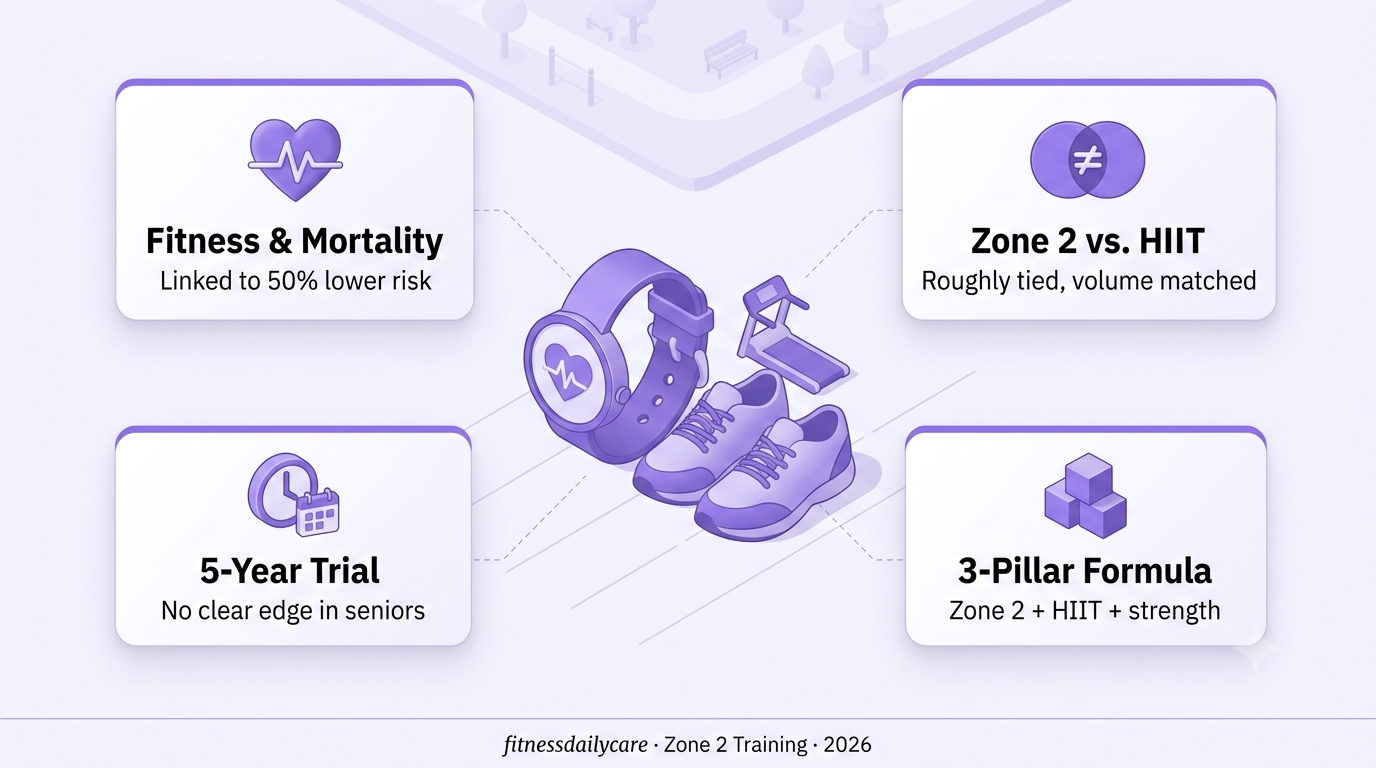
The broader link between cardiorespiratory fitness and longevity is genuinely strong. Meeting physical activity guidelines has been linked to roughly half the mortality risk in large cohort data. But when the Generation 100 trial specifically tested five years of moderate-intensity continuous training in adults aged 70 to 77, it didn’t outperform a usual-activity control group, and interval training trended more favorably.
Is zone 2 uniquely best for mitochondria?
Not according to a 2025 Sports Medicine review. When training volume is matched, higher-intensity exercise produced equal or greater mitochondrial adaptations.
What Generation 100 found
Five years of moderate-intensity training in adults 70-77 didn’t clearly outperform a usual-activity control group; interval training trended more favorably.
What zone 2 actually does
It stimulates mitochondrial biogenesis through the PGC-1alpha signaling pathway and builds an aerobic base with low injury risk and fast recovery.
The real prescription
Zone 2 works best combined with high-intensity intervals for VO2max and resistance training for muscle, not as a stand-alone longevity plan.
Stop treating zone 2 training as the single best exercise
MythbustingThe 2025 review’s core finding wasn’t that zone 2 doesn’t work, it’s that it isn’t uniquely superior to higher-intensity training for mitochondrial adaptations when total volume is matched. Both approaches move the needle, they just do it through overlapping mechanisms.
Use zone 2 for what it’s actually good at: volume without burnout
Practical useUnlike high-intensity training, zone 2 can be performed frequently, 3 to 4 sessions a week, without excessive fatigue or long recovery windows. That sustainability is the real advantage, not some unique metabolic superiority.
Build a mixed program, not a zone 2-only one
ProgrammingThe most comprehensive longevity benefit comes from combining zone 2 for aerobic base, high-intensity intervals for VO2max, and resistance training for muscle mass and strength. Zone 2 is the foundation of that stack, not the entire structure.
Zone 2 isn’t overhyped as a concept.
It’s overapplied as a universal prescription.
- Combine it with resistance and interval work — not either/or, all three pillars matter
- 3-4 sessions a week, 45-90 minutes each — the commonly cited range, not a strict requirement
- Consistency beats precision — a lactate meter is overkill for general health goals
- Don’t expect body composition changes — zone 2 alone won’t build muscle or reshape your physique fast
- Track total weekly training volume — not just which “zone” you spent time in
⚠️ What Zone 2 Training Doesn’t Deliver
1. It won’t dramatically reshape your physique on its own. Zone 2 alone doesn’t build meaningful muscle or burn enough to change body composition in 8-12 weeks.
2. The “3-4 hours a week” figure isn’t from longevity trials. It’s borrowed from endurance-training practice, not a dose specifically validated for lifespan outcomes.
3. In older adults, the evidence is thinner than the hype suggests. The Generation 100 trial found moderate-intensity training alone didn’t clearly outperform a usual-activity control group over five years.