
Compression Boots, Do They Actually
Speed Recovery?
They feel amazing after leg day. Here’s what compression boots recovery research actually supports, and where the marketing gets ahead of the science.
Compression boots recovery has become one of the most photographed rituals in fitness. Sit on the couch, zip on the boots, scroll your phone while they inflate and deflate around your legs. It feels like recovery. The question worth asking is whether it actually is one, in a way that shows up anywhere other than how you feel in the moment.
The honest answer, based on the research, is partly yes, partly overstated. Multiple peer-reviewed trials, including a frequently cited 2015 study in the Journal of Strength and Conditioning Research on elite gymnasts, found lower soreness scores after using pneumatic compression compared to passive rest. But when researchers looked at objective markers like muscle damage and next-session performance, the evidence gets a lot thinner.
There’s also a regulatory detail most marketing skips entirely. Pneumatic compression devices carry FDA 510(k) clearance for deep vein thrombosis prevention and lymphedema management, a completely different clinical use than the “speeds up your leg day recovery” pitch on the box. Here’s what the evidence actually supports, and what it doesn’t.
How they actually work
Sequential pneumatic compression moves fluid through the legs. That’s meaningfully different from a static compression sleeve, but not clearly better in head-to-head trials.
When the benefit shows up
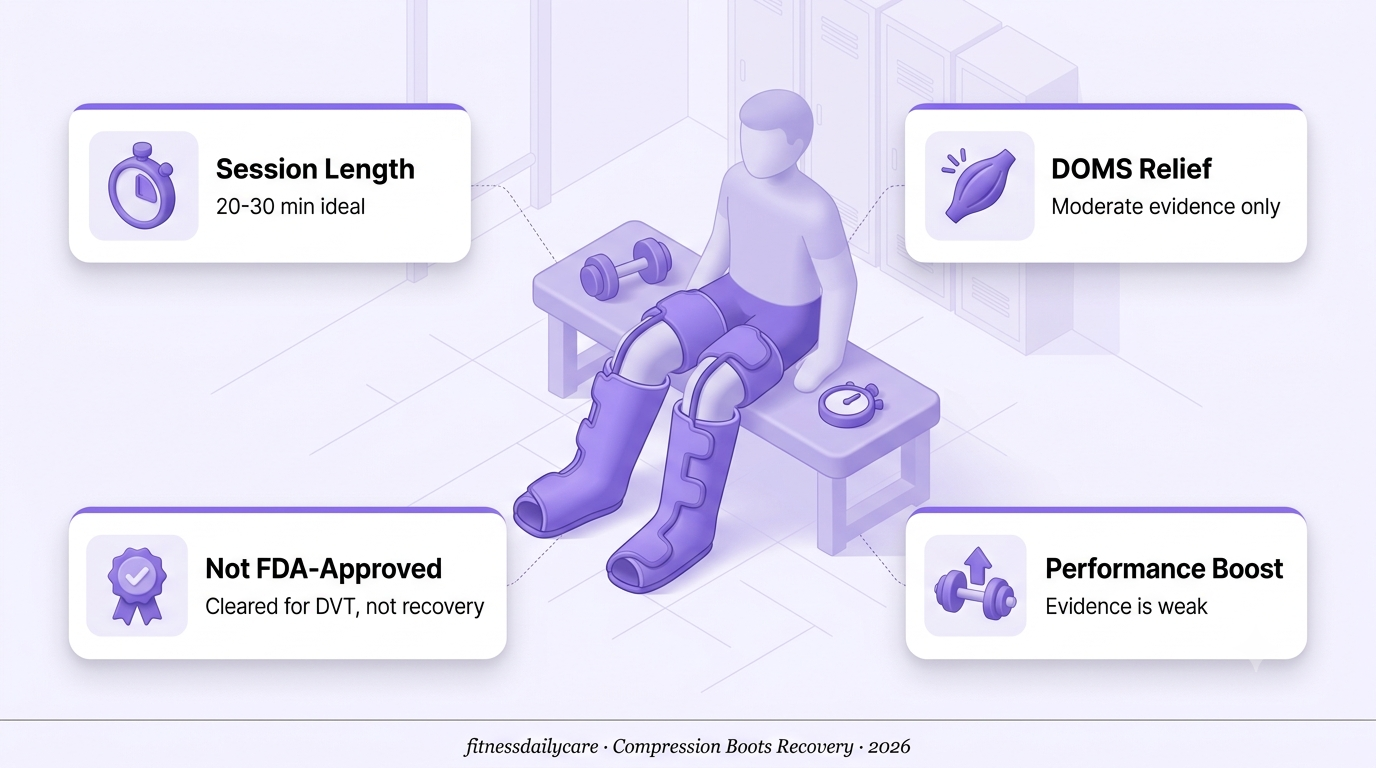
Peak soreness relief appears 48-72 hours after exercise, not the moment you take the boots off, contrary to how they’re marketed.
Not cleared for what you think
Pneumatic compression devices hold FDA 510(k) clearance for DVT prevention and lymphedema, not for athletic performance recovery specifically.
Don’t expect a strength boost
Evidence for next-session performance carryover is weak to mixed. Boots help you feel recovered more than they measurably speed muscle repair.
Use compression boots recovery for how you feel, not for muscle repair
Mindset shiftThe research is honest about this split. Subjective fatigue and soreness scores improve meaningfully. Objective muscle-damage markers, like creatine kinase levels, show mixed results at best. Treat the boots as a comfort and circulation tool, not a substitute for the muscle repair that happens through sleep and protein intake.
Keep sessions to 20-30 minutes, not longer
ProtocolTrial protocols typically run 15-30 minutes post-exercise at 40-100 mmHg with sequential distal-to-proximal inflation. Sessions beyond 45 minutes haven’t shown greater benefit and can cause discomfort or temporary numbness in the legs.
Don’t ditch a cheap compression sleeve for boots
Cost checkA 2025 review comparing six studies found no clear evidence that pneumatic compression boots outperform static compression garments, stretching, massage, or active recovery. If a $30 compression sleeve gives you a similar soreness benefit to a $600 boot system, that’s worth knowing before you buy.
Compression boots recovery is real,
but the science is quieter than the marketing.
- 20-30 minute sessions — trial protocols use 40-100 mmHg with sequential inflation, longer isn’t better
- Expect relief at 48-72 hours — not immediately after your workout, that’s when peak soreness reduction shows up
- Don’t skip a compression sleeve — evidence shows similar benefits at a fraction of the cost
- Watch for numbness or tightness — that’s a signal to loosen the settings or stop the session
- Prioritize sleep and protein first — those remain the biggest levers for actual muscle repair
⚠️ What Compression Boots Recovery Doesn’t Do
1. They’re not a medical circulation treatment. The FDA clearance covers DVT prevention and lymphedema, a different regulatory category than the consumer “recovery boot” marketing implies. Don’t self-treat a circulation concern with one.
2. They won’t reliably boost tomorrow’s performance. Evidence for next-session strength or power carryover is weak to mixed across current trials.
3. Overly tight settings or long sessions can cause numbness. Sessions well beyond 30-45 minutes have been linked to discomfort without added benefit.
Compression Boots Recovery, What the Evidence Says
Compression Boots, Do They Actually
Speed Recovery?
They feel amazing after leg day. Here’s what compression boots recovery research actually supports, and where the marketing gets ahead of the science.
Compression boots recovery has become one of the most photographed rituals in fitness. Sit on the couch, zip on the boots, scroll your phone while they inflate and deflate around your legs. It feels like recovery. The question worth asking is whether it actually is one, in a way that shows up anywhere other than how you feel in the moment.
The honest answer, based on the research, is partly yes, partly overstated. Multiple peer-reviewed trials, including a frequently cited 2015 study in the Journal of Strength and Conditioning Research on elite gymnasts, found lower soreness scores after using pneumatic compression compared to passive rest. But when researchers looked at objective markers like muscle damage and next-session performance, the evidence gets a lot thinner.
There’s also a regulatory detail most marketing skips entirely. Pneumatic compression devices carry FDA 510(k) clearance for deep vein thrombosis prevention and lymphedema management, a completely different clinical use than the “speeds up your leg day recovery” pitch on the box. Here’s what the evidence actually supports, and what it doesn’t.
How they actually work
Sequential pneumatic compression moves fluid through the legs. That’s meaningfully different from a static compression sleeve, but not clearly better in head-to-head trials.
When the benefit shows up
Peak soreness relief appears 48-72 hours after exercise, not the moment you take the boots off, contrary to how they’re marketed.
Not cleared for what you think
Pneumatic compression devices hold FDA 510(k) clearance for DVT prevention and lymphedema, not for athletic performance recovery specifically.
Don’t expect a strength boost
Evidence for next-session performance carryover is weak to mixed. Boots help you feel recovered more than they measurably speed muscle repair.
Use compression boots recovery for how you feel, not for muscle repair
Mindset shiftThe research is honest about this split. Subjective fatigue and soreness scores improve meaningfully. Objective muscle-damage markers, like creatine kinase levels, show mixed results at best. Treat the boots as a comfort and circulation tool, not a substitute for the muscle repair that happens through sleep and protein intake.
Keep sessions to 20-30 minutes, not longer
ProtocolTrial protocols typically run 15-30 minutes post-exercise at 40-100 mmHg with sequential distal-to-proximal inflation. Sessions beyond 45 minutes haven’t shown greater benefit and can cause discomfort or temporary numbness in the legs.
Don’t ditch a cheap compression sleeve for boots
Cost checkA 2025 review comparing six studies found no clear evidence that pneumatic compression boots outperform static compression garments, stretching, massage, or active recovery. If a $30 compression sleeve gives you a similar soreness benefit to a $600 boot system, that’s worth knowing before you buy.
Compression boots recovery is real,
but the science is quieter than the marketing.
- 20-30 minute sessions — trial protocols use 40-100 mmHg with sequential inflation, longer isn’t better
- Expect relief at 48-72 hours — not immediately after your workout, that’s when peak soreness reduction shows up
- Don’t skip a compression sleeve — evidence shows similar benefits at a fraction of the cost
- Watch for numbness or tightness — that’s a signal to loosen the settings or stop the session
- Prioritize sleep and protein first — those remain the biggest levers for actual muscle repair
⚠️ What Compression Boots Recovery Doesn’t Do
1. They’re not a medical circulation treatment. The FDA clearance covers DVT prevention and lymphedema, a different regulatory category than the consumer “recovery boot” marketing implies. Don’t self-treat a circulation concern with one.
2. They won’t reliably boost tomorrow’s performance. Evidence for next-session strength or power carryover is weak to mixed across current trials.
3. Overly tight settings or long sessions can cause numbness. Sessions well beyond 30-45 minutes have been linked to discomfort without added benefit.