
Ultra-Processed Food, Why the Same Calories Meant 500 More
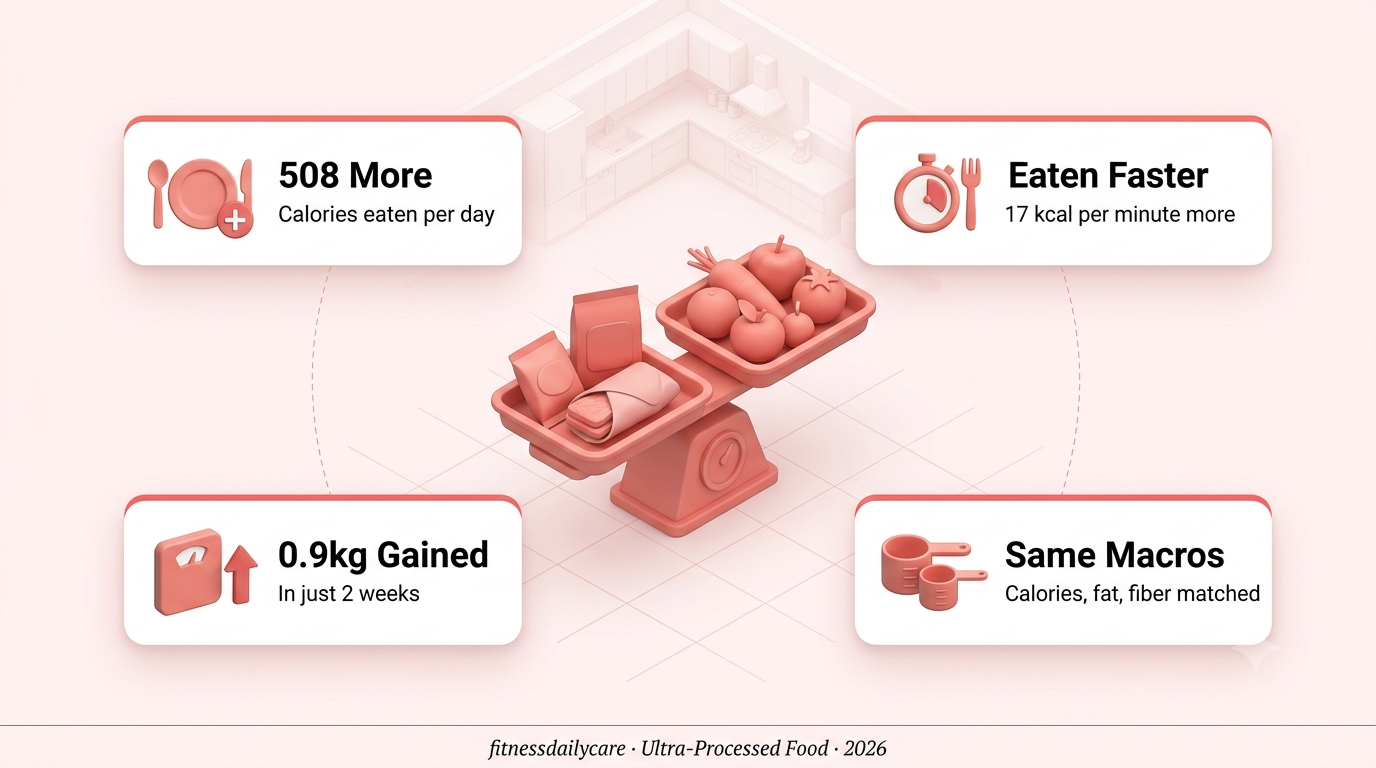
An NIH trial matched two diets for calories, sugar, fat, fiber, and sodium exactly. People still ate 508 more calories a day on the ultra-processed version, and gained weight in two weeks.
Ultra-processed food and weight loss got its first real causal test in 2019, and the design was almost unfair to the “it’s just calories” argument. Researchers at the NIH Clinical Center admitted 20 adults for a full month and fed them two diets in random order, two weeks each: one built from ultra-processed foods, one built from minimally processed whole foods. The catch is that both diets were matched, meal for meal, on calories, sugar, fat, fiber, sodium, and macronutrients. On paper, the two diets should have produced identical results. They didn’t.
People were told to eat as much or as little as they wanted. On the ultra-processed diet, they voluntarily ate 508 more calories a day than on the unprocessed diet — almost entirely from extra carbs and fat, with protein intake essentially unchanged. Over two weeks, participants gained about 0.9kg on the ultra-processed diet and lost about 0.9kg on the unprocessed one. One clue as to why: people ate the ultra-processed meals noticeably faster, about 17 calories per minute faster, which may have outpaced the gut signals that normally tell the brain to stop.
This article covers what the trial actually measured, where a newer 2025 study adds to the picture, and what a finding like this does and doesn’t mean for how you eat day to day.
Why It Happens
Participants ate ultra-processed meals 17 kcal/minute faster, likely outpacing the gut signals that normally trigger fullness.
What the Trial Showed
Hall et al. found 508 more calories eaten daily on a diet matched exactly for calories, sugar, fat, fiber, and sodium.
The Myth This Breaks
“As long as the macros match, processing doesn’t matter” — this trial specifically matched macros and still found a large gap.
What Actually Works
A 2025 follow-up found that slowing eating rate through food texture alone cut intake by 369 kcal/day, even within a processed-heavy diet.
The two diets were matched calorie for calorie, macro for macro.
People still ate 500 more a day.
Ultra-Processed Food, the Practical Version
Build Meals Around Whole Foods When You Can
FoundationThis isn’t a call for a perfect diet — it’s a nudge toward the direction the evidence actually points. Whole and minimally processed foods, even matched for calories, appear to leave people eating less without trying, simply because of how the meal behaves in the mouth and gut.
Slow Down the Eating Rate, Not Just the Ingredient List
The 2025 UpdateA 2025 randomized trial at Wageningen University tested this directly: two all-ultra-processed diets, identical in every measured nutrient, differing only in food texture. The version with textures that slowed eating led to 369 fewer calories a day than the faster-eating version — inside a 90%-ultra-processed diet either way.
Watch the Carb-Fat Combination, Not the “Processed” Label Alone
The MechanismThe extra 508 calories in the trial came almost entirely from carbohydrate and fat together, not protein. Many hyper-palatable ultra-processed foods pair the two (pastries, chips, fried snacks) in a way whole foods rarely do — that combination, not “processing” as an abstract category, may be doing more of the work.
Use This for Systems, Not Guilt
Realistic FramingThis is a small study (n=20) over a short window (2 weeks per diet), and it measured ad libitum eating in a metabolic ward, not real-world convenience, cost, or cooking skill. It’s genuinely useful evidence that food form matters, not a verdict that any processed food is dangerous or that imperfect eating is a personal failure.
- Default to whole foods when the option and time exist — the strongest evidence favors this
- Choose textures that need chewing — slower eating rate alone cut intake in the 2025 trial
- Watch refined carb + fat combos — the specific pattern behind most of the extra calories
- Don’t aim for zero processed food — the research doesn’t support an all-or-nothing standard
- Still track your overall deficit — food quality is a lever, not a substitute for the basics
⚠️ What This Study Doesn’t Prove
1. It’s small and short. Twenty adults, two weeks per diet, in a controlled metabolic ward — a landmark first causal trial, but not the final word on real-world eating.
2. Some methodological questions were raised. After publication, independent researchers flagged points about the analysis; the study’s author addressed them, and most reviewers considered the core finding to hold up, but it’s a reminder that any single trial deserves scrutiny.
3. “Ultra-processed” isn’t automatically “unhealthy.” The category includes plenty of convenient, useful foods (frozen vegetables, canned beans, whole-grain bread) alongside the hyper-palatable snacks the trial focused on — the label alone doesn’t tell you everything.
It’s not that ultra-processed food tastes better.
It’s that it disappears before your body can say stop.