
Eating Speed, How Slowing Down Moved the Scale Without Cutting Calories
Same meals. Same portions. A 20-minute rule your gut hormones have been waiting for.
Here’s the reality about eating speed: most weight-loss advice starts with what’s on the plate. Cut calories, swap carbs, drop the seed oils. But there’s a variable almost no one measures, and it may matter more than any of those. It’s the number of minutes between your first bite and your last.
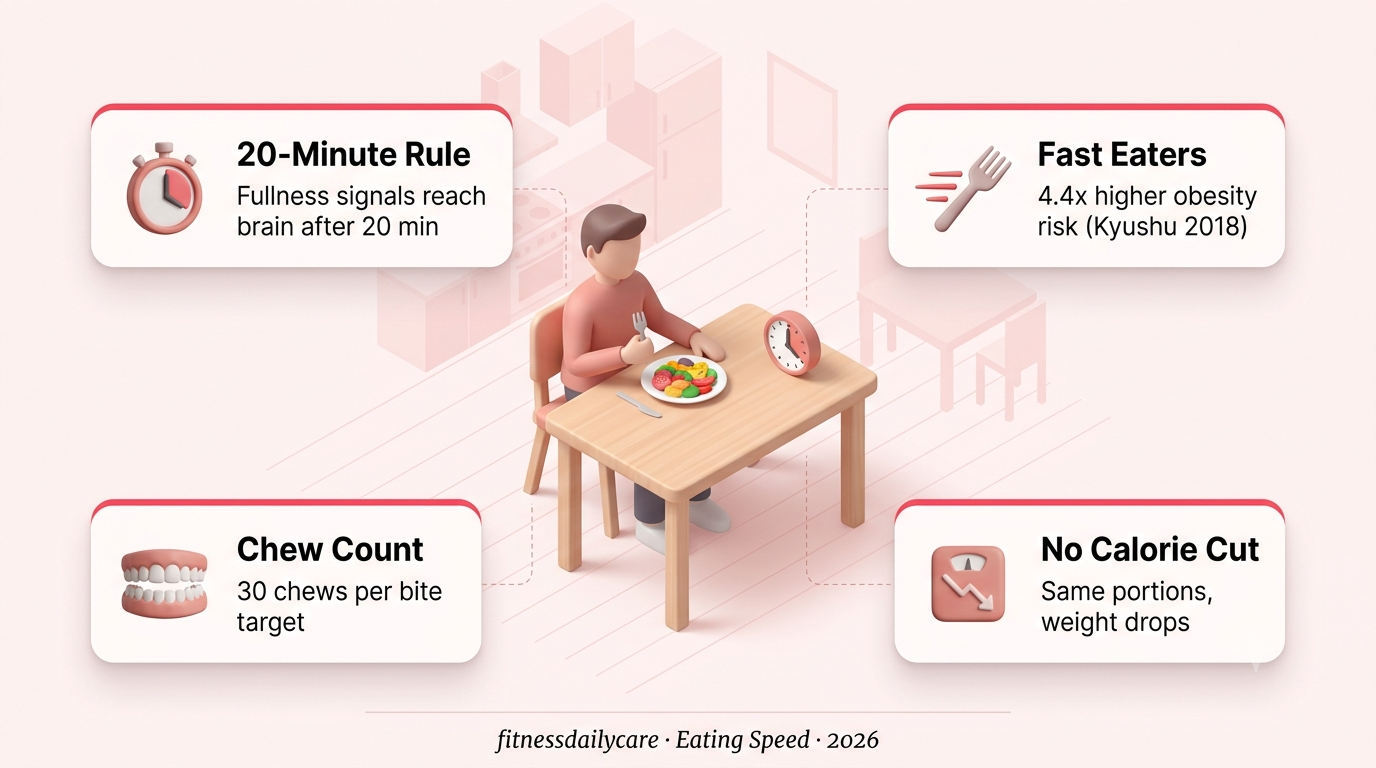
The truth is, your gut needs about 20 minutes to tell your brain you’ve had enough. Cholecystokinin (CCK), GLP-1, and peptide YY — the same hormones that GLP-1 drugs like Ozempic and Wegovy amplify — are already being made by your body. But they need time to travel. Finish a meal in eight minutes and you’ve overshot the signal by a wide margin.
What follows isn’t a diet plan. It’s what the research from Kyushu University, Nagoya University, the American Journal of Clinical Nutrition, and BMJ Open actually shows about how eating speed shapes body weight, gut hormones, and metabolic health. No calorie cutting required.
Why does eating speed matter?
Kyushu University tracked 59,717 adults over 5 years in BMJ Open (2018). Slow eaters had significantly lower BMI and waist circumference, independent of calorie intake.
How eating speed triggers the hormone lag
CCK, GLP-1, and PYY — released from the small intestine — take roughly 20 minutes to signal fullness. Fast eating overshoots the signal entirely.
Does chew count really matter?
Chewing 40 times per bite (vs 15) reduced ad libitum calorie intake by 12% and improved satiety hormones (American Journal of Clinical Nutrition).
Is eating speed a sustainable habit?
Unlike restrictive diets, slowing down doesn’t require willpower reserves or food tracking. Habit stacking with utensil-down cues is what works long-term.
The scale moved before I ever changed
what was on the plate.
Your satiety hormones actually get heard
The mechanismCCK starts firing within minutes when fat and protein hit the small intestine. GLP-1 and PYY follow. But these signals need roughly 20 minutes to shape appetite behavior. Finish a 600-calorie meal in eight minutes and you’re just getting started when the “stop” signal finally arrives — usually while you’re eyeing dessert.
Calorie intake drops without conscious tracking
The dataIn an American Journal of Clinical Nutrition mastication trial, participants who chewed each bite 40 times instead of 15 ate 12% fewer calories at the meal — and reported the same satisfaction. That’s about 240 fewer calories on a 2,000-calorie day, without weighing food, counting macros, or feeling deprived.
Visceral fat responds even at normal BMI
Under-the-radarThe 2024 Yamagata Cohort Study in Frontiers in Nutrition looked at 6,548 Japanese adults with normal BMI (18.5–25). Fast eaters showed elevated waist circumference — a proxy for visceral fat — even when weight looked fine on paper. Body composition can shift silently regardless of what the scale says.
Metabolic syndrome risk drops with pace
Downstream healthA BMC Public Health 2018 meta-analysis found that fast eating was associated with a 35% higher risk of metabolic syndrome — the cluster of high blood pressure, high triglycerides, low HDL, elevated waist circumference, and insulin resistance. Eating speed independently predicted risk after adjusting for calorie intake and activity.
Digestion, blood flow, and thermic effect all improve
Bonus effectA Wiley Obesity journal study (Hamada, 2014) found that slow, thorough chewing increased diet-induced thermogenesis — the calories your body burns processing food. Roughly an extra 10 calories per 300-calorie meal, alongside increased splanchnic (gut) blood flow. Not massive per meal, but over a month it’s around 2,000 extra calories spent on digestion alone.
Put your utensil down between bites
The base habitThe single most effective slow-eating cue in behavioral trials. When your fork or spoon is in your hand, you’re loading the next bite before you’ve finished the current one. Setting it down forces a natural pause — 3 to 5 seconds — and roughly doubles meal duration for most people without any conscious effort.
Aim for 30 chews per bite, not 40
Realistic targetThe 40-chew studies work but reduce meal enjoyment past a certain point. 30 chews per bite is the practical sweet spot — enough to blunt the eating rate meaningfully, not so much that food goes flavorless. If 30 feels like a lot, most fast eaters chew about 10 to 15 times per bite. So even doubling that is a real win.
Eat the protein and fiber first
Order mattersProtein and fiber trigger the strongest CCK and GLP-1 release. Starting your meal with them primes the satiety cascade earlier in the 20-minute window. This is the same logic behind Sweetgreen-style bowls that lead with grilled chicken and greens rather than a bread basket. Same calories. Different biology.
Kill the screen mid-meal
Attention rulesEating while watching Netflix, scrolling TikTok, or working through emails silences the internal fullness signal by hijacking attention. Reviews in Appetite have found distracted eating leads to higher intake at the meal and more snacking later. You’re not slower because you’re distracted; you’re eating past the signal without noticing.
Use the “conversation pace” test
Social cueSlow eaters in every study finished last at group meals. That’s not a bug — it’s the goal. When you’re eating with someone, match their pace at the slowest reasonable point rather than racing to a clean plate. If you’re eating alone, imagine you’re mid-conversation. Talk-pace eating is naturally around 25 to 30 minutes per meal, which lines up neatly with the 20-minute satiety window plus buffer.
Fast eating overshoots
a signal that’s already there.
- Set the fork down between bites — the single highest-leverage cue, no counting required
- Target 30 chews per bite — most fast eaters chew 10 to 15, so doubling is realistic
- Protein and fiber first — triggers CCK and GLP-1 earlier in the 20-minute satiety window
- Aim for 25 to 30 minutes per main meal — matches the hormone timing plus a small buffer
- No screens the first 10 minutes — distraction is what silences internal fullness signals
⚠️ Slower Isn’t Automatically Better
1. Extreme chewing kills enjoyment. Studies pushing 30+ seconds per bite reduced snacking later but also cut meal satisfaction significantly. Sustainable behavior beats optimal biology every time.
2. Slow eating doesn’t neutralize junk food. Chewing an ultra-processed snack 40 times doesn’t turn it into a whole food. Slowing down amplifies real satiety signals, not the artificial hyper-palatability of engineered foods.
3. If you have a swallowing or dental condition that makes chewing painful, talk to a dietitian or MD before chasing a chew-count target. This is a supporting habit, not medical advice.