
Rest Between Sets, Shorter Isn’t Better for Muscle Growth
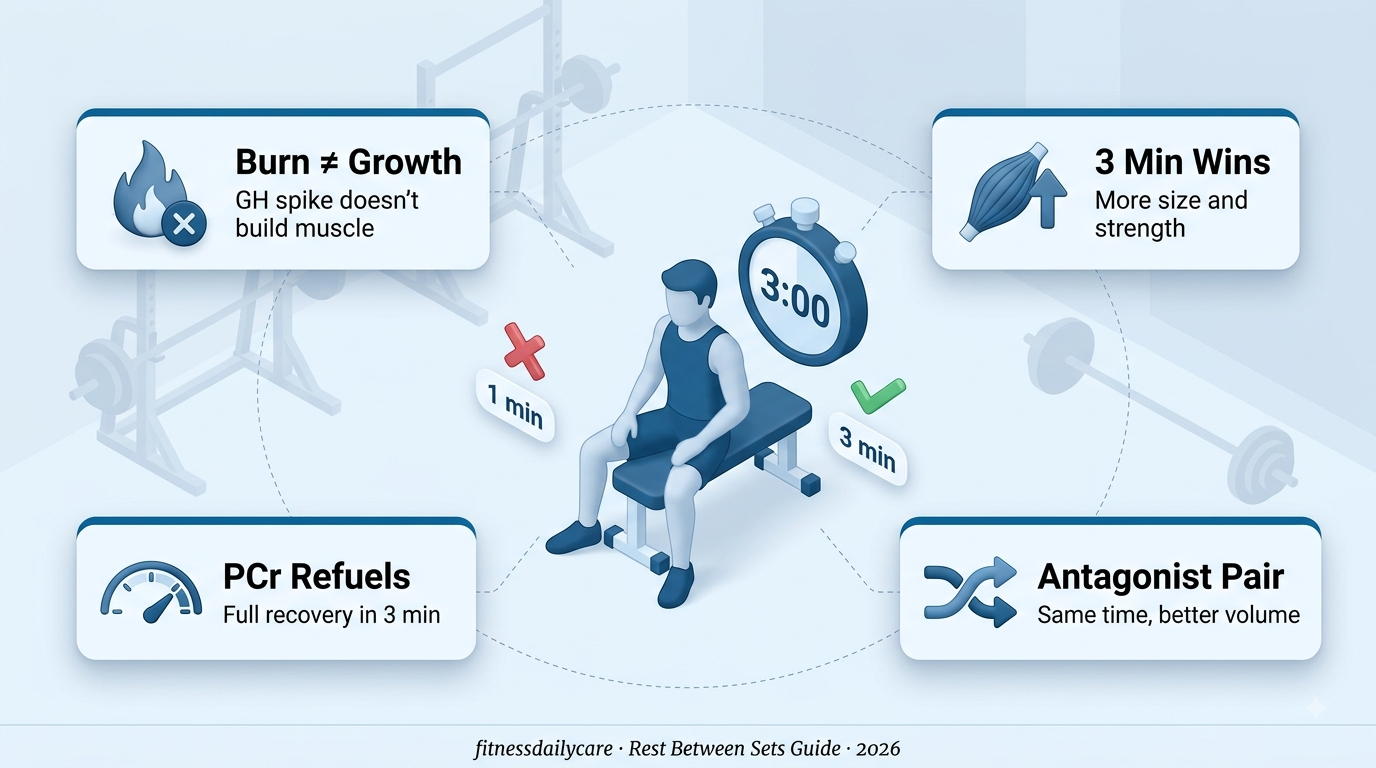
After 8 weeks, the group resting 3 minutes between sets gained more muscle and more strength than the group resting 1 minute. The burn you feel from short rest periods isn’t growth — it’s just discomfort.
Rest Between Sets is the training variable most people manage by feel rather than by evidence — and almost everyone’s instinct is wrong in the same direction. Shorter rest feels more productive. It keeps the heart rate up, produces a satisfying burn, and makes a 45-minute workout feel dense and intense. The assumption underneath all of it is that feeling harder equals working better. For muscle growth, that assumption has been consistently contradicted by research for over a decade.
The clearest test came from Schoenfeld, Pope, Benik and colleagues in 2016, published in the Journal of Strength and Conditioning Research. Twenty-one young resistance-trained men followed identical 8-week programs — same exercises, same sets, same rep ranges, same frequency. The only difference was Rest Between Sets: one group rested 1 minute, the other rested 3 minutes. Muscle thickness of the elbow flexors, triceps, and quadriceps was measured by ultrasound before and after. The 3-minute group gained significantly more in every measurement. They also gained more strength on the bench press and back squat.
The mechanism isn’t mysterious. Longer Rest Between Sets preserves the ability to generate force in subsequent sets. When you rest 60 seconds after a hard set of squats, phosphocreatine stores — the fuel system for high-intensity muscle contractions — are only partially replenished. The next set starts at a deficit. You lift less weight, complete fewer reps, and accumulate less total volume. Multiply that deficit across every set of every session and the total training stimulus shrinks considerably. The 3-minute group lifted more per session, which produced more hypertrophy over 8 weeks. The maths isn’t complicated; the gym culture around it is.
The myth that short Rest Between Sets is the hypertrophy-optimized approach traces to an older theory: that the metabolic stress and growth hormone spike from shorter, denser training drives muscle growth. It feels plausible because the burn is real. But the GH spike from short rest periods doesn’t correlate meaningfully with hypertrophy — Morton et al. 2016 confirmed that systemic GH and testosterone elevation from resistance training doesn’t determine muscle growth outcomes. The burn is a signal that glycolytic metabolism is working hard. It is not a signal that your pectorals are getting bigger.
The guide below covers five principles of Rest Between Sets that actually drive muscle growth, and the goal-specific targets the research supports.
The burn signals muscle growth
The burn from short rest periods reflects lactate accumulation and glycolytic stress — not hypertrophic stimulus. The sensation is real; the inference is wrong. Metabolic stress is a minor driver of growth compared to mechanical tension and volume.
Short rest spikes growth hormone
True — but irrelevant. The acute GH rise from short rest periods looks impressive on paper but doesn’t correlate with actual muscle hypertrophy. Morton et al. 2016 confirmed this definitively: systemic GH doesn’t determine muscle growth outcomes.
Bodybuilders use short rest, so it works
Elite bodybuilders use short rest periods on isolation and pump work — accessory exercises where volume and feel matter more than peak force output. They don’t use short rest on heavy compound sets. The distinction is critical and widely missed.
Dense training = efficient training
A workout that finishes faster isn’t a more effective workout. A 75-minute session with proper Rest Between Sets and full volume accumulation outperforms a 45-minute session with compressed rest and degraded set quality.
The burn tells you glycolysis is working.
It doesn’t tell you your chest is growing.
Rest Between Sets: 5 Principles That Drive Muscle Growth
Longer Rest Preserves the Volume That Drives Hypertrophy
Training volume — sets multiplied by reps multiplied by load — is one of the strongest predictors of hypertrophy identified in resistance training meta-analyses. The 2017 dose-response meta-analysis (Schoenfeld, Ogborn, and Krieger) found that 10+ sets per muscle group per week produced meaningfully greater muscle growth than lower volumes. The critical mechanism linking rest periods to this outcome: insufficient Rest Between Sets reduces the load and reps achievable in subsequent sets, quietly deflating weekly volume below the productive threshold.
In the Schoenfeld 2016 trial, the 3-minute rest group completed more total reps at heavier loads across their 8-week training period than the 1-minute group. The programs were identical on paper. In practice, the 1-minute group was running a systematically lower-volume program because every short rest period cost them 1-3 reps and a small percentage of their working load on the following set. Compounded across dozens of sets weekly over 8 weeks, that volume deficit produced measurably less muscle growth.
The implication is direct: if you consistently cut Rest Between Sets short to save time, you are running a lower-effective-volume program than your session log suggests. The sets are logged as complete. The actual volume is not complete.
Phosphocreatine Needs 3 Minutes to Fully Replenish
The bioenergetic reason longer Rest Between Sets outperforms shorter rest for strength and hypertrophy comes down to phosphocreatine (PCr) — the immediate energy substrate for high-intensity muscular contractions lasting 6-12 seconds. A heavy set of squats, a max set of bench press, a hard set of rows — all of these draw primarily on the phosphagen system during the working reps. PCr depletes rapidly during the set and requires time to replenish before the next set can be performed at comparable intensity.
Research on PCr replenishment kinetics shows that approximately 50% of PCr is restored within 30 seconds of rest, 75% within 90 seconds, and full replenishment requires 3-5 minutes. One-minute Rest Between Sets starts the next heavy set at roughly 75% of peak PCr availability — already meaningfully compromised. A 3-minute rest restores close to full capacity. This explains the drop-off in rep counts observed in the 1-minute groups across multiple studies: it’s not motivation or technique that fails, it’s fuel.
This PCr replenishment timeline is why strength athletes — powerlifters, Olympic weightlifters, and anyone training for maximal force production — use Rest Between Sets of 3-5 minutes on their heaviest compound movements. They’ve learned empirically what exercise physiology confirms: full fuel replenishment requires adequate time, and there’s no shortcut that doesn’t cost performance.
Rest Duration Should Match Training Goal, Not Preference
The biggest mistake lifters make with Rest Between Sets is using a single duration for every exercise and goal. Muscular strength, hypertrophy, and endurance have different metabolic demands and different optimal recovery windows. Applying the same 90-second rest to a 3-rep max deadlift attempt and a 15-rep cable crossover set is mismanaging both.
The research-backed framework by goal: strength and power development (1-6 rep ranges, maximal force output) requires 3-5 minutes Rest Between Sets — long enough for neural recovery and near-complete PCr replenishment. Hypertrophy-focused training (6-15 rep ranges, submaximal loads taken close to failure) performs best at 2-3 minutes — enough recovery to maintain set quality without allowing full fatigue clearance. Muscular endurance and conditioning (15+ reps, circuit formats, finishers) can work at 30-90 seconds, where the incomplete recovery is intentional and the training adaptation targeted is cardiovascular and local endurance, not hypertrophy.
Within a single session, rest duration can and should vary by exercise type. Heavy compound movements early in the session at 3-minute rest, lighter accessory work later at 90 seconds to 2 minutes. This is how most well-designed programs actually operate — the idea that “short rest equals hypertrophy training” is a simplification that ignores how sophisticated bodybuilders and coaches actually structure their sessions.
The Last Sets of a Session Are Where Growth Happens
Hypertrophic stimulus is not evenly distributed across a workout. The first set of any exercise, when muscles are fresh and glycogen is high, produces some stimulus. The final sets of a session — where accumulated fatigue means you’re working genuinely close to failure — produce disproportionately more stimulus per set. This is the pattern behind the concept of “working sets”: the early sets are warm-up, and the sets that count are the ones where maintaining form and rep count requires maximum effort.
Short Rest Between Sets degrades set quality non-linearly. Sets 1 and 2 look fine. Sets 3, 4, and 5 collapse in load and reps as fatigue compounds. The very sets that should produce the most growth end up being the ones most compromised by inadequate recovery. The result is a session that looks like 5 working sets on paper but effectively delivers 2-3 quality sets of stimulus — and 2-3 compromised sets that add fatigue without adding proportional growth signal.
Protecting the quality of the final sets requires protecting the rest periods that precede them. A 3-minute rest that feels like too long a pause becomes a 3-minute investment in the quality of the set that follows. Viewed from that angle — as preparation for the next set rather than wasted time between sets — the discipline of adequate rest becomes straightforward.
Use Rest Time, Don’t Just Wait Through It
The practical objection to longer Rest Between Sets is time: a gym session with proper 3-minute rests runs 20-30 minutes longer than one compressed with 60-second rests. For people with limited gym time, this creates a genuine scheduling problem. The solution is active rest strategy — using the rest window deliberately rather than just waiting.
Several techniques let lifters maintain longer rest periods for their working exercises without inflating total session time. Antagonist pairing (a set of bench press, then 3 minutes rest during which you perform a set of rows, then return to bench) keeps one muscle group working while the other recovers. This format maintains rest duration for each exercise while doubling the training density of the session. Studies on antagonist pairing confirm comparable hypertrophy to straight sets with the added benefit of higher total volume per unit time.
A second strategy: reduce isolation exercise volume and invest the freed time into compound rest periods. Five minutes of cable curls replaced by 5 minutes of adequate rest before the final squat set produces better overall growth outcomes for most intermediate lifters. The compound lifts are where the most muscle gets built. The isolation exercises are the accessories. Protect the quality of what matters most.
⚠ The Exception: Short Rest Is Appropriate for These Contexts
Short Rest Between Sets (30-90 seconds) is not always wrong — it’s wrong specifically for the goal of maximizing hypertrophy or strength on heavy compound movements. For muscular endurance, metabolic conditioning, circuit training, or sport-specific fitness preparation, short rest intervals are the appropriate tool. The goal determines the optimal rest period, and those goals are legitimate training objectives.
Similarly, the pump-focused isolation work that bodybuilders use at the end of a session — high-rep cable work, finisher circuits, drop sets — often uses short rest intentionally because the goal at that point in the session is metabolic stress and blood flow to the target muscle, not maximal force production. Short rest in that context is a deliberate tool. The mistake is applying that short-rest tool to the heavy compound movements at the beginning of the session where it actively reduces growth stimulus.
Rest Between Sets: Goal-Based Rest Periods at a Glance
▎ The Evidence-Based Rest Period Framework
- Maximal strength (1-5 reps, heavy compounds) → 3-5 minutes. Squat, deadlift, bench press, overhead press. Full PCr replenishment needed for maximum force output. Never rush these.
- Hypertrophy compounds (6-12 reps) → 2-3 minutes. Romanian deadlift, weighted pull-up, incline press, barbell row. Enough recovery to maintain load and reps across all sets.
- Hypertrophy isolation (10-15 reps) → 1.5-2 minutes. Curls, lateral raises, cable crossovers, leg extensions. Lower peak force demand means shorter rest still produces quality sets.
- Endurance and conditioning (15+ reps, circuits) → 30-90 seconds. Intentional incomplete recovery is the training stimulus here. Not applicable to hypertrophy-focused work.
- Antagonist pairing (any goal) → 90-second per-exercise rest, combined. Bench + Row, Squat + Hip Hinge, Overhead Press + Lat Pulldown. Each exercise effectively rests 3 minutes while the opposite pattern works.
Rest isn’t wasted time.
It’s preparation for the set that counts.
4 Rest Period Mistakes That Quietly Kill Your Gains
Same rest for every exercise
Resting 60 seconds after a heavy squat set and 60 seconds after a cable curl treats two completely different training stimuli identically. Match rest to exercise type and goal, not to a uniform timer.
Shortening rest to save time on compounds
Cutting 90 seconds from compound rest periods “saves” 10-15 minutes of session time at the cost of 20-30% of effective training volume. The trade is almost always net negative for hypertrophy outcomes.
Scrolling instead of recovering during rest
Mental disengagement during rest is fine. Physical activity that elevates heart rate — anxious walking, aggressive foam rolling, unrelated movement — partially competes with PCr replenishment. Sit, breathe, and actually recover.
Ignoring rep drop-off as a warning sign
Losing 4+ reps between set 1 and set 3 of the same exercise is a direct signal that rest is insufficient. Most lifters chalk it up to fatigue and keep moving. It’s a correctable variable — just rest longer.
Rest Between Sets · The Verdict
3 minutes outperformed 1 minute for both hypertrophy and strength — Schoenfeld 2016, 8-week RCT, all other variables identical. Not a close result.
The burn from short rest is glycolytic stress, not hypertrophy signal. GH spikes from short rest don’t determine muscle growth outcomes (Morton et al. 2016).
Match rest to goal: Strength = 3-5 min, Hypertrophy compounds = 2-3 min, Isolation = 1.5-2 min, Endurance = 30-90 sec.
PCr takes 3 minutes to fully replenish. Starting the next heavy set before that window means starting at a fuel deficit — fewer reps, lower load, less volume.
Antagonist pairing solves the time problem. Full rest for each exercise, doubled training density, comparable hypertrophy to straight sets with higher total volume per hour.