
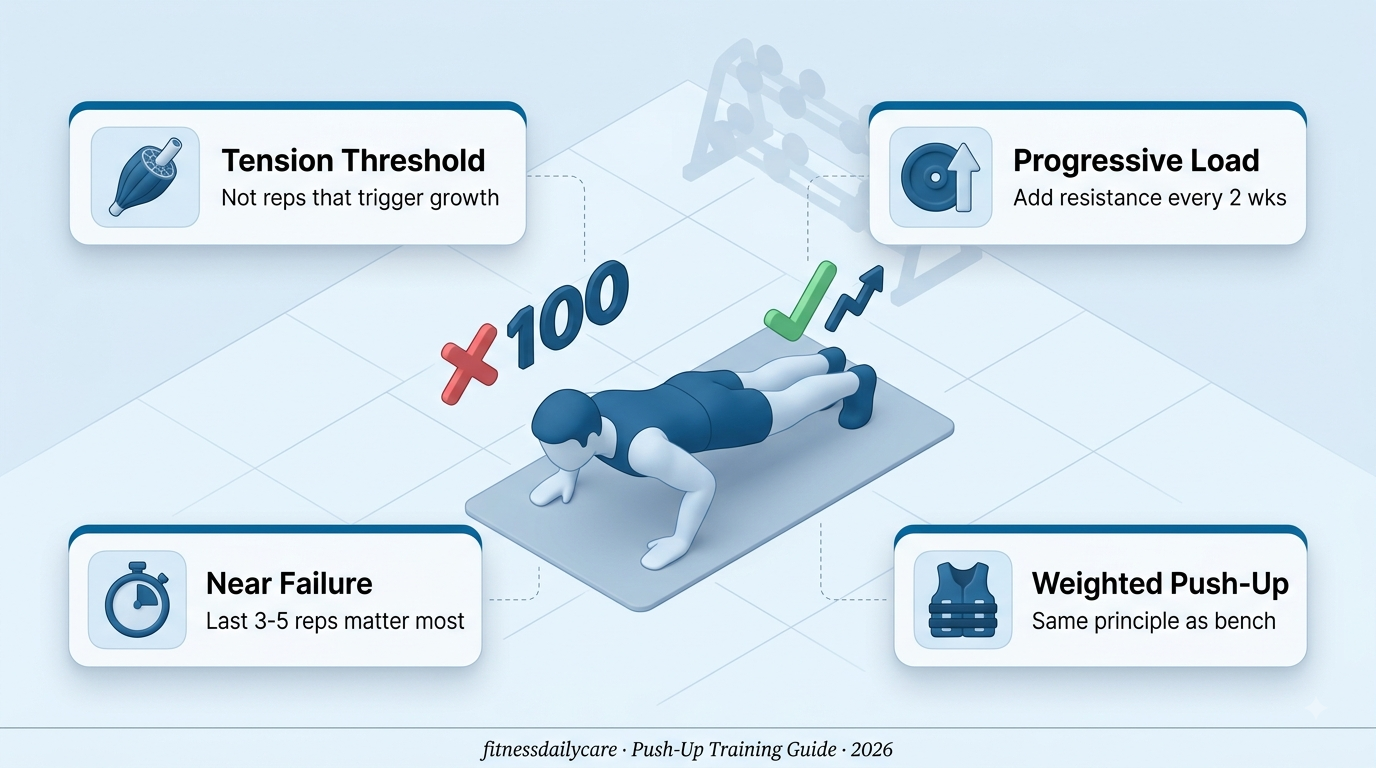
Push-Up Reps Don’t Build Chest, Progressive Overload Does
If you can do 30+ push-ups easily, your chest isn’t growing. The variation is too easy. A network meta-analysis of 747 people confirmed it’s not the rep count that matters — it’s proximity to failure.
Push-Up Reps are the metric everyone tracks and the metric that matters least for chest muscle growth. Ask someone how their push-up training is going and they’ll answer with a number: “I can do 50 now.” That’s a significant achievement in endurance — but if they could already do 30 without struggling, the jump to 50 built almost no new chest muscle along the way. The pectorals adapted to the load weeks ago. What kept improving was their cardiovascular fitness and local muscular endurance, not hypertrophy.
The confusion traces to a fundamental misunderstanding of what triggers muscle growth. The stimulus for hypertrophy is mechanical tension near the point of failure — the last few reps of a set where the muscle is working hard enough to activate high-threshold motor units and accumulate metabolic stress. It’s not total rep count. It’s not duration. It’s the quality of stimulus applied in the reps that matter: the ones your muscles almost can’t complete.
A network meta-analysis of 28 studies and 747 people (Kotarsky et al., referenced across the bodyweight training literature) found that hypertrophy is load-independent — meaning push-ups and bench press produce comparable chest muscle growth when matched for effort and proximity to failure. The qualification “when matched for effort” is doing enormous work in that sentence. Easy push-ups do not match bench press effort. Push-ups done 2-3 reps from failure on a challenging variation absolutely do.
The practical implication is liberating for people training without equipment and troubling for those grinding through high-rep sets and wondering why their chest isn’t responding. Push-ups work. High-rep easy Push-Up Reps don’t. And the gap between those two statements is the entire difference between training that produces results and training that produces only fatigue.
This guide breaks down why high Push-Up Reps fail, how to diagnose your current variation, and the five progression principles that actually drive chest hypertrophy from a bodyweight program.
Adaptation removes the growth signal
Once your pectorals can handle the load of standard push-ups, they stop sending hypertrophy signals. The body adapts to survive the stress efficiently, not to grow larger muscle fibers.
High reps at low intensity train endurance
Above 15-20 reps at comfortable intensity, the primary adaptation shifts from type II muscle fiber growth (hypertrophy) to local muscular endurance and mitochondrial density. You get fitter, not bigger.
You never reach the reps that matter
The last 3-5 reps before failure are where hypertrophy stimulus concentrates. In a set of 30 easy reps, those critical final reps are reps 28-30. Most people quit at 30 without ever getting there.
Volume replaces intensity, both lose
Adding more push-up sets as a substitute for harder variations compounds the problem. More sets of insufficient stimulus doesn’t accumulate into enough signal for growth — it just adds fatigue.
It’s not the rep count.
It’s the reps you almost couldn’t finish.
Push-Up Reps: 5 Progressive Overload Principles That Actually Build Chest
Progress the Variation, Not the Rep Count
The most effective form of progressive overload for push-up training isn’t adding reps to your current variation — it’s advancing to a harder one. The push-up progression ladder is well-documented in the bodyweight training literature: standard push-ups → decline push-ups (feet elevated increases load on upper chest) → archer push-ups (one arm carries more of the load, equivalent to roughly 70% of bodyweight) → pseudo-planche push-ups → weighted vest push-ups → one-arm push-ups.
Each step up the ladder roughly doubles the effective load on the working muscle relative to the step before. Moving from standard to archer push-ups isn’t just a difficulty upgrade — it’s a fundamentally different stimulus. Kotarsky’s 2018 research found push-ups matched bench press for chest hypertrophy when intensity was controlled. That finding only holds when the push-up variation is actually challenging. A standard push-up at submaximal effort doesn’t match a moderately-loaded bench press in stimulus quality, regardless of how many reps are performed.
The practical rule: when you can perform 15 clean reps of any variation without approaching failure, it’s time to advance. Not to add reps. Not to add sets. Advance. The variation, not the count, carries the progressive overload that drives chest growth.
Train 2-3 Reps From Failure Every Set
Proximity to failure is the variable the research keeps returning to across rep ranges, exercise types, and training populations. A set taken to 3 reps from failure produces the hypertrophic stimulus that matters. A set stopped at a comfortable 30 reps when you could theoretically do 50 doesn’t — regardless of how many total reps you accumulate. The last few reps, not the early ones, activate the high-threshold motor units responsible for type II fiber growth.
This doesn’t mean training to complete failure every set. Research on resistance training volume and recovery shows that stopping 1-3 reps short of failure (leaving reps in reserve, or RIR 1-3) produces hypertrophy nearly identical to going to failure, with substantially less recovery cost. Training to complete failure occasionally is useful as a test of current capacity — not as the daily protocol.
The 2-for-2 rule (GymAware, popularized through Stronger by Science) gives a practical trigger for progression: when you can perform 2 additional reps beyond your target rep goal in the last set, for two consecutive workouts, it’s time to progress. This avoids the common mistake of advancing too quickly (before adaptation is complete) or too slowly (staying on a variation that’s already ceased to provide adequate stimulus).
Slow the Eccentric to Increase Stimulus Without Changing Variation
Tempo manipulation is an underused form of progressive overload that adds meaningful stimulus to any push-up variation without requiring a harder variation or external load. The eccentric phase (lowering down) is where the most muscle damage and growth stimulus occurs — your pectoral is lengthening under tension, which is the mechanical condition that most effectively drives protein synthesis. Slowing the lowering phase from 1 second to 3-4 seconds significantly increases time under tension and the hypertrophic stimulus per rep.
A set of 10 push-ups with a 3-second eccentric and 1-second pause at the bottom is meaningfully harder than a set of 10 at normal tempo — and produces a stimulus more comparable to weighted pressing than the same reps done quickly. This technique is particularly useful as a bridge between variations: when standard push-ups are getting easy but archer push-ups aren’t yet achievable, a slow-tempo standard push-up extends the utility of the variation before the jump.
The combination of variation advancement and tempo manipulation gives bodyweight trainees almost unlimited progressive overload options. A 4-second eccentric archer push-up with a 2-second pause at the bottom provides a chest stimulus that rivals moderately heavy dumbbell pressing. Push-Up Reps performed this way — fewer in count, slower in tempo — outperform fast high-rep sets every time.
The 40-60 Reps Per Session Rule (With Caveat)
Research on weekly volume for chest hypertrophy (including from the 2017 meta-analysis on dose-response relationships) suggests that 10+ sets per muscle group per week produces greater hypertrophy than lower volumes — and that two sessions per week generally outperforms one high-volume session because quality in later sets of a fatigued session degrades. For push-up-based training, this translates to 40-60 challenging reps per session, 2-3 sessions per week.
The critical qualifier: these reps need to be hard reps. Forty easy reps don’t satisfy the same stimulus requirement as 40 reps performed across sets taken close to failure on a genuinely challenging variation. The volume target assumes quality. Many people who train push-ups daily at low effort generate enormous weekly rep counts while creating almost no growth signal — they’ve confused volume with stimulus.
The split that works: 3-4 sets of 8-12 challenging Push-Up Reps, 2 sessions weekly. Total working reps: 48-96 per week, all taken within 1-3 reps of failure on a variation where 15+ reps clean isn’t possible. This is less total volume than most daily push-up practitioners accumulate, and produces significantly more chest muscle growth.
Increase Range of Motion for Deeper Chest Activation
Range of motion is one of the most overlooked progressive overload tools in bodyweight training. A push-up performed with hands on parallel bars or push-up handles allows the chest to descend several inches below hand level — achieving a stretch in the pectorals at the bottom position that standard floor push-ups never reach. That stretched position under load is where hypertrophy stimulus is highest, which is why dumbbell pressing generally outperforms barbell pressing for chest development despite lower total load.
Deficit push-ups (hands elevated on books, parallettes, or push-up handles) extend the range of motion to match or exceed dumbbell pressing range. Combined with the tempo principle above — a 3-second eccentric into full stretch at the bottom — this variation provides a chest stimulus that most gym-goers on standard flat-bench programs don’t achieve.
The combination of deficit push-ups, slow eccentric, and proximity to failure is one of the highest-return bodyweight chest protocols available. It requires no equipment beyond push-up handles or two thick books, takes 15 minutes, and provides enough mechanical tension and time under tension to produce measurable chest hypertrophy over 6-12 weeks when applied consistently with the 2-for-2 progression rule.
⚠ Daily Push-Up Challenges Usually Produce Endurance, Not Muscle
The “100 push-ups a day for 30 days” challenge format is popular, motivating, and almost entirely ineffective for chest hypertrophy in anyone who can already perform more than 20 consecutive standard push-ups. Daily easy Push-Up Reps train local muscular endurance, improve cardiovascular efficiency, and build a habit — all useful things. They do not consistently produce meaningful chest or triceps muscle growth in trainees who’ve already adapted to the movement.
If the goal is endurance or completing the challenge for its own sake, continue. If the goal is a larger, more defined chest, replace the daily challenge with 3 sets of hard push-up variations, twice per week, with progressive overload applied every 2 weeks. The latter protocol takes less total time and produces dramatically better hypertrophy outcomes.
Push-Up Reps: The Complete Progression Ladder
▎ The 6-Level Progression (Start Where You Belong)
- Level 1 — Standard push-up, 3×8-12. If you can do more than 15 clean reps without struggling, start at Level 2. The standard push-up is a beginner stimulus, not a permanent chest exercise.
- Level 2 — Decline push-up (feet on chair), 3×8-12. Shifts more load to the upper chest and increases total percentage of bodyweight lifted. If 15 reps becomes comfortable, advance.
- Level 3 — Diamond or close-grip push-up, 3×8-12. Increases triceps contribution and changes the line of force across the pectorals. Combine with slow (3-second) eccentric.
- Level 4 — Archer push-up, 3×6-10 per side. One arm carries the majority of the load. Roughly equivalent to pressing 70-75% of bodyweight. Most intermediate trainees find this significantly harder than expected.
- Level 5 — Weighted vest push-up or deficit push-up, 3×6-10. External load or extended range of motion. Apply the 2-for-2 rule every 2 weeks to increase load or progress to Level 6.
- Level 6 — One-arm negative push-up, 3×3-5 each arm. Lower on one arm (3-5 seconds eccentric), return to top using both arms. Once you can control the eccentric cleanly for 5 reps, add a partial concentric press.
If 30 push-ups feel easy,
you stopped training your chest weeks ago.
4 Push-Up Habits That Guarantee a Plateau
Same variation for months
Standard push-ups stop producing chest growth within 4-6 weeks for most people. Staying on the same variation regardless of how comfortable it feels is the fastest route to a permanent plateau.
Stopping far from failure
Ending each set at 20 reps when you could do 35 means the last 15 reps — where the hypertrophy signal concentrates — are never trained. Comfortable push-ups aren’t building chest muscle.
Treating daily push-ups like training
Casual daily push-ups feel productive but produce almost no hypertrophy after the first 6-8 weeks of adaptation. Recovery between challenging sessions matters. Daily easy reps just accumulate fatigue.
Skipping the eccentric
Fast push-ups with a snap at the bottom eliminate the most hypertrophic portion of the movement. The lowering phase under control — especially the last 2-3 inches near the chest — is where chest growth lives.
Push-Up Reps · The Verdict
30+ easy reps = endurance training, not hypertrophy. If you can do that many without struggling, the variation is too easy for chest muscle growth.
Push-ups match bench press for chest growth — when matched for effort. The “when matched for effort” part is the whole game.
Progress the variation, not the rep count. Standard → Decline → Archer → Weighted. Each step resets you into the 6-15 hard-rep hypertrophy zone.
Train 2-3 reps from failure every set. The 2-for-2 rule: exceed your target by 2 reps for 2 workouts in a row → advance the variation or load.
Slow the eccentric. 3-second lowering phase increases time under tension and hypertrophic stimulus without requiring a harder variation or extra equipment.