
Full-Fat Dairy, What the New 12-Week Study Actually Found
A University of Toronto trial found three daily servings of full-fat dairy didn’t raise weight, fat, or cholesterol, right as it lines up with a major reversal in U.S. dietary guidance that took effect earlier this year.
I’ve been buying skim milk out of habit for years, mostly because that’s what I was told to do decades ago. It’s one of those dietary rules that got absorbed so completely into normal grocery shopping that I never really questioned it. So when a fresh University of Toronto trial made headlines this week arguing that full-fat dairy might not deserve the reputation it’s had since the low-fat era, I wanted to actually read the study instead of just the headline.
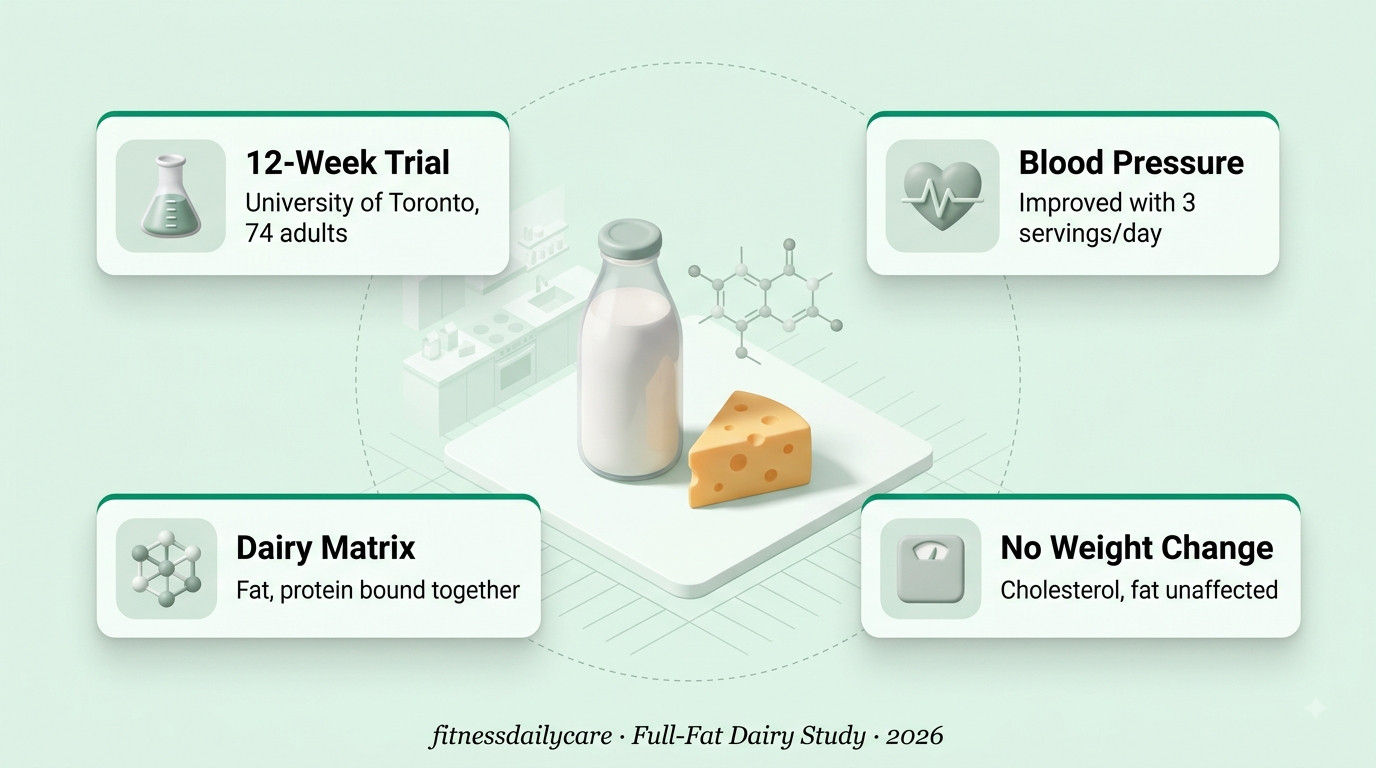
The trial, led by professor Harvey Anderson and published in The Journal of Nutrition, followed 74 adults with overweight or obesity for 12 weeks. One group ate a low-dairy, calorie-restricted diet. Two other groups added three daily servings of full-fat dairy, one calorie-matched, one with no calorie restriction at all. Across all three groups, the researchers found no meaningful differences in body weight, body composition, cholesterol, or insulin resistance. The dairy groups also saw improved blood pressure and higher intake of calcium, protein, and vitamin D.
That result lands at a notable moment. The 2025-2030 Dietary Guidelines for Americans, released by HHS and USDA in January, already moved away from decades of blanket low-fat dairy recommendations. This study adds a mechanism, something called the dairy matrix hypothesis, that helps explain why full-fat dairy doesn’t seem to behave like other sources of saturated fat. Here’s what the trial found, how the dairy matrix idea works, and where healthy skepticism still belongs.
What the 12-week trial found
Three daily servings of full-fat dairy caused no meaningful change in weight, body composition, cholesterol, or insulin resistance, while improving blood pressure and micronutrient intake.
Old advice assumed all saturated fat is equal
Decades of low-fat guidance treated dairy fat the same as saturated fat from any other source, without accounting for how the food’s structure changes digestion.
The dairy matrix hypothesis
Fat, protein, and minerals in dairy are physically bound together, which appears to slow digestion and change how the body processes and absorbs the fat.
Who benefits most
Older adults with lower energy needs, who often struggle to get enough protein and calcium, may see the clearest practical upside from this shift.
Full-Fat Dairy, What The Study Actually Found
This is one clinical trial, not a complete rewrite of nutrition science, and it’s worth reading it as exactly that. It’s a well-designed randomized controlled trial with a clear mechanism proposed for its results, but it’s also a study of 74 people over 12 weeks, funded in part by a dairy-industry research partnership. Both of those facts are true at once, and both matter for how much weight to put on the findings below. Reading past the headline to the actual study design, funding disclosure, and stated limitations is exactly the kind of scrutiny any single nutrition trial deserves, regardless of which direction its conclusions happen to point.
The trial behind the full-fat dairy headlines
Key evidenceResearchers recruited 74 adults with overweight or obesity and randomly assigned them to one of three groups: a low-dairy, calorie-restricted diet; an energy-neutral diet with three daily servings of full-fat dairy; or an unrestricted diet with three daily servings of full-fat dairy and no calorie cap. After 12 weeks, the team measured body weight, body composition, energy metabolism, blood lipids, and dietary intake across all three groups.
The results, published in The Journal of Nutrition, showed no meaningful differences in weight gain, body composition, or cholesterol levels between the low-dairy group and either of the two dairy groups. Anderson, the study’s lead author, put it plainly: participants who had three servings of dairy didn’t show adverse blood cholesterol, lipid levels, or evidence of insulin resistance. The dairy groups also had higher intake of calcium, protein, and vitamin D, along with improved blood pressure readings, three nutrients that many adults, and older adults especially, tend to fall short on even when following otherwise reasonable diets.
It’s worth sitting with how counterintuitive that is against decades of grocery store messaging. Reduced-fat and skim options have occupied more shelf space than their whole-fat counterparts for years, built on the assumption that removing fat from dairy was an unambiguous health upgrade. This trial doesn’t prove that assumption was wrong in every case, but it does show that adding the full-fat version back in, at a realistic three-servings-a-day amount, didn’t produce the metabolic penalty that assumption would predict, at least not within the 12-week window this particular study was designed to measure.
The dairy matrix hypothesis explained
Key evidenceAnderson suggested the disagreement over the risk of saturated fats in dairy could be explained by the dairy matrix hypothesis. As Anderson describes it, dairy contains two proteins, casein and whey, physically bound together with fat and other nutrients rather than existing as separate, isolated components. That structure is thought to slow and steady the delivery of nutrients into the body, which changes their overall health impact compared to the same nutrients consumed in isolation, a distinction that standard nutrition labeling was never designed to capture.
At a more technical level, dairy fat sits inside fat globules wrapped in a membrane called the milk fat globule membrane, while casein proteins form spherical clusters called micelles woven through the food’s structure. Some researchers believe this arrangement affects how bile acids, which help the body absorb fat, get recycled in the gut, potentially reducing cholesterol reabsorption through a pathway that simple saturated-fat-content labeling doesn’t capture. That’s a meaningfully different story from treating a gram of saturated fat in cheese the same as a gram of saturated fat in a piece of processed meat, even though a standard nutrition label would show them identically.
None of this is entirely new territory for nutrition science. The matrix concept has been gaining ground for years across other whole foods too, where researchers increasingly find that isolated nutrients behave differently in a lab setting than they do bound up inside an actual food. Nuts, eggs, and whole grains have all seen similar reassessments, where the packaging a nutrient arrives in turns out to change its net effect on the body in ways a simple nutrition label can’t capture. Dairy, in that sense, is one more entry in a pattern nutrition researchers have been documenting across multiple food categories.
Why full-fat dairy may not act like other saturated fat
Key evidenceThe apparent contradiction, saturated fat being linked to cardiovascular risk in general while full-fat dairy shows neutral or positive effects in study after study, may come down to looking at fat in isolation rather than considering the whole food. A food’s health effects, in this framework, depend on how its components interact rather than simply how much of one nutrient it contains on a label, a shift in thinking that runs counter to how most consumer nutrition advice has traditionally been communicated.
There’s also a satiety angle worth noting. Researchers point to gut hormones like GLP-1, CCK, and PYY, the same hormones targeted by popular weight-loss medications, that appear to respond to dairy’s particular fat-protein structure. When those hormones stay elevated longer after a dairy-containing meal, people may naturally eat somewhat less at their next meal without consciously trying to, which offers a plausible biological explanation for outcomes that would otherwise look like they defy basic calorie accounting.
This satiety mechanism also helps explain a detail that might otherwise seem surprising: the group eating three daily servings with no calorie restriction at all still didn’t gain meaningful weight over the 12 weeks. If the added dairy servings were purely extra calories layered on top of an unchanged diet, weight gain would be the expected outcome. Instead, something in how the body responded to those meals appears to have offset at least part of the added energy, consistent with a genuine appetite-signaling effect rather than simple calorie math.
Who benefits most from this shift
ContextAnderson specifically flagged older adults as a group likely to see real practical benefit. Older people often have lower overall energy needs, which makes it harder to hit protein and calcium targets without also overeating. Full-fat dairy delivers those nutrients more efficiently per calorie than reaching for low-fat versions and making up the difference elsewhere, and the trial’s findings suggest that efficiency doesn’t come with the metabolic downside long assumed. That distinction matters more than it might sound: an older adult trying to preserve muscle mass and bone density on a smaller daily calorie budget has fundamentally different nutritional priorities than someone actively trying to lose weight.
That doesn’t mean this is a universal green light. People managing existing cardiovascular disease, specific lipid disorders, or dairy allergies and lactose intolerance still need individualized guidance rather than applying a 74-person, 12-week trial directly to their own medical situation, since none of those groups were the focus of this particular study’s design.
There’s also a real-world compliance angle worth considering. Diet advice only works if people actually follow it, and cutting fat out of dairy products often means giving up flavor and satiety, two things that make a diet sustainable long-term. If the whole-fat version delivers similar or better metabolic outcomes while being more satisfying to eat, that’s a meaningful practical advantage even before getting into the underlying biology, and it may partly explain why dietary compliance in some full-fat dairy trials has outperformed compliance in matched low-fat comparison groups.
How this fits the bigger full-fat dairy picture
ContextThis trial doesn’t stand alone. It adds to a growing body of research, cited by the study’s own authors, in which multiple human studies have failed to link full-fat dairy consumption to the negative health outcomes older guidance predicted. It also lines up with the direction of the 2025-2030 Dietary Guidelines for Americans, which moved away from blanket low-fat dairy recommendations toward a broader “eat real food” framing. Taken together, these separate lines of evidence, laboratory mechanism research, clinical trials like this one, and shifting federal policy, are converging on a similar conclusion from different angles, which is generally a stronger signal than any single study taken alone.
The broader policy context matters here too. The 2025-2030 Dietary Guidelines shift wasn’t built around this single trial, since it was released in January before the study’s wider media coverage, but the two developments reinforce each other. Federal guidance moving away from a decades-old low-fat default, combined with a peer-reviewed trial supporting that direction, gives the shift more credibility than either would carry alone.
Food was never just the nutrients
we could isolate from it on a label.
- Three servings a day is the tested amount — the trial used this as its target, not an upper limit to chase past
- Choose plain over sweetened — the dairy matrix argument applies to milk, plain yogurt, and cheese, not sugar-loaded flavored versions
- Older adults may benefit most — full-fat dairy is a calorie-efficient way to hit protein and calcium targets with a smaller energy budget
- Don’t ignore existing conditions — cardiovascular disease, lipid disorders, or lactose intolerance still call for individualized medical guidance
- Treat this as one strong data point, not a total reversal of everything you’ve heard about saturated fat from other sources
- Watch how the shift feels — some people find whole-fat dairy more satisfying, which can make an overall diet easier to stick with long-term
None of this requires an elaborate grocery overhaul. For most people, it’s a matter of picking up whole milk instead of skim next time, choosing a plain full-fat yogurt over a fat-free one, and not automatically reaching for the reduced-fat cheese out of habit. The trial’s results suggest that swap, made consistently over weeks rather than days, is unlikely to move the needle on weight or cholesterol in the direction older guidance predicted.
⚠️ Where Caution Still Makes Sense
1. It’s one trial of 74 people. That’s a reasonable size for a 12-week randomized controlled trial, but it’s not a massive population study, and results in a small sample don’t automatically generalize to everyone, especially outside the overweight and obese adult population this trial specifically recruited.
2. The funding source is worth knowing. The study was funded in part by Dairy Research Cluster 3, a joint government and dairy-industry initiative, a detail some coverage of this research has left out entirely. That doesn’t automatically invalidate the findings, since the trial went through standard peer review, but it’s relevant context for how to weigh the result alongside independently funded research on the same question.
3. This isn’t permission for unlimited dairy. The trial tested three daily servings of plain, full-fat dairy, not ice cream, sweetened yogurt, or dairy-based desserts, which come with their own added sugar and calorie considerations that weren’t part of this study design.
4. Existing heart conditions change the calculation. Anyone managing diagnosed cardiovascular disease or a lipid disorder should discuss dairy fat intake with a doctor rather than applying this study directly to their own treatment plan.
5. Twelve weeks is a short window. The trial measured outcomes over 12 weeks, which is enough time to detect meaningful metabolic shifts but not long enough to speak confidently to what happens over years of sustained full-fat dairy intake. Longer-term follow-up studies would help confirm whether these effects hold up or shift over a longer timeline.
A nutrient in isolation and a nutrient
in context can behave like two different things.
Full-Fat Dairy, What The Research Says
None of this means the saturated fat conversation is over, and it doesn’t mean every dairy product deserves a health halo regardless of what else is added to it. It means the blanket “full-fat dairy is bad” message that shaped grocery store shelves for decades looks less solid than it once did, and the actual research points toward something more specific: the food a nutrient comes packaged in may matter as much as the nutrient itself. That’s a more nuanced conclusion than either “eat all the cheese you want” or “avoid saturated fat entirely,” and it’s the one the evidence actually supports right now.