
You Overate Last Night, Here’s What Actually Helps the Next Day
The scale is lying. The guilt is counterproductive. And fasting tomorrow makes it worse. Here’s what the research says to do instead.
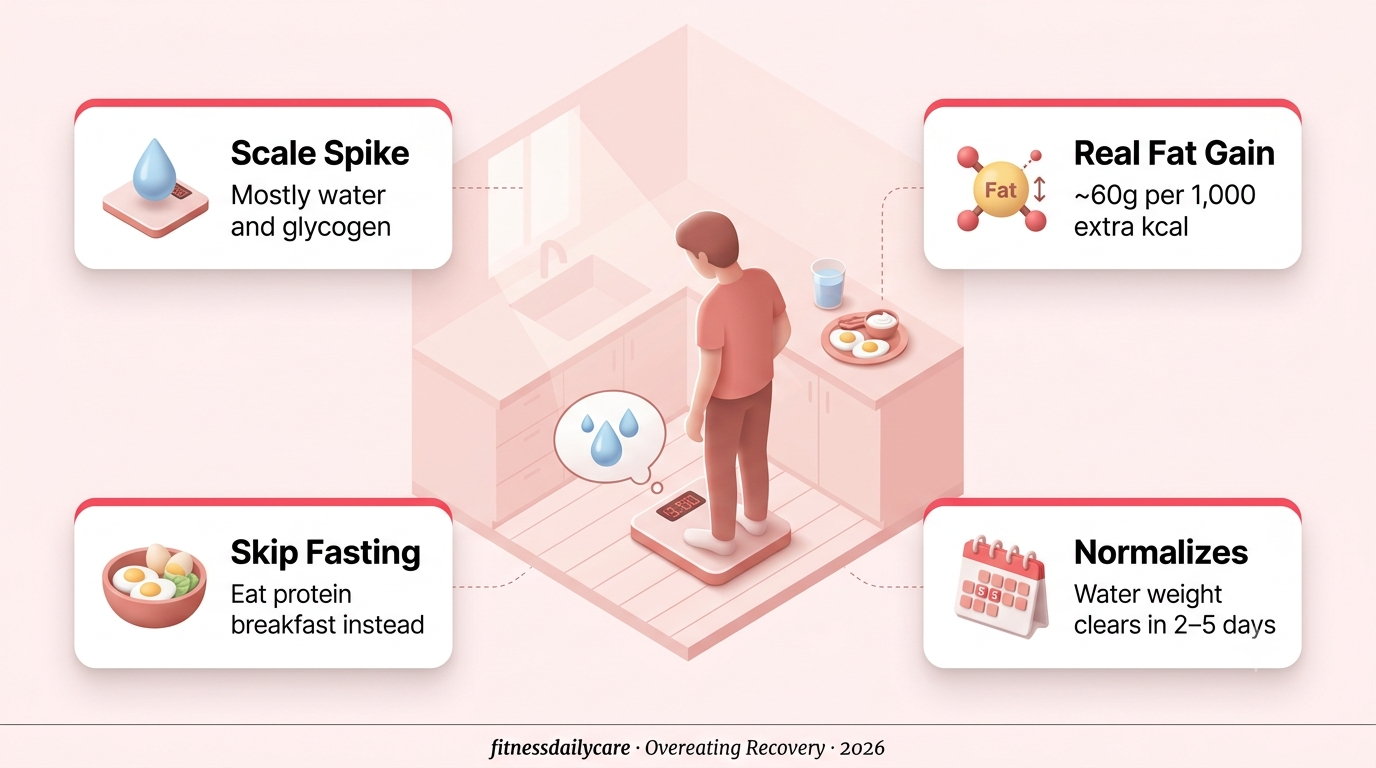
Here’s the reality when you overate last night: the number on the scale tomorrow morning is going to be wrong. Not slightly off — significantly, misleadingly wrong. A 2 to 4 pound overnight jump after a big meal is almost entirely water retention, sodium, glycogen, and undigested food weight. The actual fat you gained from one evening is closer to 60 to 130 grams — not the 2 pounds the scale suggests.
The instinct to compensate — skip breakfast, eat 500 calories tomorrow, punish yourself with a long cardio session — is the one thing most likely to make next week worse. Skipping meals spikes cortisol. Cortisol directs fat storage to the midsection. It also drives hunger to rebound harder, setting up a restrict-then-overeat cycle that research consistently links to worse long-term weight outcomes than simply moving on.
What follows is what the overfeeding research and behavioral science actually show about what happens after you overeat, and exactly what to do — and not do — the next day to get back on track without derailing the broader effort.
When you overate: glycogen fills first, fat storage is small
When you overeat carbohydrates, the body prioritizes storing them as muscle and liver glycogen before converting to fat. Fat storage from a single overeating event is genuinely small — the Acheson et al. study found even 5,000 kcal/day of mostly carbs converted only 110g to fat on day one.
One high-fat overeating day drops insulin sensitivity 28%
A University of Bath study found a single day of high-fat overfeeding (78% above daily requirements) reduced whole-body insulin sensitivity by 28%. This is the real short-term metabolic cost — and it’s why the next day’s food quality matters more than its quantity.
When you overate: the all-or-nothing response is the real diet killer
Research shows that viewing an overeating event as a failure — “I already ruined it, might as well keep going” — leads to extended overeating and poor long-term adherence. The overeating itself doesn’t break the diet. The reaction to it does.
Normal eating for 2–5 days fully normalizes the scale
The Nourish 2014 study found water weight from 3 days of significant overeating normalized within 5 days of returning to normal eating. One event does not require a recovery protocol — it requires returning to routine.
The overeating didn’t break the diet.
The guilt response might.
Don’t skip breakfast — eat protein instead
Most important ruleSkipping breakfast after you overate feels logical — fewer calories in to offset yesterday’s surplus. It isn’t. Skipping meals elevates cortisol, which preferentially drives fat to the midsection and increases hunger later in the day, setting up a repeat overeating event in the evening. The correct move is a normal protein-forward breakfast: 30 to 40g protein, moderate carbs, low fat. Eggs and Greek yogurt. Cottage cheese and fruit. This stabilizes blood sugar, keeps cortisol in check, and kills the afternoon hunger spike before it arrives.
Do not step on the scale today
Protect the mindsetThe scale the morning after you overate will show 2 to 4 pounds more than yesterday. Almost none of that is fat. It’s sodium-driven water retention, glycogen stored from the extra carbohydrates, and the physical weight of undigested food still in the GI tract. That number is not informative. It is misleading, and for most people it triggers the all-or-nothing reaction that makes things significantly worse. Skip the scale today and tomorrow. Weigh yourself again in 3 to 5 days when the water weight has cleared.
Take a 10-minute walk after each meal today
Restore insulin sensitivityAfter you overate — especially if the overeating was high-fat — whole-body insulin sensitivity can drop by up to 28% the following day. A short walk after meals is the fastest way to restore it. Muscle contractions move GLUT4 transporters to the cell surface, clearing blood glucose independently of insulin. Three 10-minute walks today catches each meal’s glucose window and accelerates the metabolic reset without the cortisol spike of a punishing cardio session.
If you overate, eat normally today — not less
The counterintuitive fixEating at normal maintenance (or even a very mild deficit of 200 to 300 kcal) the day after you overate is more effective than aggressive restriction. Extreme restriction triggers adaptive thermogenesis, drops NEAT unconsciously, and spikes the hunger hormones that caused the overeating episode in the first place. The goal is to normalize, not compensate. Your body is remarkably good at self-correcting after a single day’s surplus — if you let it.
Hydrate more than usual today
Flush the sodiumHigh-sodium meals — restaurant food, takeout, processed snacks — are typically what drives the next-morning scale spike. Sodium causes water retention; adequate hydration flushes excess sodium faster and reduces the retention window from 5 days down to 2 to 3. Target around 3 to 3.5 liters of water today (more if you exercise). Sparkling water, herbal tea, and electrolyte-free fluids all count.
The real fat gain was 60 grams.
The scale said 3 pounds.
Don’t fast or do a “cleanse”
The most common mistakeFasting the day after you overate is the most intuitive response and among the most counterproductive. It spikes cortisol (which steers fat to the midsection), drops blood sugar (which triggers cravings for high-calorie foods), and reduces NEAT unconsciously — meaning your body moves less and burns fewer calories without you noticing. “Cleanses” have no clinical basis at all. The liver processes whatever you ate within 24 to 48 hours regardless of what you drink.
Don’t do a brutal workout to “burn it off”
The punishment trapA 2-hour cardio session to compensate for 1,500 extra calories is both ineffective (2 hours of moderate cardio burns roughly 600 to 800 calories, covering less than half the surplus) and physiologically costly. High-intensity punitive workouts spike cortisol, increase muscle damage without adequate recovery, and — crucially — increase post-workout appetite substantially. You end up eating more the rest of the day than the workout burned.
Don’t use it as permission to extend the overeating
The all-or-nothing wall“I already blew it, so I might as well enjoy the rest of the weekend” is the all-or-nothing cognitive trap that research consistently identifies as the primary predictor of poor long-term diet adherence. One overeating event doesn’t require recovery beyond normal eating. Two days becomes three. The damage isn’t the original overeating — it’s the extended surplus that follows when the episode is treated as a reset point rather than a one-off.
- Eat a protein-forward breakfast — 30–40g protein; don’t skip it
- Skip the scale for 3–5 days — the spike is water, not fat; it’s misleading
- Walk 10 minutes after each meal — restores insulin sensitivity, not a punishment
- Eat normally — not less — restriction spikes cortisol and sets up the next overeating event
- Drink 3–3.5 liters of water — flushes sodium and clears water retention faster
⚠️ When to Take Overeating More Seriously
1. If it’s happening 3+ times per week. Regular overeating episodes — especially accompanied by a sense of loss of control — may indicate binge eating disorder. This is a clinical condition, not a willpower problem. A registered dietitian or therapist who specializes in eating behavior is the right resource, not a stricter diet.
2. If the guilt is disproportionate. Some distress after overeating is normal. Significant shame, self-punishment thoughts, or extreme compensatory behavior (prolonged fasting, excessive exercise, laxative use) are warning signs worth discussing with a healthcare professional.
3. If it happens every weekend. A consistent pattern of weekday restriction followed by weekend overeating is a diet structure problem, not a willpower problem. The weekday restriction is too aggressive and the weekend is the inevitable metabolic and psychological rebound.