
Mediterranean Diet for Weight Loss, Why It Keeps Winning Every Year
Nine years at the top of every major diet ranking. 7,447-person PREDIMED trial. 31% diabetes risk drop. The case for the diet that never trends because it never stops working.
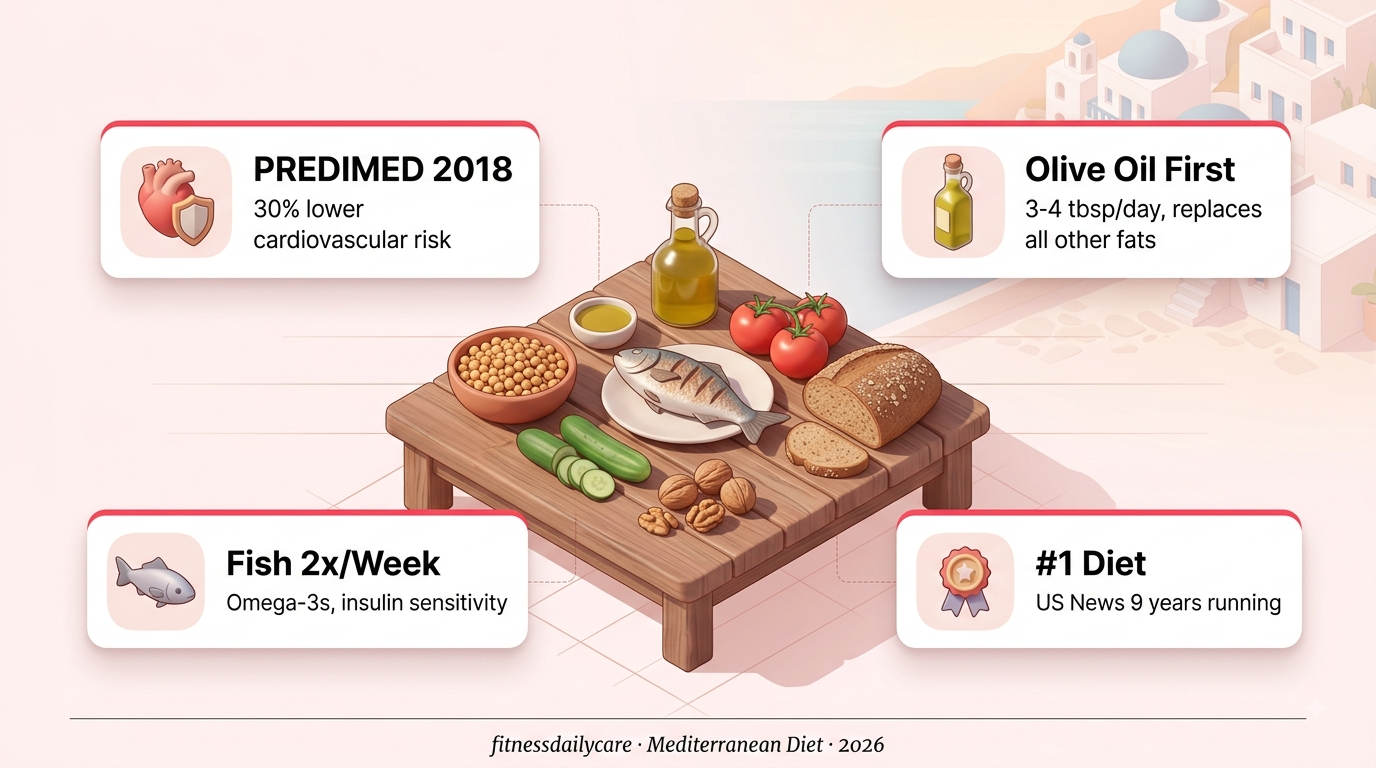
Here’s the reality about the Mediterranean diet: it doesn’t trend on TikTok. There’s no 30-day challenge attached to it, no branded supplement stack, no before-and-after transformation photo format it fits. And that’s exactly why it’s been ranked the #1 diet by US News for nine straight years — it works slowly, durably, and without requiring you to track a single calorie.
The PREDIMED trial — 7,447 participants, randomized controlled design, nearly 5 years of follow-up — found that a Mediterranean diet with extra-virgin olive oil or nuts reduced major cardiovascular events by 30%. PREDIMED-Plus, its follow-up trial of nearly 5,000 people combining the eating pattern with calorie reduction and exercise, cut type 2 diabetes risk by 31%. A 2025 meta-analysis of 26 randomized controlled trials found waist circumference dropped an average of 2.48 cm more in Mediterranean diet groups versus controls.
What follows is what the Mediterranean diet actually is, why it works for weight loss without feeling like a diet, and the practical translation for a US eating context where feta and olive oil aren’t exotic but meal planning still requires some intention.
Mediterranean diet fiber and fat suppress appetite naturally
Olive oil, nuts, fish, legumes, and vegetables are all high in fiber or healthy fat — the two macronutrients most reliably linked to satiety. You eat less naturally without tracking, because the foods physically fill the stomach and slow gastric emptying.
Low glycemic load keeps insulin stable
Whole grains, legumes, and vegetables replace refined carbs. The glycemic load stays low across most meals, which means smaller insulin spikes, less fat-storage signaling, and a metabolic environment more favorable to fat oxidation.
Mediterranean diet: the only pattern people actually stick to
ATTICA cohort study (20 years, 2002–2022): Mediterranean diet adherence was associated with lower BMI trajectories long-term. The pattern works partly because it doesn’t eliminate food groups — wine, cheese, pasta in moderation are all in.
Anti-inflammatory foods change fat biology
Extra-virgin olive oil (oleocanthal), oily fish (omega-3s), and polyphenol-rich vegetables lower systemic inflammation — which is directly linked to visceral fat accumulation, insulin resistance, and cortisol dysregulation.
The best diet is the one
with 7,447 people behind it.
Olive oil is the primary fat — not a garnish
Foundation ingredientExtra-virgin olive oil (EVOO) is the caloric anchor of the Mediterranean diet pattern. The PREDIMED trial provided participants with 1 liter of EVOO per week — roughly 4 tablespoons per day. This sounds like a lot, but it replaces butter, seed oils, and margarine entirely. Oleocanthal in EVOO acts as a natural anti-inflammatory compound; polyphenols support gut microbiome diversity; monounsaturated fats improve LDL particle size.
Fish and seafood twice a week minimum
Protein foundationOily fish — salmon, sardines, mackerel, anchovies, tuna — provide omega-3 fatty acids (EPA and DHA) that reduce systemic inflammation, improve insulin sensitivity, and support lean mass preservation during weight loss. White fish and shellfish fill the remaining days. Red meat drops to a few times per month, processed meat essentially disappears.
Legumes three to four times a week, not as sides
The underrated anchorLentils, chickpeas, cannellini beans, black beans — these are the Mediterranean diet’s protein and fiber dual deliverers. A cup of cooked lentils provides 18g protein and 16g fiber at around 230 calories. The fiber drives satiety hormone release (CCK, PYY), slows gastric emptying, and feeds gut bacteria associated with lower body weight. Legumes also carry a very low glycemic load despite being carbohydrate-rich.
Vegetables at every meal, fruit as dessert
Volume eating without restrictionThe Mediterranean diet is a volume eating pattern by design — large quantities of non-starchy vegetables (tomatoes, peppers, zucchini, leafy greens, artichokes, cucumbers) fill the plate before protein and starch. This drives satiety at lower calorie density. Fruit — seasonal, whole, not juiced — replaces dessert. No foods are banned; the structure naturally crowds out ultra-processed food.
Whole grains and nuts in moderation — not elimination
What makes it sustainableThe Mediterranean diet is not low-carb. Whole grain bread, farro, brown rice, and whole wheat pasta appear regularly in small-to-moderate portions. A small handful of walnuts, almonds, or pistachios (30g, ~170 cal) replaces processed snacks. The nut group in PREDIMED showed the same cardiovascular benefit as the olive oil group — this is the most under-discussed finding in all of dietary science.
It’s not about what you cut.
It’s about what you build around.
Build every lunch and dinner around a vegetable base
The plate structureHalf the plate: non-starchy vegetables (any preparation — roasted, raw, sautéed in EVOO). A quarter: protein (fish, legumes, or chicken). A quarter: whole grain or legume-based starch. A drizzle of EVOO over everything. This isn’t calorie counting — it’s a plate architecture that naturally produces a moderate-calorie, high-satiety meal every time without thinking about macros.
Replace one processed snack with nuts and fruit daily
Smallest sustainable changeIf the full diet overhaul feels overwhelming, start here: swap one daily processed snack (chips, cookies, protein bars with 20 ingredients) for a small handful of walnuts or almonds plus a piece of seasonal fruit. That swap alone replaces an ultra-processed calorie source with omega-3s, fiber, and polyphenols — and it’s the single change with the best adherence data for people building toward the full pattern.
Cook with EVOO exclusively for two weeks
Fat swap firstThe highest-impact single ingredient change is replacing all cooking fats with extra-virgin olive oil. Butter, vegetable oil, coconut oil, margarine — all out. EVOO for sautéing, roasting, dressing, dipping. The flavor profile shifts, the inflammatory fat profile of your diet changes significantly within days, and it’s a change that requires zero calorie counting or meal planning.
Eat with intention, not with a timer
The lifestyle fitThe Mediterranean approach to eating is as much behavioral as nutritional. Meals are meant to be unhurried, social, and eaten at a table — which naturally slows eating speed, reduces total intake, and aligns with the fullness hormone timeline. The culture that produces this diet doesn’t eat at a desk or in a car. The food quality matters; so does how you eat it.
Mediterranean diet with calorie reduction: the PREDIMED-Plus approach
PREDIMED-Plus approachPREDIMED-Plus tested the Mediterranean diet combined with an energy restriction of around 600 kcal/day and physical activity promotion — producing 5–6 kg weight loss at one year in overweight adults with metabolic syndrome. The key insight: get the food quality right first, then reduce portions. Doing it in reverse (restricting first, quality later) produces worse adherence and worse outcomes.
- EVOO as primary fat — replace all other cooking oils, target 3–4 tbsp/day
- Fish or seafood twice weekly — oily fish (salmon, sardines, mackerel) preferred
- Legumes 3–4 times weekly — lentils, chickpeas, cannellini beans as protein anchors
- Vegetables at every meal — half the plate, any preparation
- 30g nuts daily — walnuts, almonds, or pistachios replacing processed snacks
⚠️ What the Mediterranean Diet Isn’t
1. It’s not a weight-loss-speed winner. Keto and VLCD produce faster initial scale drops from water and glycogen loss. The Mediterranean diet produces slower, durable fat loss without the rebound. If you need 10 lbs off in 30 days, this is the wrong tool — it’s the right tool for 10 lbs off and keeping them off.
2. It’s not permission to eat unlimited bread and pasta. Whole grain portions are modest (a quarter of the plate). Refined pasta, white bread, and pizza are fringe, not foundation. The carbs in this pattern come primarily from legumes and vegetables, not grain-based starches.
3. It’s not one specific cuisine. “Mediterranean” covers Spain, Italy, Greece, Turkey, Lebanon, and Morocco — cuisines that differ dramatically. The shared principles are olive oil, fish, legumes, vegetables, nuts, and moderate whole grains — not a particular set of recipes.