
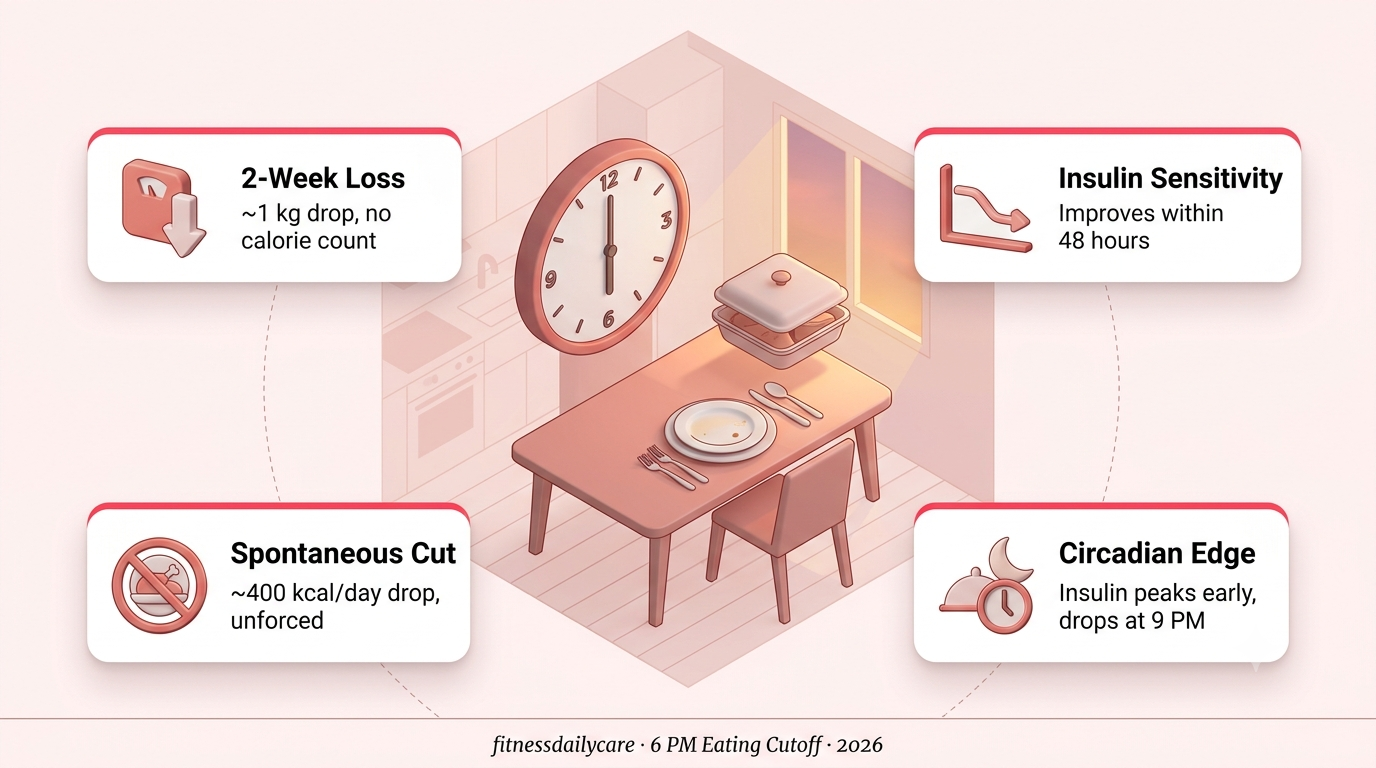
6 PM Eating Cutoff, What 2 Weeks Actually Does to Your Body
The most-studied evening cutoff in nutrition research. Insulin sensitivity, fat loss, and roughly a pound down without touching what’s on your plate.
Here’s the reality about a 6 PM eating cutoff: it’s one of the most-studied meal-timing interventions in nutrition science over the past decade. Researchers call it early time-restricted eating — eTRE for short — and the trials keep finding the same thing. Compress the eating window earlier, and the body responds fast. Weight, insulin sensitivity, blood pressure, glycemic variation. All move in the right direction within days.
The 6 PM cutoff itself isn’t magic. What matters is that most people naturally eat within a 10-hour window (8 AM to 6 PM) once they draw the line, and that window ends before the body’s insulin sensitivity drops sharply in the evening. That’s when your muscles, liver, and fat cells stop responding well to what you eat. Melatonin starts rising around 9 PM. Insulin secretion gets suppressed. Every gram of carbohydrate you eat after 8 PM lands on a different metabolic playing field than the same gram at noon.
What follows is what the peer-reviewed research from Cell Metabolism, Nutrients, and controlled inpatient trials actually shows about a 6 PM cutoff, what to expect at 2 weeks, and how to make it stick without turning dinner into a spreadsheet.
2-week eTRF trial: −1 kg, no calorie count
Jones et al. 2020 (n = 16 healthy men) found 2 weeks of an 8 AM–4 PM window produced ~1 kg loss and ~400 kcal/day spontaneous reduction, with improved whole-body insulin sensitivity independent of weight change.
Circadian insulin sensitivity peaks early
Muscle, liver, and adipose tissue have intrinsic circadian clocks. Insulin sensitivity is highest in the morning and drops sharply after evening melatonin rise (~9 PM). Same carbs, worse metabolic response late.
Glycemic variation drops within 48 hours
ScienceDirect 2024 found glucose time-in-range improves within 2 days of starting eTRE, driven by lower postprandial glucose spikes. The metabolic response is faster than most people expect.
A 10-hour window makes the 6 PM eating cutoff stick
Strict 6- and 8-hour windows work in trials but drop compliance in real life. A 6 PM cutoff with an 8 AM start = 10 hours of eating, which most studies find sustainable for months at a time.
Draw the line at 6 PM.
The body does the rest.
Spontaneous calorie reduction, no counting required
The main leverAcross the eTRE literature, the most consistent finding is a ~300 to 500 kcal/day spontaneous reduction without any calorie prescription. People simply stop eating that second helping, the after-dinner ice cream, and the late-night snack — because those foods usually land after the cutoff. The eating window closes; the calorie cut takes care of itself.
Insulin sensitivity improves within days
The metabolic effectSutton et al. 2018 (Cell Metabolism) — one of the landmark eTRE papers — found improved insulin sensitivity and pancreatic β-cell responsiveness in prediabetic men after 5 weeks, even at maintenance weight. Jones et al. 2020 found whole-body insulin sensitivity improvement within 2 weeks. The muscle-glucose uptake data suggests the change starts within the first few days.
Glycemic variation flattens within 48 hours
Fastest visible changeScienceDirect 2024 continuous glucose monitor (CGM) data showed glucose time-in-range improving within 48 hours of starting eTRE, driven by lower postprandial glucose spikes and less overnight hyperglycemia. If you wear a CGM (Dexcom, FreeStyle Libre, Nutrisense), the change is often visible on day 2.
Sleep improves alongside evening fasting
Downstream benefitLate eating pushes back cortisol and body temperature curves, disrupts melatonin timing, and drives nighttime reflux. Cutting food at 6 PM lets those signals align. Multiple eTRE trials report improved subjective sleep quality and reduced sleep onset time within the first two weeks. Better sleep, in turn, lowers next-day hunger — the loop runs in the right direction.
Fat loss preserves muscle when protein stays high
The recomp angleThe 2025 Nutrients RCT found eTRE produced significantly more weight loss than a delayed window or control — without any reduction in triceps muscle thickness or push-up endurance. That means the loss was primarily fat, not muscle. This is the pattern you want for body recomposition: the scale moves, but the muscle stays.
Move dinner earlier to hit the 6 PM eating cutoff
The core shiftThe most common eTRE mistake is treating the cutoff as “no dinner.” It’s not — it’s earlier dinner. Aim to sit down at 5:00 or 5:30 PM, finish by 6, and stop. This gives you a proper meal, satisfies the social ritual, and hits the metabolic sweet spot before evening insulin sensitivity drops.
Front-load protein and calories earlier in the day
Anti-hunger structureThe biggest failure mode is arriving at 8 PM ravenous and torching the whole plan. The fix is upstream: protein-forward breakfast (30–40g), a substantial lunch, and a real dinner at 5:30. Nutrient timing that front-loads protein and complex carbs kills late-evening cravings before they arrive.
Zero-calorie fluids after the 6 PM eating cutoff
Adherence hackWater, sparkling water, black coffee, unsweetened tea, herbal tea. All fine after the cutoff and none of them break the fast in any metabolic sense. Peppermint or chamomile tea in particular reduce the psychological pull toward evening snacking. A can of LaCroix or a hot mug of tea while others eat dessert is often enough.
Start with 5 days a week, not 7
Sustainability firstThe single biggest predictor of long-term eTRE success is flexibility for social meals. Restaurant dinners with friends, family birthdays, work events — trying to hold a strict 6 PM cutoff through all of it kills adherence in weeks. A 5-of-7 or Monday-through-Friday version captures most of the metabolic benefit while leaving room for real life.
Track sleep and morning weight, not evening scale
Data that mattersThe two most useful metrics for tracking an eTRE cutoff are morning fasted weight (same time, same conditions) and sleep quality (subjective or via a wearable). Evening weight swings 3–5 pounds with dinner alone and tells you nothing. Morning weight over 2–3 weeks shows the real trend. Better sleep tells you the timing is working systemically.
Same calories, same food.
The clock does the work.
- Last bite by 6 PM — earlier dinner (5:00 to 5:30 PM), finished by cutoff
- Protein-forward breakfast (30–40g) — kills late-evening cravings before they start
- Zero-calorie fluids only after cutoff — water, sparkling water, herbal tea
- 5 days a week, not 7 — leaves room for social meals, protects long-term adherence
- Track morning weight and sleep — the two metrics that actually show the trend
⚠️ Where eTRE Is Not the Right Tool
1. Not for people with active or recent eating disorders. Any window-based eating pattern can trigger restrictive spirals in vulnerable populations. Talk to a registered dietitian before starting if this applies.
2. Not for pregnant or breastfeeding women. Compressed eating windows haven’t been studied enough in these populations. Standard evenly-distributed eating remains the recommendation.
3. Type 1 diabetes and insulin-dependent conditions require medical supervision before any meal-timing change. Coordinate with your endocrinologist first — insulin dosing will need adjustment.