
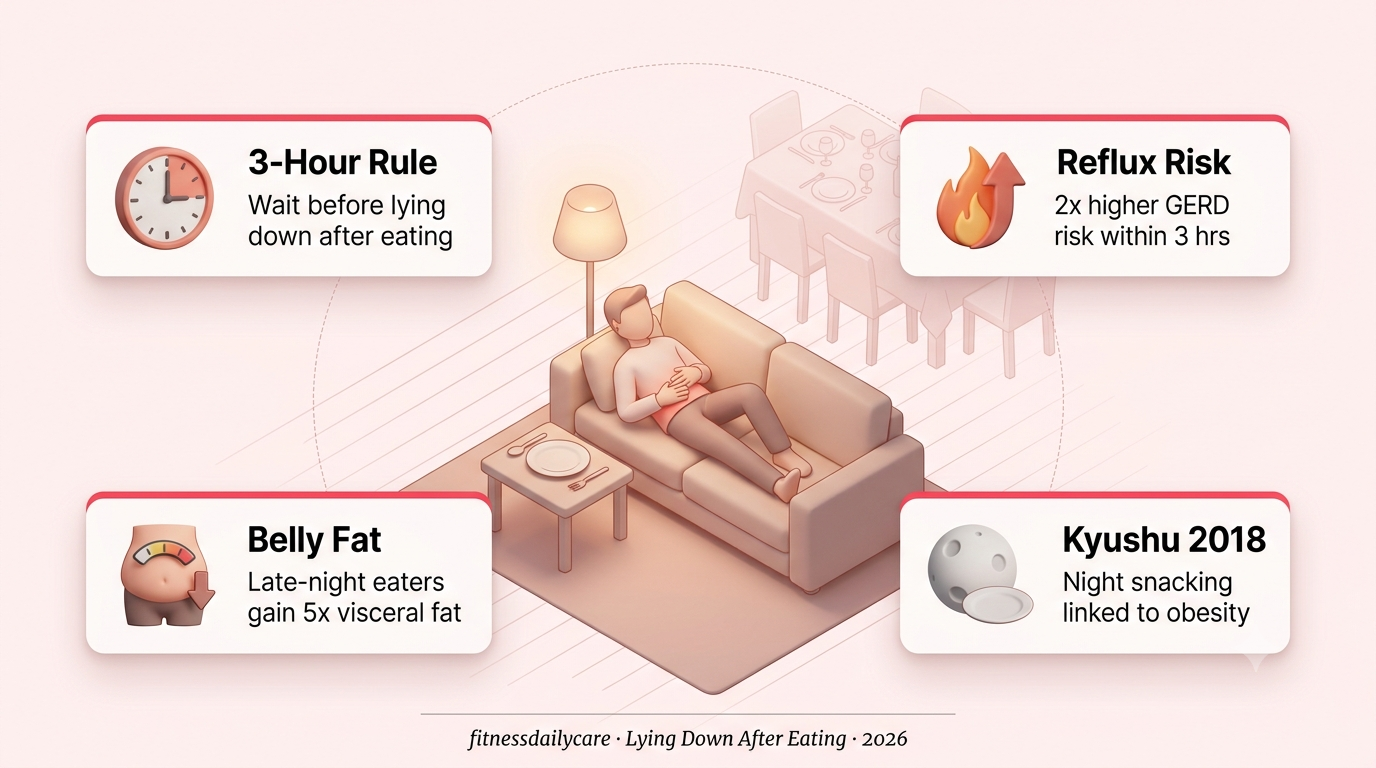
Lying Down After Eating, What It Actually Does to Your Belly Fat
The 3-hour rule, why gravity matters more than you think, and what late-night dinners do to your metabolism.
Here’s the reality about lying down after eating: the couch after dinner feels like recovery. It’s not. From a metabolic and gastroesophageal standpoint, it’s the worst 30 minutes you can spend that day. The problem isn’t just heartburn — it’s what gravity, hormone timing, and evening circadian biology do to every calorie you just ate.
The three-hour rule from clinical gastroenterology exists because it takes roughly that long for the stomach to empty most solid meals into the small intestine. Lie down inside that window and stomach contents press against the lower esophageal sphincter (LES). Acid reflux spikes. Sleep gets fragmented. Ghrelin rises the next day. Insulin sensitivity dips. It’s a chain reaction — and it ends at your waistline.
What follows is what the research from Cell Metabolism, PNAS, BMJ Open, and clinical gastroenterology guidelines actually shows about lying down after eating, and how to structure evenings so gravity is on your side instead of against you.
Why lying down after eating breaks the 3-hour rule
Clinical gastroenterology guidelines set 3 hours because that’s the average time your stomach needs to empty a mixed meal into the small intestine. Reclining before that overwhelms the lower esophageal sphincter.
Evening metabolism runs slower
Cell Metabolism (2022, Vujović et al.) found late meals decreased 24-hour energy expenditure, increased hunger, and altered adipogenesis (fat-cell formation) pathways versus identical earlier meals.
Where lying down after eating sends the calories
Late-night eating patterns show consistent associations with dyslipidemia, increased visceral adiposity, and metabolic syndrome across observational studies. The scale weight may look normal while belly composition shifts.
Reflux, sleep, and next-day hunger
Nighttime reflux fragments sleep. Fragmented sleep raises ghrelin and lowers leptin, driving higher calorie intake the following day — a self-reinforcing loop many people miss entirely.
The couch after dinner feels like recovery.
Your gut disagrees.
Lying down after eating hijacks your LES
The mechanismStanding or sitting, gravity keeps stomach acid where it belongs. Reclining removes that assist. The lower esophageal sphincter (LES) — the one-way valve between stomach and esophagus — has to hold pressure on its own, and it often loses. Result: acid backwash into the esophagus, the burning sensation you know as heartburn, and over time, chronic GERD risk.
Evening thermic effect drops meaningfully
The dataDiet-induced thermogenesis — the calories your body burns processing food — is roughly 10% lower in the evening than in the morning (Bo et al., 2015; Morris et al., 2015). Same meal, fewer calories burned digesting it. A 700-calorie dinner effectively costs your body more net calories than a 700-calorie breakfast would. Lying down amplifies this by further slowing gastric motility.
Adipogenesis pathways switch on
Under-the-radarThe Vujović et al. Cell Metabolism 2022 study — one of the strongest human trials on meal timing — used isocaloric (calorie-matched) meals to isolate timing alone. Late eating upregulated adipose tissue gene expression favoring lipid storage over lipid breakdown. Translation: your fat cells were more receptive to storing what you ate late than what you ate earlier. Same calories in. Different biology out.
Sleep fragmentation drives next-day hunger
The downstream costNighttime reflux is a top-three cause of fragmented sleep in adults. Fragmented sleep, in turn, raises ghrelin (hunger hormone) and lowers leptin (satiety hormone) the following day. Studies consistently show poorly rested adults eat roughly 300–400 extra calories the day after disrupted sleep — usually skewed toward high-calorie, hyper-palatable foods. The single dinner-then-couch decision echoes 24 hours forward.
Kyushu 5-year data lines up with the mechanism
Population evidenceThe Kyushu University BMJ Open study of 59,717 adults tracked several evening eating behaviors alongside body weight over 5 years. Eating within 2 hours of sleep — the closest population-level proxy for lying down after eating — was independently associated with higher BMI and waist circumference, even after adjusting for total calorie intake, exercise, and eating speed.
Take a 10-minute post-dinner walk
Highest-leverage habitEven a slow, easy walk right after dinner accelerates gastric emptying, blunts the post-meal blood glucose spike (multiple studies show a ~12–22% reduction), and creates upright time when your stomach needs it most. You don’t need cardio zones or step counts. Just around the block.
Move dinner earlier, not smaller
Timing beats sizeIf your dinner is at 9 PM and you’re in bed by 10:30, the fix isn’t skipping food. It’s shifting the meal to 6:30 or 7. That single change buys you 2.5+ upright hours without touching calories or macros. For most people this alone accounts for meaningful body composition improvement over months.
Elevate the head of your bed 6 to 8 inches
If late meals are unavoidableGastroenterology guidelines consistently recommend a 6-to-8-inch bed elevation for anyone with reflux tendencies who eats within 3 hours of sleep. Use bed risers under the headboard legs, not stacked pillows — pillows only elevate the head and neck, which can actually worsen the acid trajectory. Full-body angle is what matters.
Cap your meal size at “comfortably 80%”
Volume mattersLarge meals distend the stomach and delay gastric emptying by 30 minutes or more. The Japanese concept of hara hachi bu — eat until you’re 80% full — isn’t spiritual advice; it’s practical stomach mechanics. Smaller meals clear faster, reflux less, and are easier to walk off. This pairs with the eating-speed data: slower eating naturally caps intake around this zone.
Trade the couch for kitchen cleanup
Habit stackingThe behavioral trap isn’t just lying down — it’s the sequence “sit down with plate → finish plate → recline in same spot.” Getting up to clear dishes, load the dishwasher, or wipe counters buys you 15 to 20 minutes of upright, low-intensity movement without any mental effort. It also breaks the visual cue linking “dinner” with “immediate couch.”
Same calories, different clock.
Different biology.
- Stay upright 3 hours after your last meal before lying down — the clinical gastroenterology consensus
- 10-minute walk in the first 15 minutes post-dinner — blunts glucose spike 12–22%
- Move dinner earlier if possible — 6:30 to 7 PM beats 9 PM for the same portion
- Elevate bed 6–8 inches at the head with risers if late meals are unavoidable
- Stop at 80% full — smaller stomach volume clears faster and refluxes less
⚠️ Where This Advice Has Limits
1. Post-meal walks aren’t a calorie-burning strategy. A 10-minute walk burns roughly 30–40 calories. The value is glucose control and gastric emptying, not the burn. Don’t skip strength training thinking the walk covers it.
2. Sitting upright is not the same as walking. Sitting on the couch upright helps with reflux but does little for glucose or gastric motility. Actual movement is the differentiator.
3. If you have persistent GERD, chest pain, or trouble swallowing, see a gastroenterologist. Lifestyle changes help typical mild reflux, but ongoing symptoms need a professional workup — not a blog article.