
Fatty Liver Diet,
The Foods That Actually Reverse MASLD
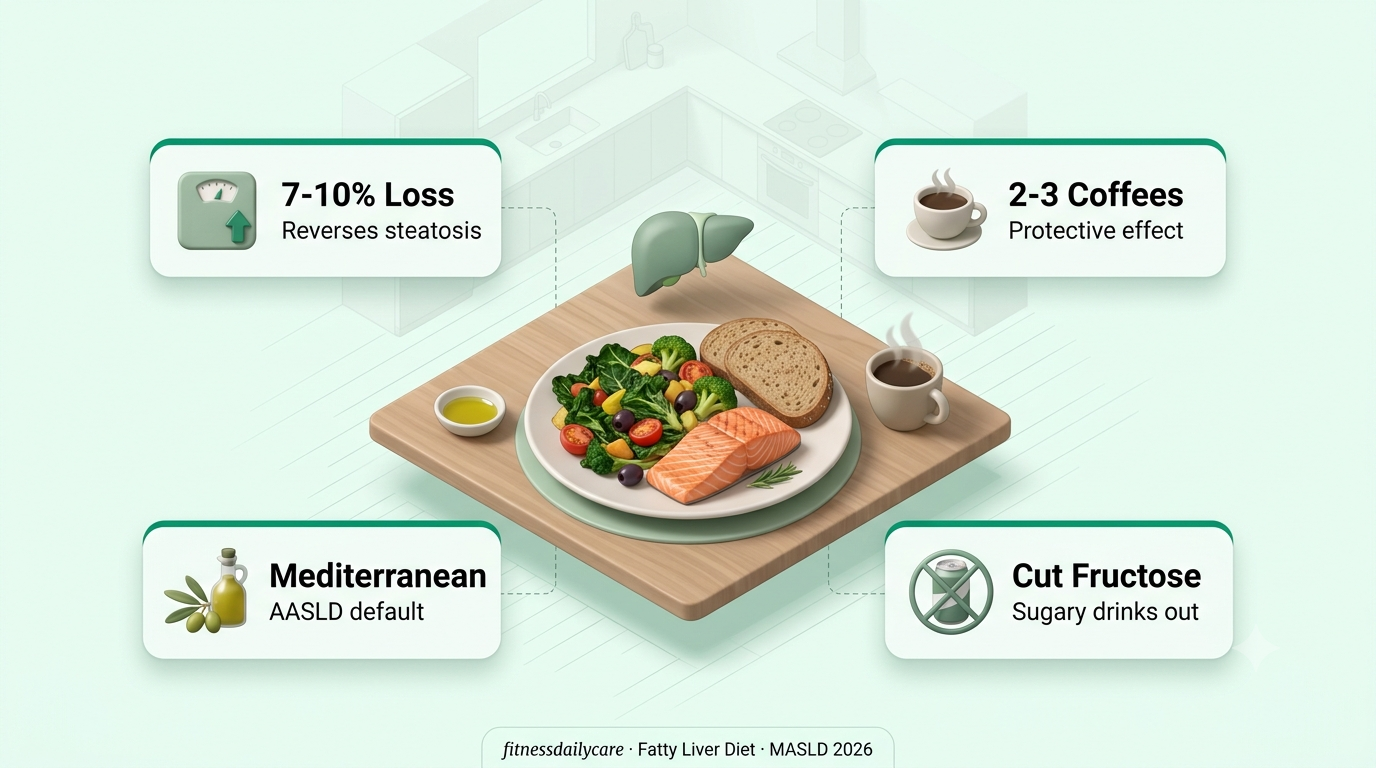
The condition was renamed from NAFLD to MASLD in 2023. The playbook that actually shrinks liver fat — 7–10% weight loss, Mediterranean pattern, 2–3 daily coffees, no fructose — hasn’t changed.
The disease got a new name in 2023, and it wasn’t cosmetic. AASLD, EASL, and ALEH — the three major liver societies — replaced “non-alcoholic fatty liver disease” (NAFLD) with MASLD: metabolic dysfunction-associated steatotic liver disease. The change reflects what hepatologists had been saying for a decade: this isn’t a disease defined by what you’re not drinking. It’s a metabolic disease driven by insulin resistance, sugar, and refined carbs — with a liver-shaped output.
Roughly 30% of US adults now have MASLD. The dietary playbook to reverse it is unusually well-agreed: modest weight loss (7–10% of body weight), a Mediterranean-style base, cutting fructose and sugary drinks, and — surprisingly — 2 to 3 cups of coffee a day. In March 2024, the FDA approved Rezdiffra (resmetirom), the first ever drug for MASH (formerly NASH), but even that label reads “as an adjunct to diet and exercise.”
Diet is still first-line. Here’s what actually reverses liver fat, based on AASLD 2023 practice guidance, the AGA lifestyle expert review, and recent MASLD-specific meta-analyses.
MASLD ≠ NAFLD is a renaming, not a new disease
The 2023 nomenclature adds a metabolic risk factor requirement (obesity, T2D, hypertension, or dyslipidemia) and drops the “non-alcoholic” framing.
Fructose & refined carbs, not fat
De novo lipogenesis in the liver converts excess sugar into stored fat. This is why sodas and juice hit harder than butter and eggs.
Mediterranean is the default
AASLD and EASL both cite Mediterranean-style eating as the strongest evidence base among named dietary patterns for MASLD.
Yes, it’s reversible in the fatty stage
Steatosis is fully reversible. Even MASH improves with weight loss. Only fibrosis and cirrhosis have progressively less room to walk back.
Build the plate on a Mediterranean base
FOUNDATIONOlive oil, leafy greens, tomatoes, legumes, whole grains, nuts, fatty fish, moderate poultry, very little red meat, minimal added sugar. Recent RCTs and meta-analyses — including a 2025 BMC Medicine paper combining Mediterranean diet with exercise — show meaningful reductions in liver fat and enzymes (ALT/AST) versus control diets. It’s the pattern with the largest MASLD-specific evidence base and is the AASLD default recommendation.
Cut sugar-sweetened drinks and juice — completely
BIGGEST LEVERFructose is the single most efficient dietary trigger of hepatic fat storage. Soda, sweetened iced coffee, sports drinks, energy drinks, and even 100% fruit juice all deliver fructose in a concentrated dose the liver has to convert. NIH research shows fructose damages the intestinal barrier and drives inflammation that accelerates liver fat accumulation. Whole fruit is fine — the fiber slows delivery. Liquid sugar is where the harm concentrates.
Drink 2–3 cups of coffee a day
SURPRISING WINMeta-analyses of 11+ epidemiological studies show that coffee drinkers have a lower risk of MASLD, MASH, and liver fibrosis in a dose-dependent way — with the biggest protection around 2–3 cups daily. The mechanism appears to be chlorogenic acids and other polyphenols reducing oxidative stress. This is one of the few pieces of dietary advice that comes with a “keep doing it” recommendation.
Aim for a 7–10% body weight loss
BIG DIALThis is where MASLD diverges from other diet articles. For fatty liver, weight loss magnitude is the strongest single predictor of reversal. AGA guidance is clear: 3–5% shrinks liver fat, 7% improves MASH inflammation, and 10%+ can regress fibrosis. For a 200 lb (91 kg) adult, that’s roughly 14 to 20 lbs (6.4 to 9 kg). Not fast. Not extreme. Just consistent.
Add fatty fish and omega-3s twice a week
STACKSalmon, sardines, mackerel, and herring supply EPA and DHA, which lower hepatic triglyceride content in randomized trials. This isn’t a stand-alone treatment — it’s a supporting layer that stacks on top of the Mediterranean base. If you don’t eat fish, an omega-3 supplement (algal or fish oil, ~1–2 g EPA+DHA daily) is a reasonable substitute, though whole fish is preferred.
Fatty liver is metabolic, not moral.
Fixable, if you catch it early.
- Base pattern — Mediterranean: olive oil, greens, legumes, whole grains, nuts, fish
- Fluids — water, sparkling water, unsweetened tea, and 2–3 cups of filter coffee
- Cut cold — soda, sweetened juice, sports drinks, energy drinks, sweetened yogurt
- Weight target — 7–10% body weight loss at 0.5–1 lb/week
- Movement — 150+ min/week moderate aerobic + 2 sessions resistance training
⚠️ WHEN DIET ISN’T THE WHOLE ANSWER
1. MASH with moderate-to-advanced fibrosis (F2–F3). Rezdiffra (resmetirom) was FDA-approved in March 2024 for this specific stage, always alongside diet and exercise. This is a hepatologist conversation, not a DIY fix.
2. Type 2 diabetes and MASLD together. GLP-1 medications (semaglutide, tirzepatide) show meaningful liver fat reduction and are increasingly used in this overlap population. Ask your prescriber.
3. Alcohol on top of MASLD. Even “moderate” drinking accelerates progression once MASLD is established. AASLD guidance is to minimize or eliminate.