
Will Lifting Make You Bulky? The 15x
Testosterone Answer
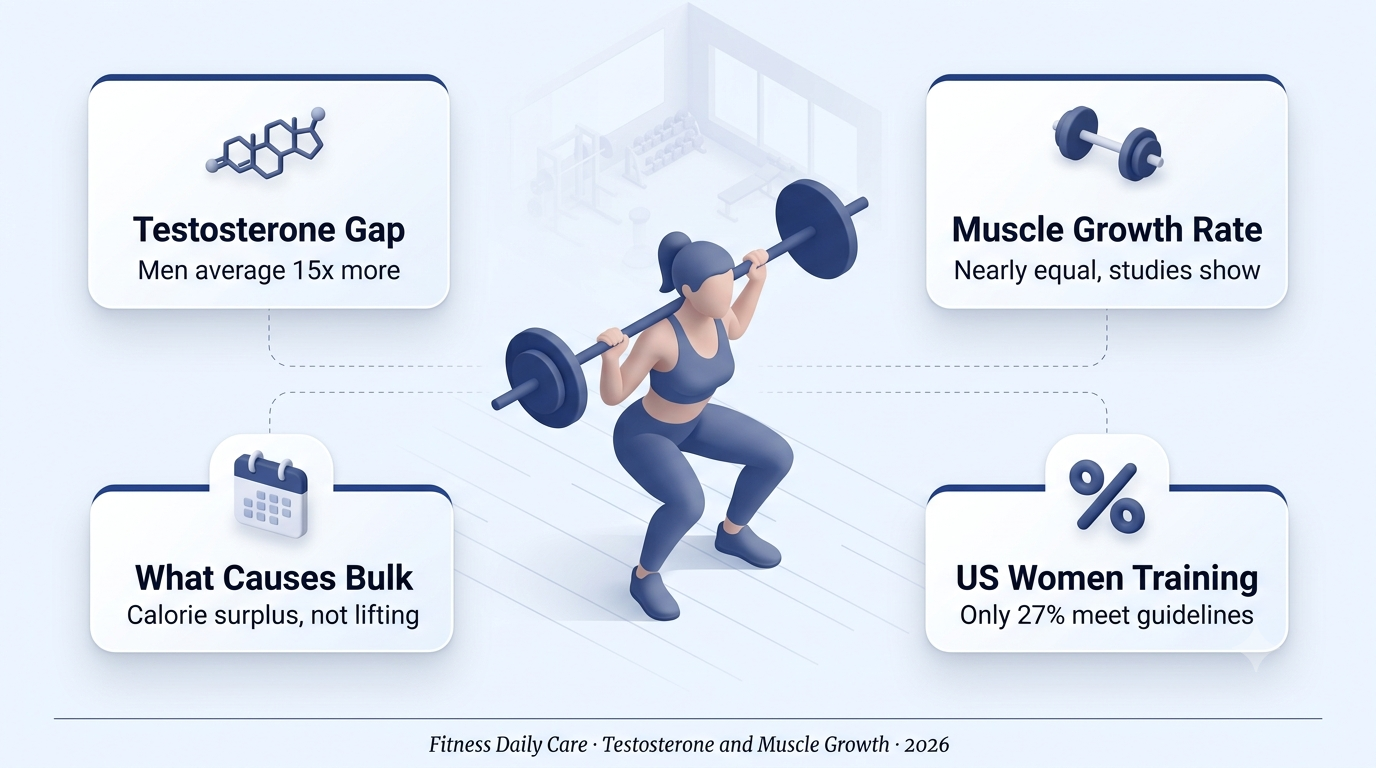
Men average about 15 times more testosterone than women. Here’s why that gap barely changes what happens when you lift.
Will lifting make you bulky? I hear this question from almost every woman who’s new to the weight room, and it usually comes with a real number attached: men have somewhere around 15 times more testosterone. That’s not a myth. It’s one of the largest hormonal differences between two groups of otherwise similar humans.
Here’s what surprised me when I actually read the training research instead of guessing. A study out of Spain’s ICNS research group tracked men and women through the same resistance program and found their relative gains in strength and muscle mass were essentially the same. Not identical in every single case, but close enough that testosterone alone can’t explain who gets “bulky” and who doesn’t.
So what actually decides the outcome? Training age, calorie surplus, genetics, and years under the bar — not the number on a hormone panel. This article walks through the real testosterone numbers, what the muscle-growth research actually shows, and why “getting bulky” from a normal lifting program almost never happens by accident.
Why The 15x Gap Exists
Testes produce far more testosterone than ovaries and adrenal glands combined. This drives men’s higher baseline muscle mass and bone density from puberty onward.
Muscle Growth Rate Is Nearly Equal
The honest answer to will lifting make you bulky: resistance-training studies find similar relative increases in strength and lean mass between men and women, despite the massive hormone gap.
What Actually Builds Muscle
Progressive overload, adequate protein, and a calorie surplus — the same three drivers for everyone, regardless of testosterone level.
Where Women Have An Edge
Higher Type I fiber percentage and faster recovery between sets can support more total training volume over a week.
How Big Is The Testosterone Gap, Really
The NumbersAdult men typically sit in the 300–900 ng/dL range for total testosterone, while adult women typically sit in the 15–70 ng/dL range. Averaged across large studies, that works out to men carrying roughly 15 times more circulating testosterone than women — some reviews put the multiple as high as 20x depending on the age group and lab method used.
That’s genuinely one of the biggest physiological differences between any two groups in human biology. It’s also why men, on average, enter adulthood with more baseline muscle mass, denser bones, and a body composition that makes visible muscle easier to build on top of.
What The Muscle-Growth Research Actually Shows
The StudiesMultiple resistance-training studies have put men and women through identical programs and measured the results. The consistent finding: relative gains in strength and lean mass track closely between the sexes. Men typically add more absolute pounds of muscle because they start with a larger frame, but the percentage increase from baseline is remarkably similar.
Researchers have also found that basal testosterone correlates with muscle mass in men, but that same relationship doesn’t hold nearly as strongly in women — meaning a woman’s natural testosterone level isn’t a reliable predictor of how much muscle she can build from training.
So Will Lifting Make You Bulky, Or Is Something Else To Blame
The Real CauseWhen it happens, it’s almost never an accident. Visible size comes from a sustained calorie surplus stacked on top of years of progressive training — usually a deliberate bodybuilding-style approach with high volume and a specific bulking phase. Genetics also plays a real role in how much muscle any individual, male or female, can carry.
For the vast majority of women lifting two to four times a week with a normal diet, that combination simply isn’t present. What actually shows up first is strength, tighter body composition, and better bone density — not size.
Where Women’s Physiology Works In Their Favor
The AdvantageWomen tend to carry a higher percentage of fatigue-resistant Type I muscle fibers, which supports faster recovery between sets and sessions. Some research also points to a more favorable growth hormone response around resistance training in women, and estrogen appears to have a protective, anti-catabolic effect on muscle tissue.
None of this means women should train identically to men in every detail — but it does mean the testosterone gap isn’t the deciding factor most people assume it is.
Testosterone explains the gap on paper.
Training explains the results in the mirror.
- Train with progressive overload — add weight or reps gradually over weeks, not every session
- Eat at maintenance or a small deficit — visible size requires a real calorie surplus, not just heavy lifting
- Track strength, not the scale — body recomposition often shows up as tighter clothes before the number moves
- Lift in the 6–12 rep range for most compound lifts — squats, deadlifts, presses, rows
- Give it 8–12 weeks before judging results — visible change from strength training takes longer than most people expect
⚠️ Two Things Worth Knowing
1. PCOS changes the picture. Women with polycystic ovary syndrome can have naturally elevated testosterone (often in the 35–50 ng/dL range or higher), which is still far below male levels but worth discussing with a doctor if muscle changes feel unusually fast.
2. Anabolic steroids are a different conversation. Everything above describes natural testosterone levels. Exogenous hormones at male-range doses produce very different, well-documented effects and carry real health risks.
The barbell doesn’t know your hormone panel.
It only knows how consistently you show up.