
Exercise for Weight Loss Just Hit #3,
for a Reason Nobody Expected
ACSM renamed the trend to Exercise for Weight Management in 2026. Here’s what actually changed, and why it matters if you’re on a GLP-1 medication.
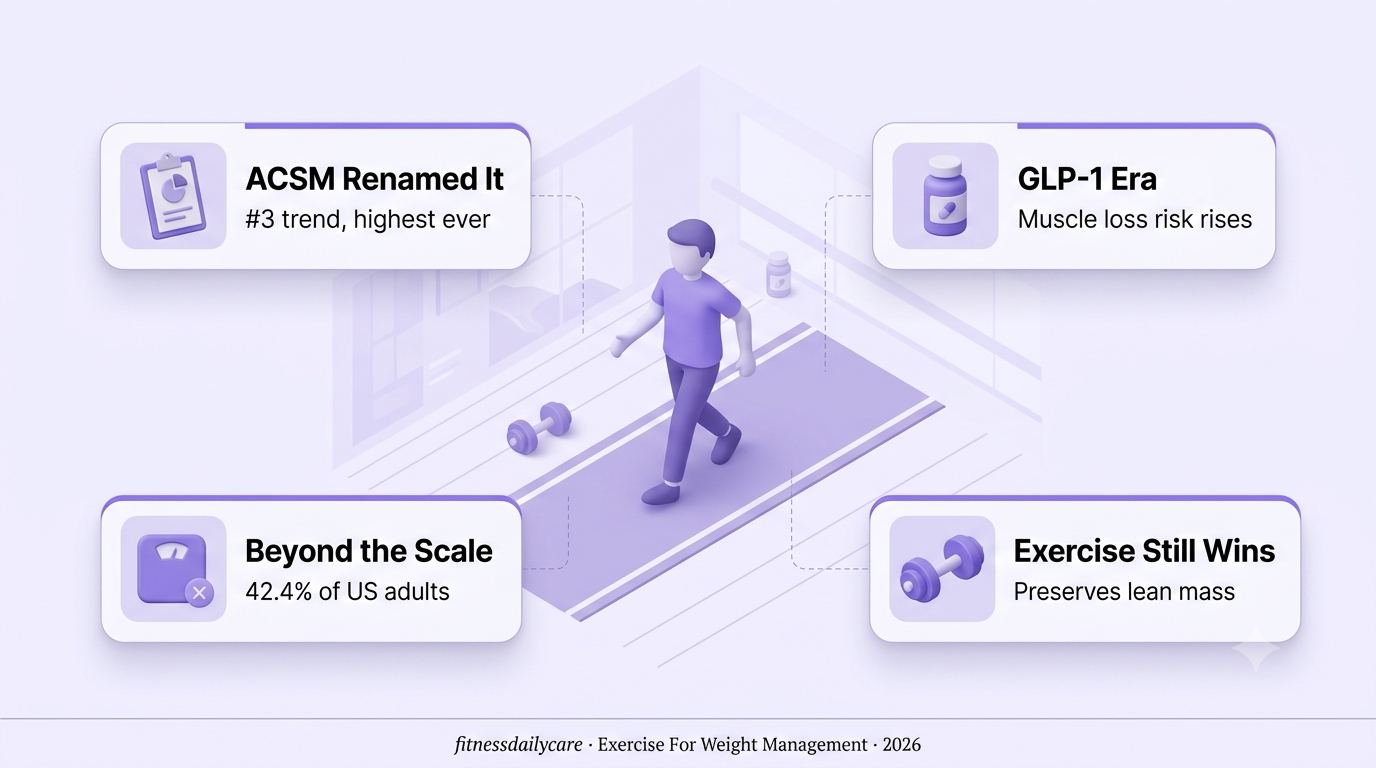
The fitness industry just quietly rewrote one of its oldest goals. For twenty years, the American College of Sports Medicine has published its Worldwide Fitness Trends survey, and for most of that time, “Exercise for Weight Loss” sat somewhere in the middle of the pack. In the 2026 edition, that category doesn’t exist anymore under that name. It’s now called Exercise for Weight Management, and it climbed to #3, its highest rank in the survey’s history.
The renaming isn’t just a branding exercise. It reflects a real shift in how exercise professionals think about body weight, one that’s been accelerated by the rise of GLP-1 medications like Ozempic, Wegovy, and Zepbound. Nearly half of US adults with obesity are now actively trying to manage their weight, and a growing share of them are doing it with a prescription in one hand and a gym membership in the other.
What this means in practice is simple, but it’s not what most people expect. Exercise isn’t being pushed aside as medications become more common. It’s being repositioned as the thing that determines whether the results from those medications actually stick, especially when it comes to keeping the muscle you have while the number on the scale goes down.
Why was it renamed?
To reflect a broader range of goals: weight loss, weight maintenance, and healthy weight gain, not just losing pounds.
How high did it rank?
#3 in 2026, its highest position ever, up from #4 in both 2024 and 2025, and #8 back in 2023.
What changed the equation?
Exercise for weight management now directly intersects with obesity medications like GLP-1 receptor agonists.
Why exercise still matters?
People who keep exercising during pharmacologic treatment preserve more lean mass after stopping medication than those on medication alone.
Stop measuring success only in pounds lost
Mindset shiftThe old framing treated the scale as the scoreboard. The new one treats strength, mobility, and function as equally important measures. ACSM’s own guidance points exercise professionals toward simple testing batteries, not just body weight, to track whether a program is working.
Don’t drop exercise for weight loss once you start a GLP-1 medication
Muscle preservationResearch cited in ACSM’s 2026 report found that people who continue exercising during pharmacologic treatment maintain greater fat loss and preserve more lean mass after stopping medication than people using medication alone. Skipping the gym while on a GLP-1 drug isn’t a shortcut, it just changes what kind of weight you’re losing.
Build a 12-week block instead of chasing a number
StructureInstead of an open-ended goal to “lose weight,” set a defined 12-week block that combines strength training, conditioning, sleep, and behavior. This is the format most exercise professionals are shifting toward, because it treats weight management as a system with several moving parts, not a single number to burn away.
It’s not about losing weight anymore.
It’s about keeping what matters when you do.
- Test function, not just weight — track a strength or mobility number alongside the scale, every 4 weeks
- Keep resistance training on GLP-1 — 2 sessions a week protects lean mass better than cardio alone
- Work in 12-week blocks — combine strength, conditioning, sleep, and behavior instead of one long open-ended goal
- Talk to a specialist first — before starting or stopping any weight-management medication
- Reassess quarterly — a simple testing battery tells you more than a daily weigh-in
⚠️ What This Rename Doesn’t Change
1. A calorie deficit is still required for fat loss. Renaming the trend doesn’t remove basic energy balance from the equation, it just widens the definition of success beyond fat loss alone.
2. Exercise isn’t a replacement for medical treatment. For significant obesity, exercise is described as a component of treatment, not a stand-alone substitute for medication or medical guidance.
3. Skipping strength work on a GLP-1 drug raises your risk. Without resistance training, a larger share of the weight lost tends to come from muscle rather than fat.
Exercise doesn’t compete with GLP-1.
It’s what makes the results last.