
That Lump in Your Throat Isn’t Anxiety,
It Might Be Silent GERD
Laryngopharyngeal reflux causes no heartburn in most cases. Globus sensation, chronic cough, morning hoarseness — 5 signs your throat is sending that get missed for years.
You wake up with a slightly raspy voice. You clear your throat every morning. Something feels like it’s permanently lodged just above your collarbone. You’ve Googled it, decided it’s probably anxiety, and moved on. Months later it’s still there — maybe worse — and the anxiety-management tips you tried made no difference. This is the classic presentation of silent GERD, medically called laryngopharyngeal reflux (LPR), and the reason it goes undiagnosed for years is precisely the thing that makes it different from regular acid reflux: it almost never causes heartburn.
Laryngopharyngeal reflux occurs when stomach acid and digestive enzymes travel above the esophagus and reach the throat, voice box (larynx), and sometimes the sinuses and airways. Unlike typical GERD, which mainly affects the lower esophagus and produces the burning chest sensation most people recognize, LPR irritates the much more sensitive tissues of the upper airway. The larynx has almost no protective lining against acid — even very small amounts of reflux reaching this area produce inflammation, muscle spasm, and the characteristic throat symptoms. Because the reflux never pools in the chest long enough to cause heartburn, there is no familiar “acid” signal to trigger a GERD diagnosis. Instead, people get treated for post-nasal drip, asthma, anxiety, allergies, or vocal cord issues for years before an otolaryngologist or gastroenterologist recognizes the pattern.
This piece covers the five most common silent GERD symptoms, why each of them appears, the lifestyle and dietary triggers that make LPR worse, and the clinical red flags that mean a same-week physician visit is warranted. Sources include Cleveland Clinic and Temple Health clinical guidance on LPR, NIH/StatPearls otolaryngology references, and peer-reviewed outcome data on LPR management.
LPR and GERD are distinct conditions
GERD affects the lower esophagus and causes heartburn. LPR reaches the upper throat and larynx, causing throat symptoms without chest burning. They can overlap but often occur independently.
The larynx has almost no acid protection
The esophagus can handle occasional acid exposure. The larynx cannot — it lacks the same protective mucosa. Even very small reflux events that would go unnoticed in the chest produce significant laryngeal inflammation.
Symptoms are worse after meals and at night
LPR symptoms peak after eating (especially large or fatty meals) and when lying down. Unlike typical GERD, daytime upright LPR also occurs — particularly during exercise, talking, or bending forward.
Untreated LPR can damage the vocal cords
Chronic acid exposure to the larynx causes progressive inflammation, contact ulcers, granulomas, and in long-standing cases, subglottic stenosis. Early lifestyle changes dramatically reduce this risk.
No heartburn doesn’t mean no reflux.
In LPR, the acid travels higher
and does its damage in silence.
5 Silent GERD Signs Most People Attribute to Something Else
Globus Sensation — The Lump That Isn’t There
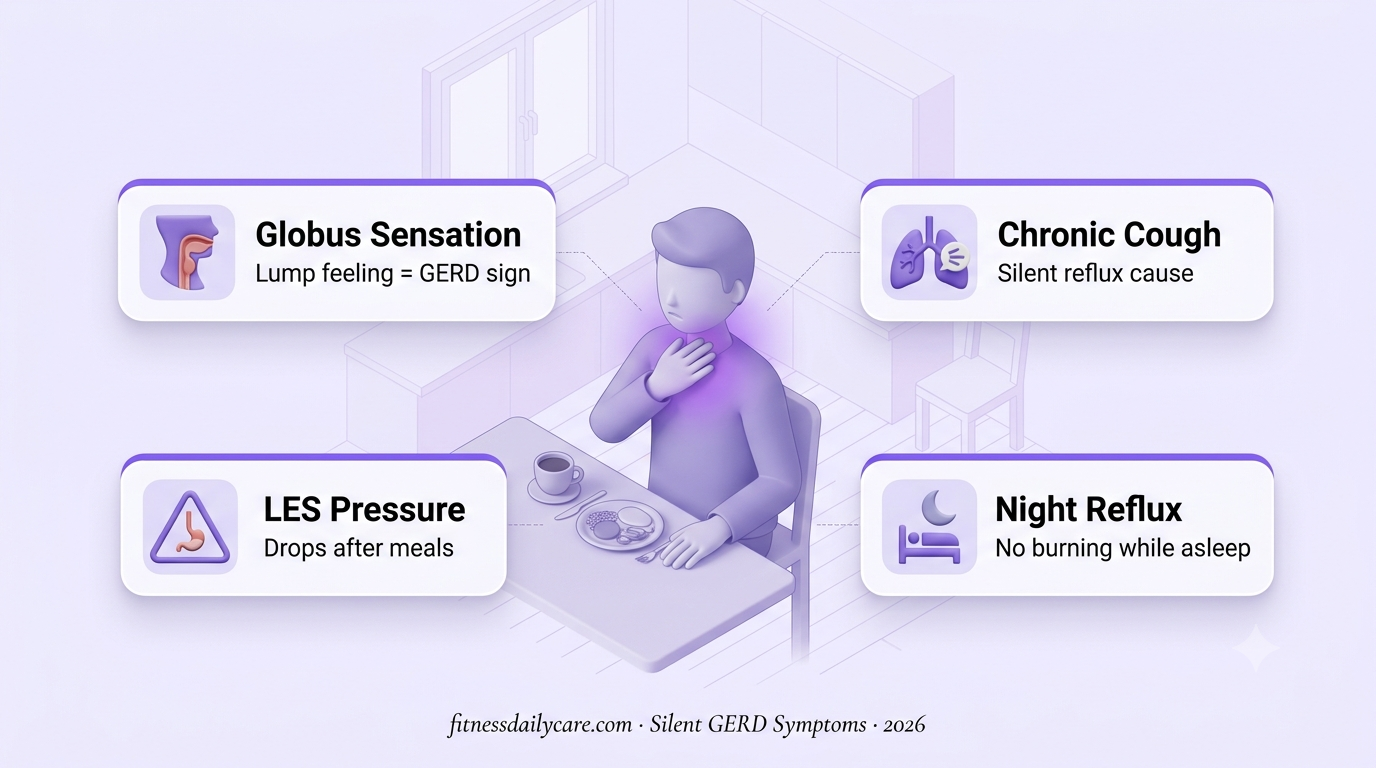
#1 SignGlobus sensation — the persistent feeling that something is stuck in the throat or just above the sternum — is the most common presenting complaint of laryngopharyngeal reflux. Clinicians at NIH/StatPearls describe it as the hallmark symptom, and it is what most patients actually search for when they type “lump feeling in throat” into a search engine. The sensation is not imaginary, and it is not caused by a physical obstruction. It is caused by two simultaneous processes: inflammation and edema of the laryngeal mucosa from repeated acid exposure, and reflex muscle spasm of the cricopharyngeal muscle at the top of the esophagus in response to that irritation.
The anxiety misdiagnosis happens here with predictable regularity. Globus sensation can worsen during emotional stress — not because anxiety causes it but because stress increases esophageal motility and LES pressure fluctuations, producing more reflux events. The person then develops a conditioned association between anxiety and the throat sensation, and a behavioral mental health diagnosis gets layered on top of the actual acid problem. The clinical distinguishing feature: anxiety-driven throat tightness typically fluctuates minute-to-minute with emotional state and resolves when distracted. LPR-driven globus is more constant, is worst after meals, and persists across all emotional states with equal intensity.
Chronic Throat Clearing — The Reflex That Never Works
#2 SignFrequent, repetitive throat clearing — the kind where you clear your throat dozens of times a day and it never actually produces relief — is the second most common LPR sign. The mechanism is a paradox: throat clearing is an attempt to remove the sensation of mucus or a foreign body from the larynx, but it actually makes LPR worse. Each aggressive throat clear produces a sharp pressure wave that pushes acid further up from the esophagus into the larynx, worsening the inflammation that triggered the urge in the first place. People with chronic LPR often report a relentless cycle where the more they clear their throat, the worse the sensation becomes.
This symptom is particularly common in professional voice users — teachers, singers, call center workers, public speakers — who also have elevated LPR risk due to high vocal load and the associated increase in subglottic pressure. The symptom is routinely attributed to post-nasal drip or allergy, and antihistamines are often tried first. When antihistamines produce no improvement over 4 to 6 weeks, LPR should be reconsidered. The key distinguishing test: does the throat clearing worsen after eating or improve when fasting? Post-nasal drip patterns are season-dependent and environment-dependent. LPR patterns are meal-dependent.
Morning Hoarseness — Voice Changes You Blame on Sleep
#3 SignWaking up with a rough, gravelly voice that takes 30 minutes to an hour to warm up is one of the most reliable clinical markers of nocturnal LPR. During sleep, the protective swallowing reflex that normally clears small reflux events slows dramatically. Horizontal position removes the gravitational barrier. The result is that even people who have very little daytime LPR experience significantly more reflux during sleep, and without swallowing to clear it, acid sits on the larynx for longer. The voice box is particularly vulnerable overnight — even a small amount of acid exposure to the vocal cords during sleep produces edema and inflammation that manifests as morning hoarseness.
The pattern most people dismiss as “I just slept funny” or “it’s just dry air” has a distinct signature: it is worse on days after larger evening meals, worse after alcohol consumption, worse when lying flat versus slightly elevated, and improves over the course of the morning as swallowing, hydration, and upright posture work to clear the irritation. A simple 3-night experiment reveals this clearly: eat a small, low-fat dinner before 6 p.m. and sleep with your head elevated 4 to 6 inches. If morning hoarseness noticeably improves those mornings, the diagnosis is effectively confirmed and the treatment direction is clear.
Chronic Dry Cough — The Cough That Outlasts Every Cold
#4 SignLaryngopharyngeal reflux is one of the three most common causes of chronic cough in non-smoking adults, alongside asthma and post-nasal drip. The LPR cough has a specific character: it is dry rather than productive, it is often worse at night and after meals, it does not respond to standard cough suppressants or antihistamines, and it can persist for weeks or months without any respiratory infection. The mechanism is direct mucosal irritation of the larynx and upper airway by acid, triggering the vagal cough reflex. Some people also experience microaspiration of tiny amounts of acid into the airway, which causes a reactive airway response that can mimic asthma.
This is the symptom most likely to be investigated at the wrong specialty first. The person sees a pulmonologist, gets a spirometry test that shows mild bronchial hyperreactivity, gets an asthma inhaler that partially helps (because it reduces the airway inflammation even though it doesn’t address the acid), and continues coughing. The key clue that points to silent GERD is the meal and posture relationship. Asthma worsens with exercise and allergens. LPR-related cough worsens after meals, with late eating, in horizontal position, and in people who also have any of the other four signs on this list.
Forward Head Posture and Desk Work Amplify Everything
#5 TriggerThis one is less a symptom and more a hidden amplifier. Prolonged forward head posture — the “text neck” position of desk workers and phone users — increases intra-abdominal pressure and directly compromises lower esophageal sphincter (LES) function. The LES is the valve between the stomach and esophagus that is supposed to prevent acid from flowing upward. When the thoracic cavity is chronically compressed by poor posture, the diaphragm loses its mechanical contribution to LES function, and reflux becomes more frequent and more severe. Several otolaryngology reviews have noted that the rise of LPR diagnoses over the past decade tracks closely with the rise of desk-based sedentary work and phone use.
Bending at the waist — to tie shoes, to load a dishwasher, to pick something up from the floor — produces a sharp increase in intra-abdominal pressure that in LPR-susceptible individuals can push acid all the way to the larynx in a single episode. People with LPR often describe sudden coughing, throat clearing, or globus worsening during these brief postural transitions. This symptom pattern is almost diagnostic: if your throat symptoms are reliably triggered by bending forward and relieved by upright posture, LPR is very likely the driver.
⚠️ When Throat Symptoms Need Immediate Evaluation
1. Difficulty swallowing solid foods or progressive dysphagia. Globus sensation is the feeling of a lump with no mechanical obstruction. True dysphagia — food actually getting stuck, coughing or choking with meals, or progressive difficulty swallowing from solids to liquids — is a red flag for stricture, motility disorder, or malignancy. Same-week evaluation.
2. Unexplained weight loss with throat symptoms. Losing 10+ pounds without trying, combined with any throat complaint, requires prompt investigation. Esophageal and laryngeal cancers can present this way.
3. Coughing up blood or blood-tinged mucus. Any hemoptysis or blood in throat secretions warrants urgent evaluation, regardless of other symptoms.
4. Visible lump or mass in the neck. Globus sensation involves no physical mass. A palpable or visible neck lump — especially if it has grown, is hard, or is non-tender — requires otolaryngology evaluation to rule out lymph node enlargement or thyroid pathology.
5. Symptoms not improving after 4-6 weeks of lifestyle changes. LPR responds well to lifestyle modification in the majority of cases. Persistent symptoms after consistent adherence to the protocol below should trigger a physician visit for pH monitoring, laryngoscopy, or empiric PPI therapy.
The Lifestyle Protocol That Resolves Most Silent GERD
The Cleveland Clinic and Temple Health both frame LPR management as primarily lifestyle-based for mild to moderate cases. Proton pump inhibitors (PPIs) are used, but they work less well for LPR than for typical GERD because the mechanism is different — the larynx is sensitive to both acid and pepsin (a digestive enzyme), and PPIs only address acid. Lifestyle changes reduce the reflux events themselves at the source, which is why they are the foundation of treatment even when medication is added. The protocol below addresses all five amplifiers simultaneously: meal timing, food triggers, posture, sleep position, and the throat-clearing reflex. Two weeks of consistent adherence typically produces measurable improvement. Give it the full 14 days before evaluating outcome — some improvements in globus sensation and hoarseness take the full two weeks to become obvious, because laryngeal tissue heals slowly.
- 3-hour eating cutoff before bed. The single highest-return change. No exceptions for 14 days. If you eat at 7 p.m., nothing after 7 p.m. — including alcohol, which relaxes the LES even more than food.
- Elevate the head of the bed 4-6 inches. Tilted bed frame or a foam wedge under the mattress — not extra pillows, which compress and lose effect. This uses gravity to keep stomach contents down overnight.
- Eat smaller portions, lower fat. Large meals increase gastric pressure. High-fat meals delay gastric emptying. Both increase reflux frequency. Cut portion sizes by 20 to 25% and reduce fried food, fatty cuts, and heavy dairy for 2 weeks.
- Avoid the top LPR trigger foods. Citrus, tomato products, chocolate, peppermint, alcohol, coffee, carbonated drinks, and spicy food all either relax the LES or increase acid production. Eliminate for 14 days, then reintroduce one at a time to find your specific triggers.
- Replace throat clearing with a dry swallow. Every time you feel the urge to clear your throat, swallow quietly and firmly instead. This takes practice but breaks the worsening cycle within a week for most people.
- Fix forward head posture at your desk. Monitor at eye level, breaks every 30 minutes. Bend at the knees for floor-level tasks. Avoid tight waistbands and belts that compress the abdomen.
- Track symptoms on a 1-5 scale daily. Rate globus, throat clearing, and cough each morning for 14 days. The trend line over 2 weeks tells you whether the protocol is working and, if not, gives your physician a useful baseline for further evaluation.
The lump in your throat after dinner
isn’t anxiety and it isn’t permanent.
It’s a mechanical problem with a lifestyle fix.