
Eating Less Protein, What the New Aging Study Actually Found
A 350+ study review from University of Wisconsin-Madison researchers challenges the “more protein is always better” push, right as U.S. dietary guidelines are telling people the opposite, and the gap between the two is exactly what’s fueling the debate.
Every protein bar, protein cereal, and protein-spiked bottle of water on the shelf is telling you the same thing: eat more. It’s been the dominant nutrition message for years now, reinforced by fitness influencers, supplement brands, and even updated government dietary guidance that leans hard into “protein first.” So when a major scientific review landed this month arguing that eating less protein might actually be the better move for a lot of adults, it stopped me mid-scroll. It’s not a minor claim either, it’s a synthesis of over 350 studies from a University of Wisconsin-Madison research team, and it’s already being covered by outlets from ABC News to Time.
The review, published in the journal Cell Press Blue in late July 2026, comes at an odd moment. Just months earlier, updated U.S. dietary guidelines had pushed Americans toward “protein at every meal.” Meanwhile, researcher Dudley Lamming and his co-author Bailey Knopf were compiling decades of data from humans, mice, flies, and yeast that pointed in the opposite direction: restricting protein, in many cases, activates biological pathways linked to better metabolism, less inflammation, and longer, healthier lifespans.
That doesn’t mean protein is bad, and it definitely doesn’t mean everyone should slash their intake starting tonight. The nuance matters here more than almost any nutrition story I’ve covered recently, and it’s easy to lose in a headline built for clicks rather than context. Here’s what the review actually found, where the surprising twin study fits in, and who this genuinely does and doesn’t apply to.
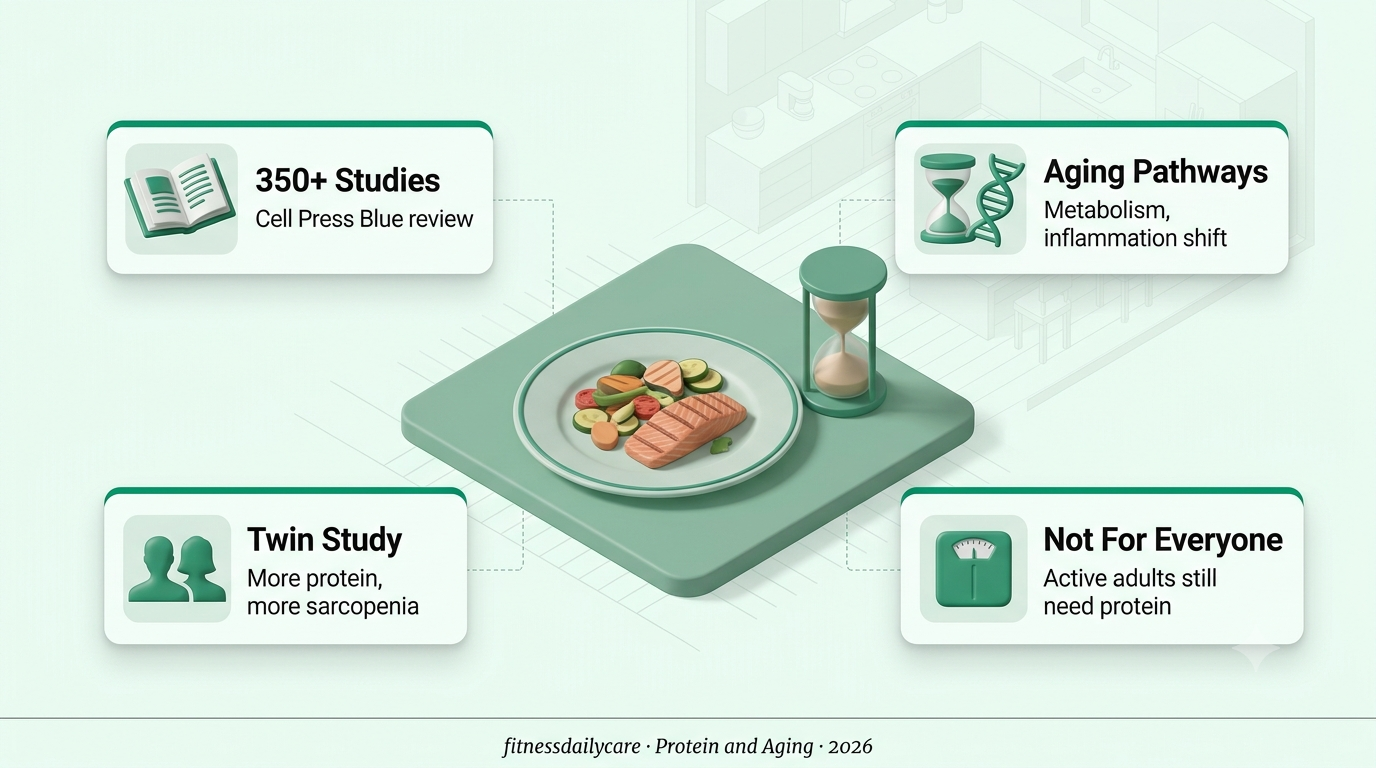
What the 350-study review found
Reducing protein intake appears to activate pathways tied to better metabolism, lower inflammation, and healthier aging across humans and multiple animal species studied, largely through a hormone called FGF21.
The twin study paradox
In 1,500 pairs of British twins over 60, the sibling who ate more protein had a higher risk of sarcopenia, the opposite of what conventional muscle-preservation advice would predict.
Who this doesn’t apply to
Older adults doing resistance training, competitive athletes, and people managing muscle loss still show real, well-documented benefits from adequate protein paired with strength exercise.
What to actually do
Personalize protein intake to activity level rather than defaulting to “more is always better” advice pushed by marketing, social media, and fortified snack packaging.
Eating Less Protein, What The Study Actually Found
Before getting into the specifics, it’s worth being clear about what this review is and isn’t. It’s not a single new clinical trial. It’s a synthesis of more than 350 previously published studies spanning humans, mice, rats, fruit flies, and yeast, pulled together to look for consistent patterns across very different organisms and study designs. That breadth is exactly why it’s getting so much attention, and exactly why the nuance below matters before changing anything about your own plate. Reviews like this one are valuable precisely because individual studies can be noisy or contradictory on their own; pooling hundreds of them helps separate a real signal from statistical noise, even if it can’t replace the kind of large, long-term human trial that would settle the question definitively.
The review behind the eating less protein headline
Key evidenceThe review, titled “The Hallmarks of Protein and Amino Acid Restriction in Aging and Longevity,” was authored by Bailey A. Knopf and Dudley W. Lamming of the University of Wisconsin-Madison and published in Cell Press Blue. It examined how reducing protein intake, or specifically reducing certain amino acids, affects aging-related biology across more than 350 studies.
The researchers point to a hormone called FGF21 as a key mechanism behind the eating less protein effect. Protein restriction raises FGF21 levels in both animals and humans, and higher FGF21 has been linked to increased energy expenditure, better blood sugar control, and reduced inflammation. In mouse studies, animals with elevated FGF21 lived longer than normal mice, with the effect more pronounced in males than females. The review also flags three specific amino acids, methionine, isoleucine, and valine, as building blocks that may drive some of these effects when consumed in excess.
This isn’t the first time researchers have looked at protein restriction, but it’s one of the largest attempts to pull the evidence together in one place. Scientists have known for decades that restricting protein extends lifespan in yeast, fruit flies, mice, and rats under controlled lab conditions. What’s changed recently is the intensity of interest in whether the same mechanisms translate to humans, driven partly by the broader boom in longevity research and partly by a growing pile of population-level data that keeps pointing in the same direction.
The twin study that surprised even the researchers
Key evidenceOne of the more striking data points cited in the coverage of this review comes from a 2023 study of roughly 1,500 pairs of British twins over age 60. Because twins share genetics and often much of their environment, comparing siblings within a pair controls for a huge number of variables that mess up typical nutrition studies. The finding: the twin who ate more protein had a higher risk of developing sarcopenia, age-related muscle loss, than their lower-protein sibling.
Lamming has called this result “exactly the opposite” of what conventional wisdom would predict, since protein is usually framed as protective against muscle loss. It doesn’t necessarily contradict every other finding on protein and muscle, but it’s a real, published data point that complicates the simple “more protein equals more muscle” story that dominates fitness marketing and social media advice today.
It’s worth noting this finding sits alongside other research pointing the opposite way. Some studies have shown higher protein diets promote weight loss and lower sarcopenia risk in older adults, particularly when combined with resistance training. That apparent contradiction, higher protein sometimes protecting against muscle loss and sometimes predicting it, is part of what drew Lamming to study this area of aging research in the first place, and it’s a big reason researchers describe this as an emerging picture rather than a settled one.
The 43-day trial behind the metabolic claims
Key evidenceBeyond animal data, the review cites human clinical trials showing real, measurable effects tied specifically to eating less protein rather than just eating fewer calories overall. One trial found that people following a low-protein diet for 43 days lost body weight and body fat, and had lower fasting blood sugar, despite eating more total calories than before the trial started. That’s a notable detail: the benefit wasn’t just from eating less overall, it tracked specifically with the drop in protein intake itself.
Epidemiological data adds another layer. Lamming has pointed to a series of large population studies showing that people eating higher-protein diets tend to have higher rates of cancer, diabetes, cardiovascular disease, and in some studies, mortality. Those are correlational findings, not proof of direct cause and effect, but they’re consistent enough across multiple large datasets that researchers are taking the pattern seriously.
What makes the 43-day trial notable is the calorie detail. Losing weight and improving blood sugar while eating more calories overall runs against the simple “calories in, calories out” framing most people use to think about weight and metabolism. It suggests the specific macronutrient composition of a diet, not just its total energy content, is doing meaningful metabolic work, which lines up with what the FGF21 research is describing at a hormonal level.
Who this doesn’t apply to
ContextLamming and other aging researchers have been explicit that this isn’t a green light for everyone to slash protein intake. Older adults face a real risk from sarcopenia, and the research on resistance exercise plus adequate protein helping preserve muscle and strength in that population is well established and shouldn’t be abandoned based on one review. People with kidney disease, liver disease, or other conditions affecting protein metabolism need individualized medical guidance, not general population advice.
Activity level matters enormously here too. As Lamming himself put it, recent guidelines encouraged people to eat more protein, but they also encouraged more exercise, and those two pieces of advice were never meant to be separated. The population most likely to see benefit from eating less protein is sedentary adults already getting more than they need, not competitive athletes, older adults doing strength training, or anyone recovering from illness or surgery.
There’s also a scale problem worth naming directly. Much of the strongest, most consistent evidence for lifespan extension through protein restriction comes from short-lived organisms like yeast and fruit flies, where researchers can run full lifespan studies in weeks or months rather than decades. Human trials on the same question have generally been small and short-term by comparison, simply because studying human aging over decades is logistically difficult and expensive. That gap between animal and human evidence is exactly why researchers are calling for more targeted human trials rather than treating this as a closed case.
So how much protein do you actually need
PracticalThe current RDA sits at 0.8 grams per kilogram of body weight per day for sedentary adults, a baseline many nutrition marketers treat as a bare minimum to exceed rather than a legitimate target grounded in actual physiological need. Moderately active adults typically land somewhere around 1.0 to 1.2 g/kg, endurance athletes around 1.2 to 1.4 g/kg, and adults doing serious resistance training often benefit from 1.6 to 2.2 g/kg, particularly older adults working to preserve muscle mass against age-related decline.
The honest takeaway from this review isn’t “eat less protein” as a universal rule. It’s “stop assuming more protein is automatically better regardless of how active you are.” For someone already eating well above their activity level’s needs from protein bars, shakes, and fortified snacks, dialing back toward the RDA baseline may be the evidence-backed move. For someone lifting weights three times a week or recovering from an injury, the opposite is still true.
It also helps to remember why protein marketing got this aggressive in the first place. Protein is genuinely satiating, genuinely useful for muscle repair, and genuinely easy to market as an unambiguous good, unlike, say, fat or carbohydrates, which carry decades of contested and confusing messaging. That made it an easy nutrient to build an entire product category around, from protein water to protein popcorn, largely independent of whether the people actually buying those products needed more of it in the first place.
What this looks like on an actual weeknight for a sedentary adult: swapping a protein-fortified snack out of habit for a normal whole-food option, and not reflexively adding a protein powder scoop to a smoothie that’s already nutritionally complete without it. Neither change requires eliminating protein or overhauling an entire diet overnight.
More protein was never automatically better.
It was just easier to sell that way.
- Match intake to activity — sedentary adults likely need far less than strength-training adults, and the RDA of 0.8 g/kg is a legitimate baseline, not a minimum to blow past
- Don’t abandon protein if you strength train — resistance exercise plus adequate protein remains well supported for preserving muscle, especially over 60
- Reassess protein-fortified habits — a protein bar, protein coffee, and protein cereal in the same day may add up to far more than you actually need
- Prioritize protein quality — whole food sources with a broader nutrient profile over heavily processed protein-spiked snacks
- Talk to a doctor before major changes — especially if you have kidney disease, liver disease, or are recovering from illness or surgery
- Reassess, don’t panic — this is one large review, not a reason to overhaul your entire diet overnight based on a single study cycle
None of that requires buying anything new or expensive. Eating less protein, for most sedentary adults, mostly means noticing where fortified products have quietly stacked up over the course of a normal day, a protein latte in the morning, a protein bar at lunch, a protein shake after dinner, and honestly asking whether that’s actually necessary rather than just habitual. For people who are training hard or aging into their 60s and beyond, the calculation runs the other way entirely, and that’s exactly the distinction this research is trying to draw out.
⚠️ Where Caution Still Makes Sense
1. This is early-stage, mixed-strength evidence. Much of the underlying data comes from animal studies in mice, flies, and yeast. Human trials on protein restriction have generally been small in scale and short-term, so the review’s authors themselves note the human evidence still needs to catch up.
2. Older adults and active people have different needs. Sarcopenia risk is real, and adequate protein combined with resistance training remains one of the best-supported tools for preserving strength and independence with age.
3. Medical conditions change the calculation entirely. Anyone with kidney disease, liver disease, or another condition affecting protein metabolism should get individualized guidance from a doctor or registered dietitian rather than applying general population findings to their own situation.
4. This isn’t permission for extreme restriction. Researchers are describing moderate reduction from an already-high baseline, not minimizing protein intake as far as possible. Going too low carries its own real risks, including impaired wound healing, weakened immune function, and accelerated muscle loss in vulnerable populations.
5. One review doesn’t overturn decades of prior research. The high-protein-for-muscle-preservation body of evidence didn’t disappear because one review synthesized data pointing a different direction. Both bodies of evidence are real; the honest answer is that the right amount of protein depends heavily on who’s asking.
The right amount of protein was never
one number for every person on the shelf.
Eating Less Protein, What The Research Says
None of this means protein is the enemy, and it doesn’t mean every high-protein product on the shelf is wasted money for everyone. It means the blanket “more protein, always” message that’s been marketed for the past few years doesn’t hold up as universally as the packaging suggests, and the actual research points toward something more personalized: match your protein to your activity level, not to whatever’s trending in the snack aisle. The people who stand to benefit most from eating less protein are the ones who never actually needed the extra in the first place, and figuring out which group you’re in matters more than following either extreme.