
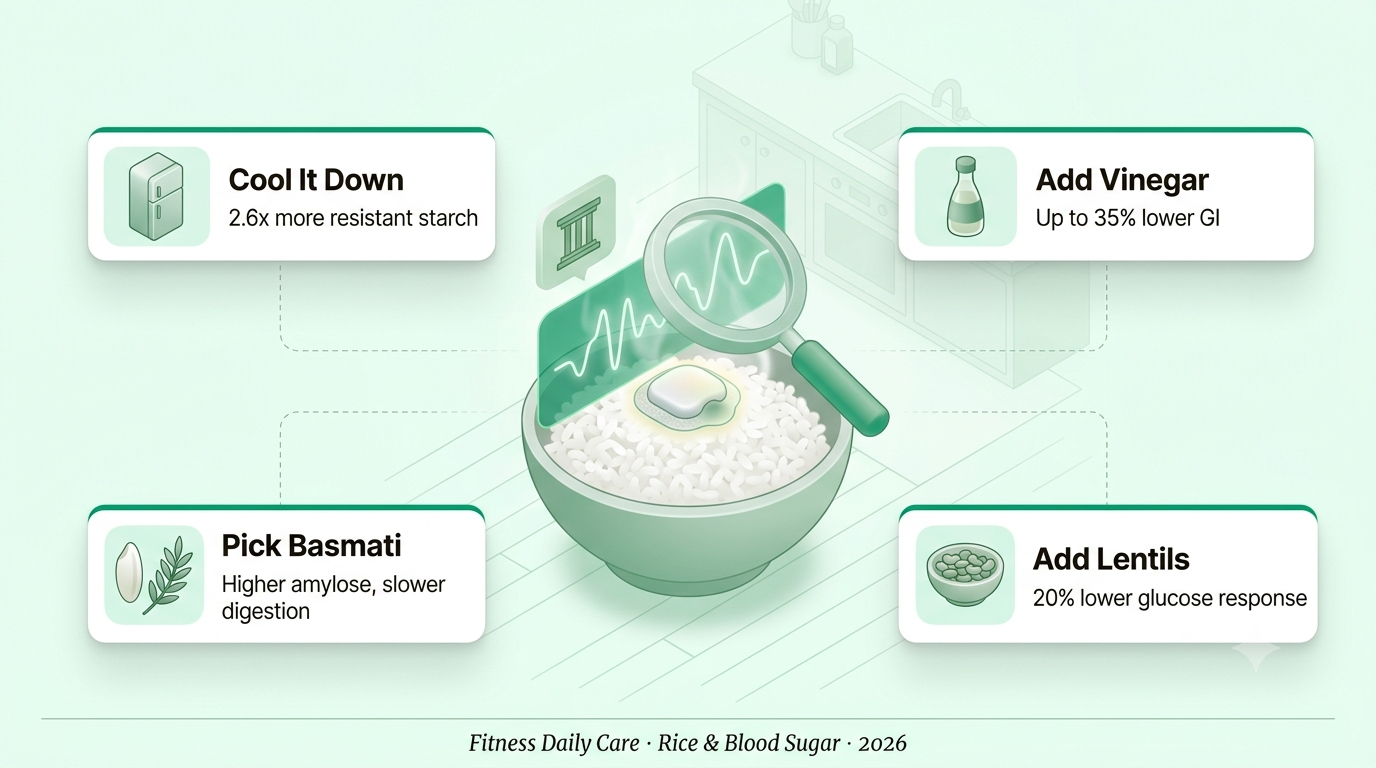
Rice and Blood Sugar, 4 Methods
Research Actually Confirms
From cooling and vinegar to rice variety and lentils — what actually changes your glucose curve, according to clinical trials
I started checking my glucose monitor against different meals after noticing that plain white rice was the single biggest spike on my log — bigger than bread, bigger than pasta. That sent me digging into rice and blood sugar research directly, not the wellness-influencer version of it: the clinical trials that measured real glucose curves after people ate rice prepared four different ways.
What I found was more modest than the internet makes it sound, but real. None of the four methods below turn rice into a low-carb food on their own. Cooling it overnight doesn’t cancel a large portion. Vinegar doesn’t erase the carbs. But stacked together, and backed by actual continuous glucose monitoring in human trials, they add up to a meaningfully flatter curve — and all four are already sitting in a typical kitchen.
This isn’t about replacing rice with something else. It’s about four specific adjustments that keep showing up in the nutrition research, plus a clear look at where the evidence is thinner than the headlines suggest.
What Resistant Starch Does
Chilling reorganizes some starch into tight crystals your digestive enzymes can’t break down easily — it behaves more like fiber than sugar.
The Effect Is Modest
Trials show a real reduction in glucose response, but it’s partial — not enough to offset a much larger portion of rice.
Amylose Content Matters
Rice above roughly 25% amylose, like basmati, digests more slowly and produces a lower glycemic response than low-amylose short-grain rice.
Vinegar Is the Strongest Lever
Adding vinegar to a rice meal lowered its glycemic response by 20 to 35% across several controlled human trials.
Cooling rice doesn’t rewrite your metabolism.
It just quietly tips the odds a little further in your favor.
Cook It, Chill It, Reheat It
Best StudiedThe clearest evidence here comes from a 2015 crossover trial: white rice cooked, then refrigerated at 4°C for 24 hours, then reheated, had 2.6 times the resistant starch of rice eaten fresh off the stove — and produced a significantly lower glucose response in 15 healthy adults. A separate trial in 32 people with type 1 diabetes found the same pattern, with a much smaller area under the glucose curve after cooled-and-reheated rice.
Add Something Acidic Before You Eat
Strongest EffectThis is the single strongest lever in the research. Adding vinegar to rice — the same acidity used in sushi rice — lowered its glycemic index by roughly 20 to 35% in controlled trials, largely by slowing the enzyme that breaks starch down into glucose. The studied range is about 10 to 30 mL of vinegar, or roughly 2 teaspoons to 2 tablespoons.
Choose a Higher-Amylose Variety
One-Time SwapNot all rice behaves the same way in your bloodstream. Rice with higher amylose content — basmati is the most common example — digests more slowly than low-amylose short-grain or sticky rice. A review of clinical trials found that high-amylose rice lowered postprandial glucose in most studies where amylose content exceeded roughly 27%.
Replace Part of the Rice With Lentils
Easy SwapA randomized crossover trial found that replacing half the available carbohydrate in a rice meal with cooked lentils cut the glycemic response by about 20%, depending on the lentil variety. The same swap with potatoes cut it by over 33%. Legumes bring fiber and protein that rice doesn’t, and both slow the glucose rise.
None of these methods replace portion control.
They just make the same bowl of rice work a little harder for you.
- Cook extra, chill overnight — refrigerate leftover rice for at least a few hours, ideally 24, before reheating and eating it
- Add 1–2 tsp of vinegar — mixed into the rice or in a side dish eaten with the meal
- Default to basmati — or another long-grain, higher-amylose variety when you have a choice
- Stir in lentils or beans — replacing roughly a third to half of the rice by volume
- Stack, don’t pick just one — the four methods work through different mechanisms, so combining them compounds the effect
⚠️ Where the Evidence Has Limits
1. Insulin users, be careful. The type 1 diabetes trial found more hypoglycemic episodes after cooled-and-reheated rice, likely because a standard insulin dose overshot the smaller glucose rise. Any carb-timing change should go through your care team if you use insulin.
2. Vinegar isn’t dose-dependent forever. The benefit was measured at 10–30 mL; there’s no evidence that more vinegar means more protection, and larger amounts can upset digestion.
3. This doesn’t cancel out portion size. Every method above modifies the same bowl of rice — none of them let a much larger bowl behave like a smaller one.