
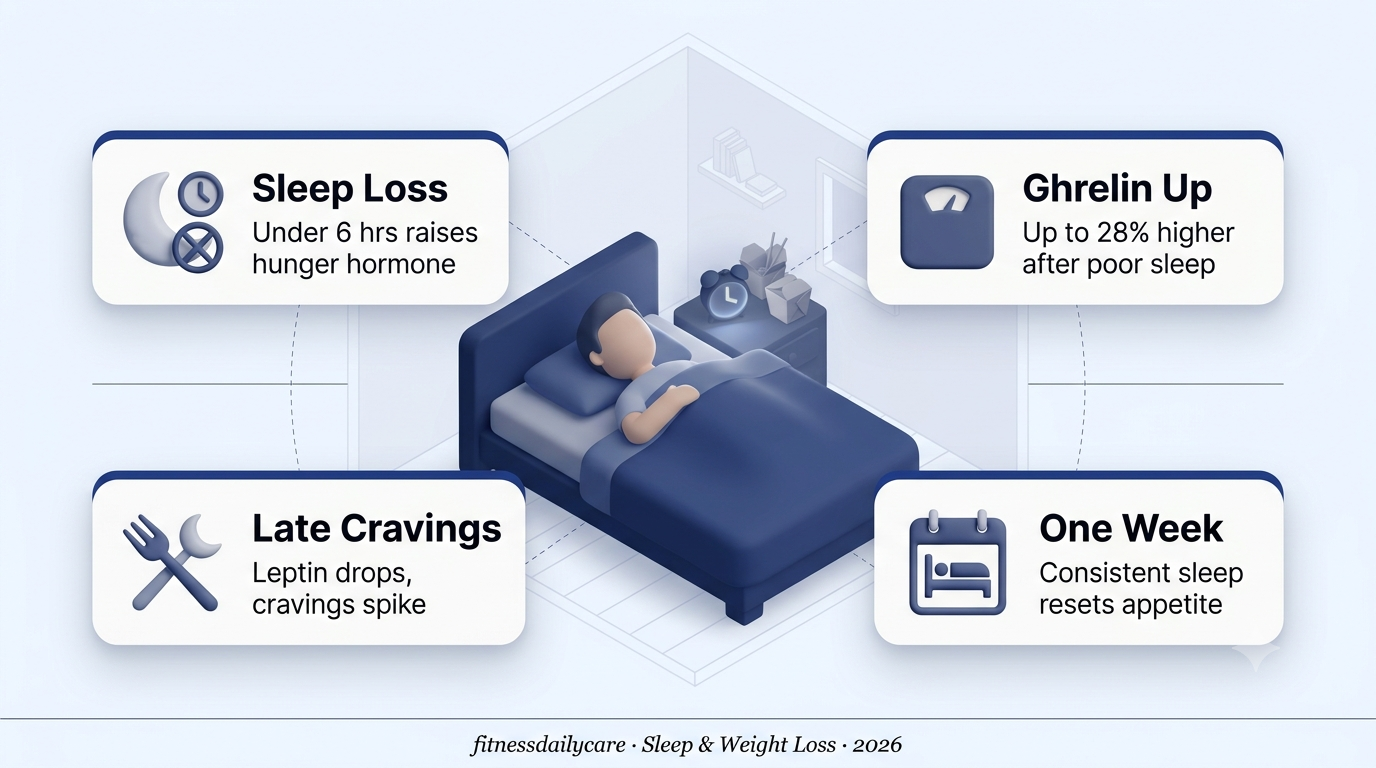
Sleep and Weight Loss, You’re Under-Sleeping Not Overeating
A 2010 Annals of Internal Medicine trial found that people sleeping 5.5 hours a night lost 55% less fat than people sleeping 8.5 hours — on the exact same diet.
Most people treat sleep and weight loss as two separate goals — one for feeling rested, one for the number on the scale. The research says they’re the same system. Back in 2004, researchers at the University of Chicago put healthy young men through two nights of four-hour sleep and measured their blood the next morning. Leptin, the hormone that tells your brain you’re full, dropped 18%. Ghrelin, the hormone that tells you you’re hungry, rose 28%. Self-reported hunger and appetite climbed right along with it.
That was a lab study measuring hormones, which is useful but doesn’t prove what happens to actual body fat. So in 2010, the same research group ran a more direct test. Ten overweight adults dieted under a moderate calorie deficit for 14 days — once while sleeping 8.5 hours a night, once while sleeping only 5.5 hours. Same food, same deficit, same people. On full sleep, 1.4 kg of the weight lost was fat. On short sleep, only 0.6 kg was fat — a 55% drop — and the loss of lean muscle mass went up 60% instead. The scale showed almost the same number both times. What came off the body was completely different.
This article walks through what that hormone and body-composition research actually shows, where the evidence is genuinely mixed, and what to do about sleep and weight loss without turning it into another thing to obsess over.
Why It Happens
Short sleep disrupts the leptin-ghrelin loop that regulates appetite, so hunger and cravings rise independent of what you ate.
What the Data Shows
Nedeltcheva et al. found sleep-restricted dieters lost 55% less fat and 60% more lean mass on the identical deficit.
The Myth This Breaks
“Calories in vs. calories out” treats sleep as irrelevant — but sleep changes what your body burns for fuel, not just how much you eat.
What Actually Works
Tasali et al. found extending sleep by 1.2 hours cut daily intake by 270 kcal with zero diet instructions given.
Sleep isn’t the reward for a good diet.
It’s the mechanism that makes the diet work.
How Sleep and Weight Loss Are Actually Connected
Protect a 7 to 9 Hour Sleep Window
FoundationThis is the single lever with the most direct evidence behind it. In the Tasali trial, participants who habitually slept under 6.5 hours were coached to extend their time in bed toward 8.5 hours — nothing else about their diet or routine was touched. Average result: 270 fewer calories eaten per day, tracked with wearables in real life, not a lab.
Watch the Post-Dinner Ghrelin Window
Craving ControlGhrelin and reward-center activity toward sweet, high-calorie food both climb after short or poor-quality sleep, which is exactly why a rough night makes 9 PM snacking feel unstoppable. Treat that window as expected, not a willpower failure.
Prioritize Protein Before You Prioritize Sleep Hacks
Muscle PreservationThe Nedeltcheva data showed short sleep shifted losses toward lean mass, not just fat. Adequate protein intake during a deficit is the standard defense against muscle loss regardless of sleep — but it matters even more when sleep is compromised, since the body is already leaning toward burning less fat for fuel.
Track Trends, Not Single Nights
Realistic TrackingOne rough night won’t sabotage a diet, and the hormone research backs that up — evidence for acute, one-night effects is more mixed than the headlines suggest. What the strongest studies measured was sustained short sleep over one to two weeks. That’s the pattern worth tracking, not any single bad night.
- 7 to 9 hours, most nights — the range every cited trial used as its “adequate sleep” baseline
- Fixed wake time — anchors the sleep window more reliably than a fixed bedtime
- Protein target held steady — your main defense against the lean-mass loss short sleep encourages
- Pre-plan the evening craving — expect it after a short-sleep night instead of fighting it blind
- 7-day sleep average — track the trend, not any single night
⚠️ What Sleep Won’t Do
1. It doesn’t replace a calorie deficit. Better sleep can reduce intake and protect muscle, but it isn’t a substitute for eating less than you burn if fat loss is the goal.
2. More isn’t automatically better. The studies here point to 7–9 hours as the useful range — oversleeping isn’t a hack, and consistently sleeping far beyond that is linked to its own health concerns.
3. The hormone evidence is mixed short-term. A 2025 meta-analysis found no significant ghrelin or leptin change across a set of sleep-deprivation trials, so don’t expect a single sleepless night to show up cleanly in a blood test — the clearer signal is in weeks-long body-composition studies.
You’re not overeating.
You’re under-sleeping, and your hormones noticed first.