
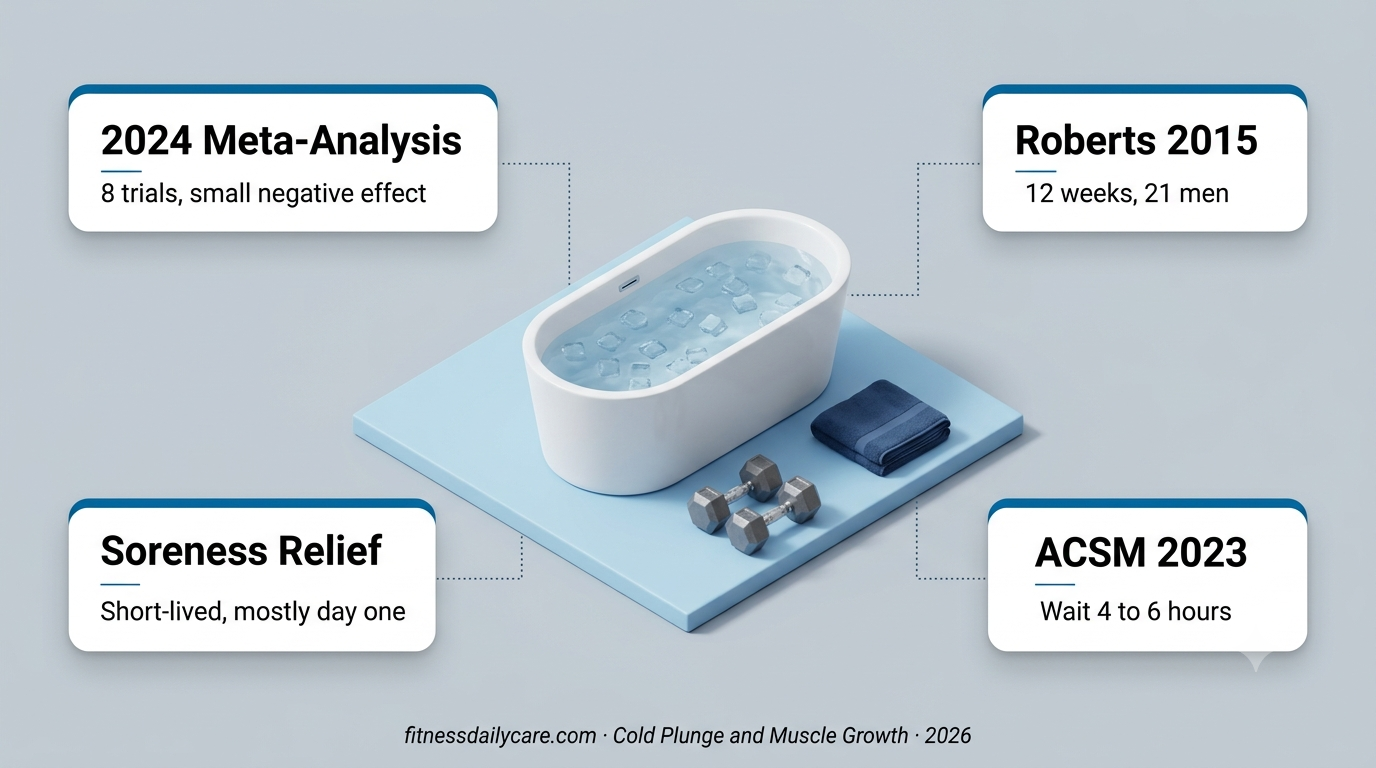
Cold Plunge After Workout, Does It Blunt Muscle Growth
Eight pooled trials and a 12-week study of 21 men tell a more careful story than the internet does
A cold plunge after workout feels like the smart move, and in one narrow sense it is. Cold water can ease soreness and make a hard session feel more recoverable.
The real question is what it does to the thing lifters actually train for. Muscle growth and next-day comfort are not the same goal.
Since 2015, controlled trials have put lifters in cold water after every session and measured what happened.
The pattern is consistent, if modest: gains came out smaller.
The effect is small, most participants were young men, and timing has barely been tested. Here is what the research shows, and where it stops being reliable.
Researchers led by Dr. Llion Roberts ran two linked experiments. In the first, 21 physically active men did strength training twice a week for 12 weeks. After every session they either sat in cold water for 10 minutes or did light active recovery.
In the second, nine active men did one bout of single-leg strength exercises. Muscle biopsies were taken before the session and again 2, 24 and 48 hours later.
Active recovery beat the cold dip on both strength and muscle mass (P < 0.05, the usual cutoff for “unlikely to be chance alone”).
Muscle grows when training damage triggers repair signals. Satellite cells, the muscle’s stem cells, help add new material to fibers. A pathway called mTORC1 switches on protein building.
One proposal is that cold narrows blood vessels and dampens that response. In Roberts’ second experiment, cold immersion blunted the short-term changes in satellite cells and in enzymes that regulate growth.
Researchers still describe the exact mechanism as unsettled, so treat this as a working explanation, not a proven chain of events.
mTORC1 activity
Lower at 1 hour and again at 48 hours after training in the cold group.
Type II fiber area
Gains were smaller after 7 weeks of 15-minute dips at 10°C (50°F).
FOXO1 protein
Baseline levels were 1.3 times higher in the cold group. FOXO1 is a marker linked to protein breakdown.
Leg press strength
Max strength gains were similar in both groups, so size and strength did not move together.
A 2024 meta-analysis in the European Journal of Sport Science pooled 8 trials that paired resistance training with post-exercise cold water immersion. Sessions ran two to three times a week, and four trials used trained lifters.
The pooled effect favored training without cold water: −0.22 (95% credible interval −0.47 to 0.04). The interval touches zero, so this is a likelihood, not a certainty. The authors put the probability that cold immersion reduced growth at about 96%.
Training status did not clearly change the picture. The authors’ meta-regression found no clear difference between trained and untrained lifters.
Strength gives a murkier picture. A 2022 meta-analysis of 10 trials (170 participants, 92% male) found cold immersion trimmed strength gains, with an effect of −0.23 (95% CI −0.45 to −0.01). Whole-body immersion showed no significant difference.
That echoes Fyfe’s 2019 trial, where fiber growth shrank but leg press gains held steady.
The newest network meta-analysis (2026, 87 studies, 2,313 participants) did not report muscle size outcomes. For strength, passive recovery ranked highest, and medium-length, moderate-temperature cold immersion did not differ from it.
Cold water is a recovery tool,
not a growth tool
A 2022 review of 52 randomized trials (1,191 adults), summarized by American Family Physician in 2025, found that cold immersion after hard exercise may improve perceived recovery and delay soreness over the next 24 hours. Dips under roughly 10 to 15 minutes in water below 59°F (15°C) were most consistent.
A separate 2023 meta-analysis of 20 studies in Frontiers in Physiology was less generous. Soreness was lower right after exercise, but not significantly lower at 24 or 48 hours once a random-effects model was applied.
Most of those trials carried high or unclear risk of bias, and only five used random allocation.
Soreness right after
Lower at 0 hours (−0.59 on a standardized scale), but not at 24 or 48 hours.
Perceived effort
Workouts felt easier right after immersion (−0.57), with no difference later.
Blood markers
Creatine kinase, a muscle-damage marker, was lower at 24 hours. Inflammation markers CRP and IL-6 did not differ.
Jump performance
Countermovement jump was lower right after immersion (mean difference −2.71).
Recovery comes first
CompetitionCold immersion makes the most sense when you need to perform again within a day or two, such as tournaments or back-to-back events.
In that setting, feeling better tomorrow can matter more than a small adaptation cost over weeks. ACSM’s 2023 overview says the evidence is strongest for whole-body endurance athletes.
Growth comes first
Hypertrophy blockIn a muscle-building phase, the trials point the other way. The pooled studies started cold exposure within about 15 minutes of training, and the group that skipped it tended to grow more.
For many recreational lifters, soreness is more annoyance than limiter. The 2026 network meta-analysis even ranked passive rest at the top for strength.
- Timing — if you lift for size, wait 4 to 6 hours after training (ACSM’s 2023 suggestion)
- Temperature — 50 to 60°F (10 to 15°C), the range used in the studies and in ACSM’s protocols
- Duration — 10 to 15 minutes, or two 5-minute dips at 50°F (10°C) as ACSM lists
- Frequency — save it for recovery-priority days, not every session
- Alternative — light active recovery (Roberts’ comparison) or passive rest (top-ranked for strength in the 2026 review)
⚠️ Safety first
1. Cold water is not risk-free. ACSM lists frostbite, cold exposure injury and loss of consciousness among the risks.
2. Talk to your doctor first if you have a heart condition, uncontrolled high blood pressure, Raynaud’s disease or a history of cold injury. ACSM also lists hypothyroidism and claustrophobia.
3. Do not plunge alone, and get out if you feel dizzy, numb or unsteady.
First, the effect size is small. A value near −0.2 is conventionally labeled small, and the 2024 interval touches zero. Cold water probably costs some growth, but not a lot.
Second, the samples are small and young. Roberts had 21 men and Fyfe had 16. The 2022 strength review was 92% male, and the 2026 network analysis was about 85% male, so results may not apply equally to women or older adults.
Third, the trials are short. The two training trials covered here ran 7 and 12 weeks. Long-term adaptations are listed as an evidence gap in the 2026 review.
Fourth, timing is barely tested. The pooled trials started cold exposure soon after training. ACSM suggests waiting 4 to 6 hours but notes that few studies have examined it.
Choose the tool
that matches the goal