
Caffeine Cutoff Time, 100 mg vs 400 mg Changes the Answer
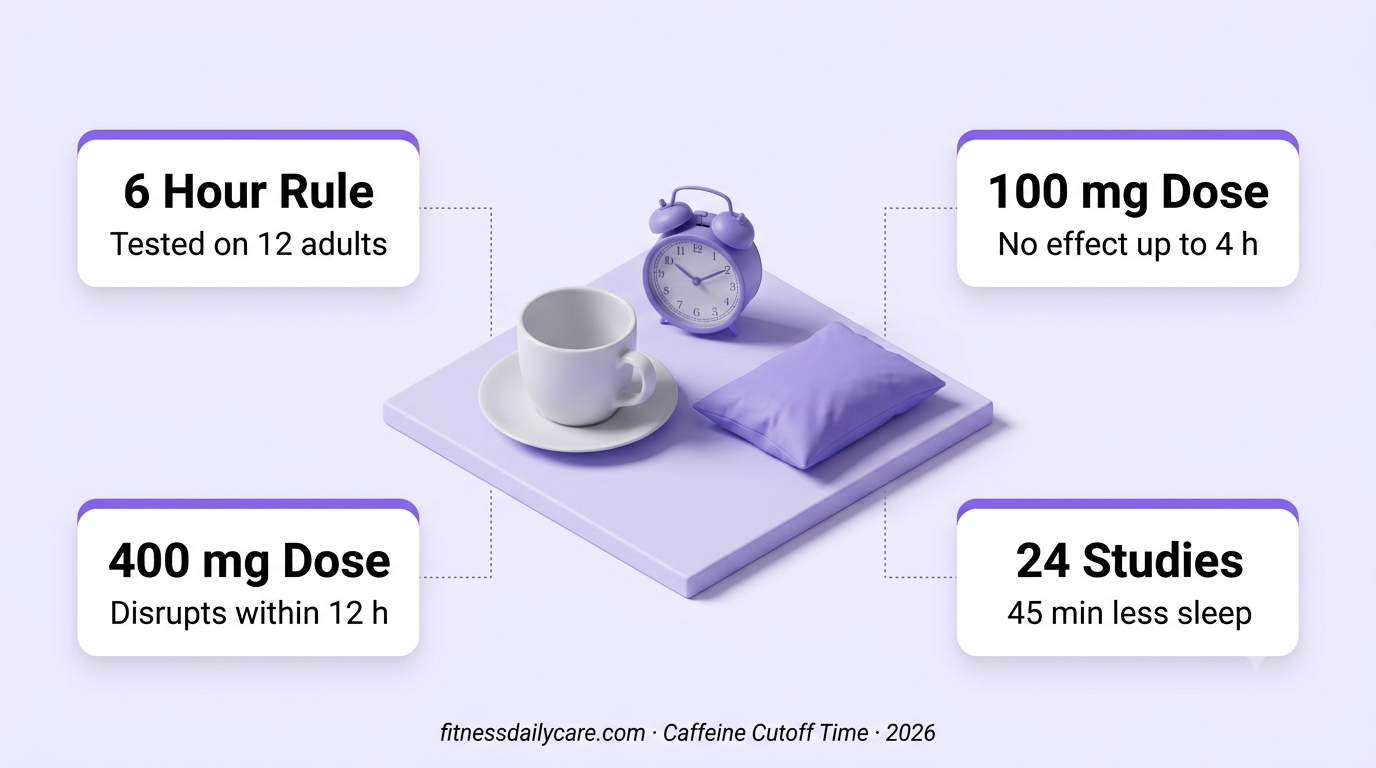
The famous 6 hour rule came from a 12 person study at 400 mg. Here is what a 2025 trial and a 24 study meta-analysis add
“Stop caffeine 6 hours before bed” is one of the most repeated sleep rules, and it traces back to one small study.
In 2013, researchers gave 12 healthy adults 400 mg of caffeine at 0, 3, or 6 hours before bedtime. Even the 6 hour dose cut sleep by roughly an hour.
That is about two to three 12 ounce cups of coffee, the FDA’s benchmark for a whole day, taken as a single dose.
A 2025 randomized trial then tested a smaller dose directly. At 100 mg, no significant effect showed up even 4 hours before bed.
So the useful question is not only “what time,” but “how much, and how late.”
Here is what the research shows, where it stops, and how to set a caffeine cutoff time you can actually use.
Drake and colleagues at Henry Ford Hospital had participants take pills at 6, 3, and 0 hours before their usual bedtime across four days, with a placebo condition for comparison. On each caffeine day, only one of the three pills held caffeine.
Sleep was tracked with a diary and a validated in-home sleep monitor, so the result did not rest on memory alone. Caffeine at all three timings reduced total sleep time.
The paper supports avoiding substantial caffeine for at least 6 hours before bed. The accompanying press release boiled that down to “nothing after 5 p.m.” for a typical bedtime.
12 adults
Healthy normal sleepers tested over four days. A small group, so individual differences carry more weight.
400 mg
Equal to the FDA’s whole daily benchmark for healthy adults, taken as one dose.
6, 3, and 0 hours
Before usual bedtime, compared with placebo. All three timings reduced total sleep time.
About 1 hour
Less sleep when caffeine was taken 6 hours before bed. Participants’ own reports did not reflect it.
Gardiner and colleagues ran a placebo controlled, double blind, randomized crossover trial in 23 men. Their habitual intake was under 300 mg a day, and the average age was 25.
Each person completed seven conditions: placebo, plus 100 mg or 400 mg of caffeine taken 12, 8, or 4 hours before bedtime, with a 48 hour washout between them.
The conditions were built to mimic a typical dose and a high dose in the morning, afternoon, and evening. Sleep was measured both objectively and by self-report.
No significant effect
Neither objective nor perceived sleep changed, even at the 4 hour mark.
Delayed sleep onset
Falling asleep slowed and sleep architecture shifted, even 12 hours before bed.
More fragmented sleep
Greater fragmentation appeared, and perceived sleep time fell about 0.7 hours versus 100 mg.
Worst for sleep quality
Perceived quality dropped 34%, and perceived sleep time fell about 1.3 hours versus 100 mg.
The cutoff isn’t one number.
It’s a dose and a clock.
The authors also modeled how long before bed caffeine should stop to avoid losing sleep time. For coffee at 107 mg per 250 mL (about 8.5 oz), they estimated at least 8.8 hours.
For a standard pre-workout serving of 217.5 mg, the estimate was at least 13.2 hours.
Those numbers are more cautious than the 2025 trial’s 4 hours for 100 mg. They answer different questions: the review models the time needed to avoid any drop in total sleep time across pooled studies, while the trial tested fixed doses in one group of men.
Our reading: treat 4 hours as the optimistic end for a small dose and 8.8 hours as the cautious end for a standard cup. That framing is editorial, not a finding from either paper.
In the 2013 study, objective sleep time dropped after caffeine at 6 hours, but participants’ reports suggested they were unaware of it. Lead author Christopher Drake noted that people are less likely to notice caffeine’s effects when it is taken in the afternoon.
The 2025 trial points the same way. With 400 mg, objective effects showed up at 12 and 8 hours before bed, but perceived sleep quality fell only at the 4 hour mark.
Falling asleep fast is also only one measure. The review found deep sleep fell about 11 minutes and time awake during the night rose 12 minutes, and both of those happen after you have already fallen asleep.
The same coffee habit can land well below or well above the 100 mg dose tested in the 2025 trial. Even the low end of a 12 ounce brewed coffee tops it.
Both trials also used capsules with a fixed amount. Your drink is not that precise, so treat any cutoff as a range rather than an exact hour.
113 to 247 mg
Per 12 fluid ounces of regular brewed, non-specialty coffee.
54 to 328 mg
Per 16 fluid ounces. A very wide range, so check the label.
2 to 15 mg
Per 8 fluid ounce cup. Far below the doses used in the studies.
400 mg
For most healthy adults across a full day. The 2025 trial gave 400 mg as one dose.
The FDA says the body takes roughly 4 to 6 hours to process half of the caffeine it takes in. That is why a bigger dose stays a problem for longer.
Using a 5 hour half-life, the middle of that range, we estimated how much of each trial dose would still be in the body at bedtime.
This is our own back-of-envelope estimate, not a measurement from either study, and real half-lives vary from person to person.
Count milligrams, not cups
DoseThe effects in both trials depended on dose. Check the label or the roaster’s number instead of guessing from the cup size.
Pick a window, not a single hour
TimingThe 2025 trial supports 4 hours for a 100 mg dose. The meta-analysis suggests 8.8 hours for one 107 mg per 250 mL coffee. Where you land between them depends on your sensitivity.
Move big doses to the morning
High doseIn the trial, even 400 mg taken 12 hours before bed delayed sleep onset. For a standard pre-workout serving of 217.5 mg, the meta-analysis suggests 13.2 hours.
Test it with nights, not feel
CheckBecause the lost sleep is often invisible, compare stretches of nights. Keep one cutoff for two weeks, then move it two hours earlier for two weeks (editorial suggestion).
- 100 mg drink · about 7 p.m. at the latest (4 hours, 2025 trial)
- One standard coffee, 107 mg per 250 mL · about 2 p.m. (8.8 hours, 2023 review)
- Pre-workout, 217.5 mg · about 10 a.m. (13.2 hours, 2023 review)
- 400 mg in one dose · no tested timing was clearly free of effects, so split it up or move it earlier
⚠️ Limits and cautions
1. Both key trials are small. The 2013 study had 12 adults over four days. The 2025 trial had 23 men, average age 25, who drank under 300 mg a day.
2. Results may not carry over. Women, older adults, and heavy caffeine users were not part of the 2025 trial.
3. Single doses, controlled conditions. Both trials used one capsule dose. Real days stack coffee, tea, soda, and supplements.
4. Cutoffs are estimates. The 8.8 and 13.2 hour figures come from modeling across pooled studies, and individual metabolism changes the answer.
5. Talk to your doctor if you are pregnant, take medications, have a heart rhythm condition, or have ongoing sleep trouble. Sleep problems can have medical causes.
You can feel fine
and still lose an hour of sleep