
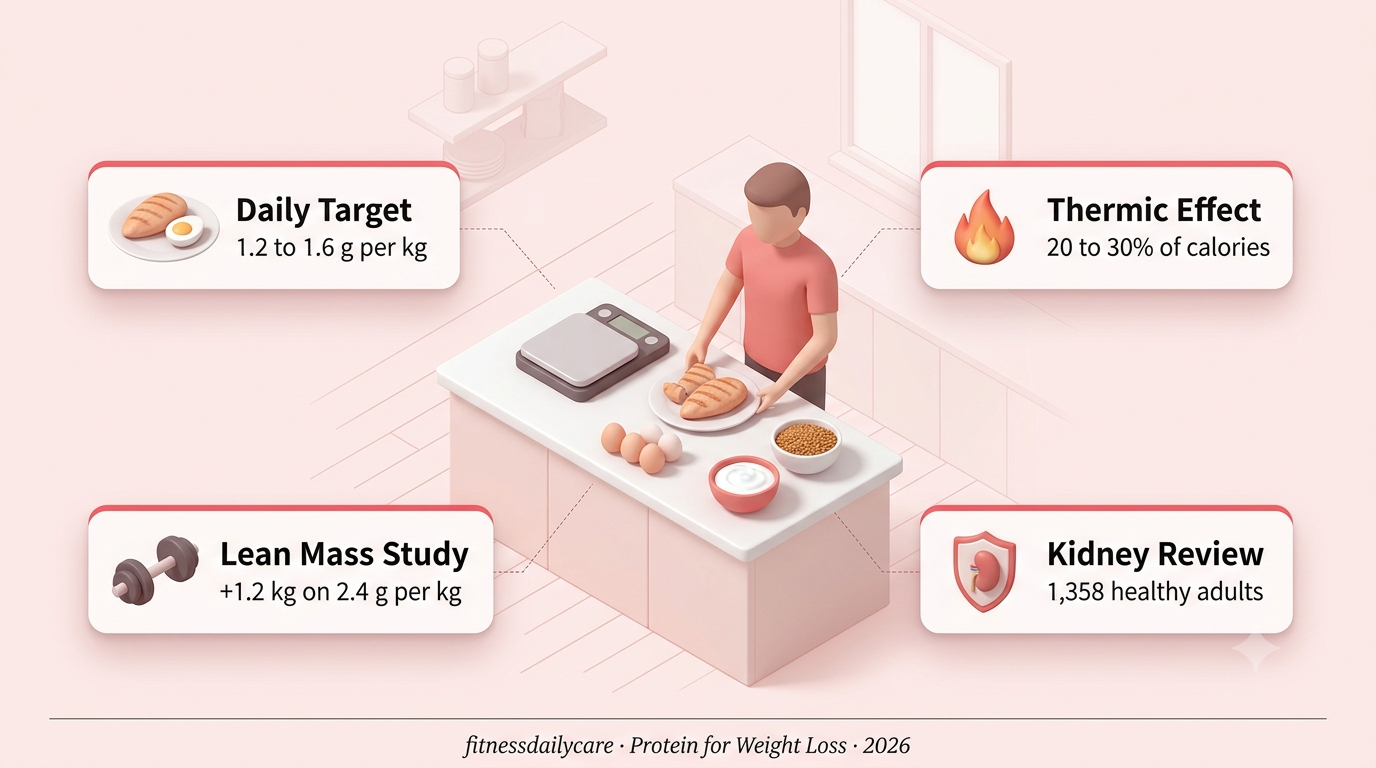
Protein for Weight Loss, Aim for 1.2 to 1.6 g Per Kilogram
What the research says about how much protein protects muscle, keeps you full, and whether the kidney and 30 g per meal myths hold up.
You can eat fewer calories and still lose the wrong kind of weight. In a deficit, the body pulls energy from fat and from lean tissue. How much comes from each depends heavily on how much protein you eat and whether you lift.
Picture a common diet day: toast and coffee, a salad at lunch, pasta at dinner. The calories fit the plan, but the protein often lands well below the 84 g that sits at the low end of the range for a 70 kg adult. Nothing feels wrong, because the scale keeps dropping.
This protein for weight loss guide closes that gap. You get the daily number, the research behind it, a simple way to split it across meals, and straight answers on the kidney and 30 g per meal myths.
Count grams per kilogram
The US guidelines point to 1.2 to 1.6 g per kg a day. The 0.8 g per kg RDA is a floor, not a plan.
Protein protects lean mass
In a 40% calorie cut, 2.4 g per kg beat 1.2 g per kg for both lean mass and fat loss.
Protein costs the most to digest
It burns about 20 to 30% of its own calories during digestion, the highest of any macronutrient.
Two big fears are overblown
Kidney damage in healthy adults and the 30 g per meal ceiling both fail against the trial data.
Calories decide how much you lose.
Protein helps decide what you lose.
How Much Protein You Actually Need
Daily protein at four intakes
Do the math for your body
Start hereSplit it across your meals
Daily rhythmBuild the plate from food first
Food listPair it with strength training
MuscleUse powder as a gap filler
OptionalTwo Protein Myths, Tested
High protein damages your kidneys
A systematic review and meta-analysis of 28 articles covering 1,358 healthy adults found that higher protein intakes did not adversely affect kidney function. Filtration rate after the trials was somewhat higher on high protein, but the change from baseline did not differ between diets.
Verdict: not supported for healthy adults. The exception is chronic kidney disease, where protein is often limited on medical advice.
Your body can only use 30 g per meal
That idea grew out of short studies that tracked muscle protein synthesis for about four hours. In a 2023 trial, researchers followed 36 healthy adults for 12 hours after 0, 25, or 100 g of protein. The 100 g dose produced a larger and longer-lasting response than 25 g, and it was still going at hour 12.
Verdict: there is no hard per meal ceiling. Spreading protein still helps with fullness and hitting your daily number.
Use your doctor’s number if you have one
If you have chronic kidney disease or a doctor has set a protein limit for you, follow that limit instead of the protein for weight loss range here. Children and teens also have different needs and should get individual advice.
Your 5-point protein check
- I know my range in grams (weight in kg x 1.2 and x 1.6)
- Every meal has a real protein source, including breakfast
- Two strength sessions a week are on my calendar
- Whole foods come first, powder only fills gaps
- I checked with my doctor if I have kidney disease or a set limit
Hit your number first.
Then worry about everything else.
The Bottom Line
- Range: the protein for weight loss target is 1.2 to 1.6 g per kg of body weight a day, per the US 2025 to 2030 guidelines.
- Split: spread it over three meals, about 28 to 37 g each for a 70 kg adult.
- Train: pair protein with strength work so the protein protects muscle.
- Safety: healthy kidneys handled higher protein in the trials reviewed. Kidney disease means following your doctor’s limit.
- Food first: use powder only to fill gaps in a whole-food plan.
Keep Building Your Plan
Protein for Weight Loss, Quick Answers
Is the 0.8 g per kg RDA enough for weight loss?
The RDA remains 0.8 g per kg for healthy adults and is set to prevent deficiency. The US 2025 to 2030 guidelines recommend 1.2 to 1.6 g per kg, and trial data in calorie deficits support going above the RDA to protect lean mass.
Can I eat most of my protein in one meal?
The 2023 trial found no hard ceiling on what muscle can use from one large serving. Even so, spreading protein across meals makes the daily total easier to reach and helps you feel full through the day.
Does a high-protein diet hurt healthy kidneys?
A review of 28 articles and 1,358 healthy adults found no adverse effect on kidney function from higher protein. People with chronic kidney disease are different and should follow their doctor’s protein limit.
Do I need protein powder to hit my number?
No. Eggs, poultry, fish, dairy, lentils, and tofu can cover it. Powder is a convenience for days when food falls short.
Editor’s note: sources
- US Dietary Guidelines for Americans 2025 to 2030 (USDA and HHS, released January 7, 2026), as summarized in American Family Physician 2026;114(1)
- Morton et al., British Journal of Sports Medicine, 2018 (49 trials, 1,863 participants)
- Longland et al., American Journal of Clinical Nutrition, 2016 (40 men, 4 weeks, ~40% energy deficit)
- Trommelen et al., Cell Reports Medicine, 2023 (0, 25, or 100 g protein, 12-hour tracking)
- Devries et al., 2018 systematic review and meta-analysis of protein and kidney function (28 articles, 1,358 participants)
- Thermic effect ranges are the commonly cited figures from nutrition physiology literature