
Fasted Cardio, Why Burning More Fat Didn’t Mean Losing More
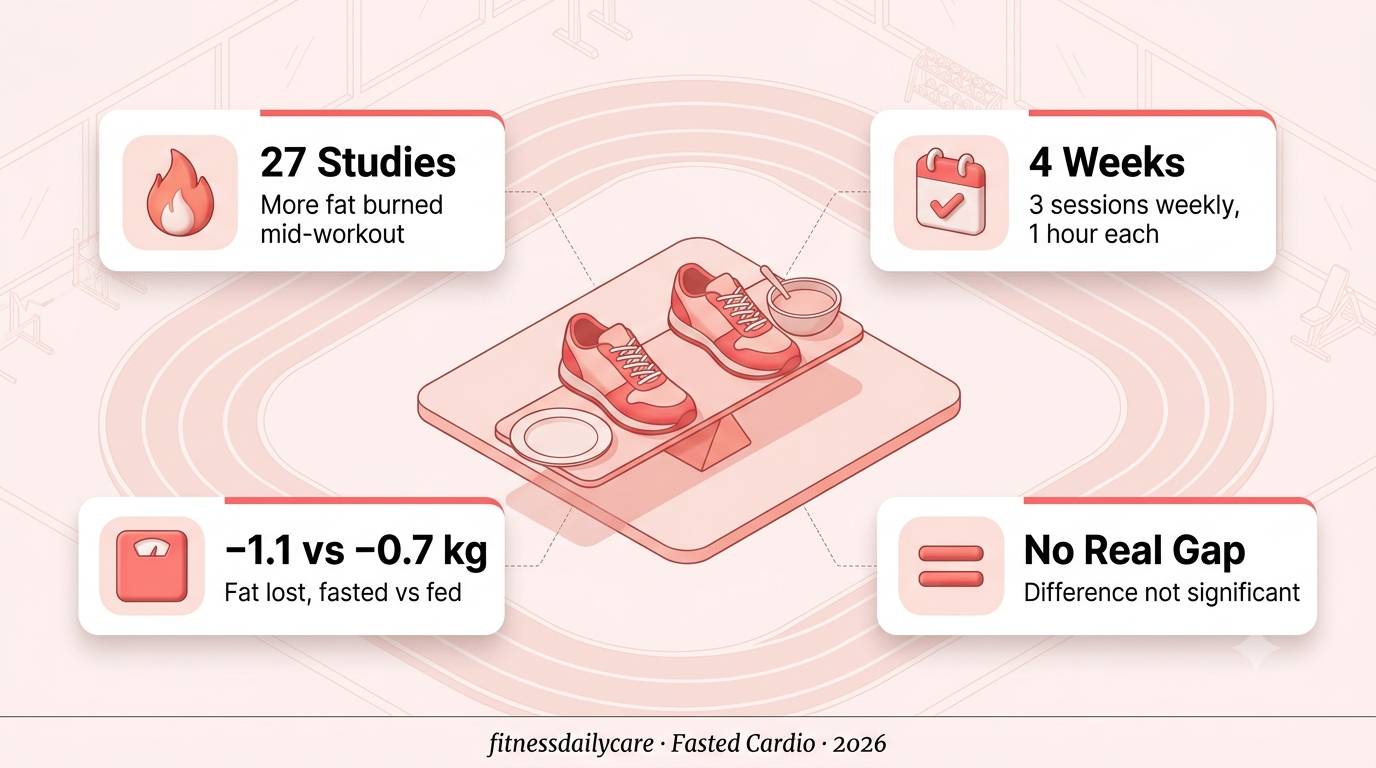
Pooled studies show fasted workouts burn more fat during the session. A 4-week trial on a calorie-restricted diet found fasted and fed groups lost fat at statistically similar rates.
Fasted cardio might be the most repeated piece of fat-loss advice in any gym. The logic sounds airtight: after an overnight fast, your body has less readily available carbohydrate, so it leans on stored fat for fuel. And that part holds up. A 2016 meta-analysis pooling 27 studies and 273 adults found that aerobic exercise done fasted produces higher fat oxidation during the session than the same exercise done fed.
The catch is that burning more fat during a workout isn’t the same as losing more body fat over weeks. In 2014, researchers tested exactly that question in 20 young women on a calorie-restricted diet. Everyone did one hour of steady-state cardio three days a week for four weeks. One group trained after an overnight fast and had a meal replacement shake afterward; the other had the shake beforehand. Both groups lost a significant amount of weight and fat mass. The fasted group lost about 1.1 kg of fat and the fed group about 0.7 kg, but the difference wasn’t statistically significant on any measure. A 2017 systematic review of five studies reached the same conclusion: the between-group effect on body mass and composition was trivial.
This article covers what that research does and doesn’t prove, and how to decide when to do your own cardio without treating timing as the main event.
Why It Sounds Right
After an overnight fast the body relies more on fat for fuel, and pooled data from 27 studies confirms fat oxidation runs higher during fasted sessions.
What the 4-Week Trial Showed
Schoenfeld et al. found both groups lost weight and fat on a calorie deficit, with no significant difference between fasted and fed.
The Myth This Breaks
“Burning more fat during the workout means losing more fat over time” — the body-composition data didn’t follow the in-session numbers.
What Actually Works
Train at the time you’ll actually show up, and keep the calorie deficit that both groups in the trial were following.
Burning more fat during the workout
isn’t the same as losing more fat by Friday.
Fasted Cardio, the Practical Version
Train When You Can Actually Be Consistent
FoundationIf timing doesn’t change fat loss in a controlled trial, the best slot is simply the one you’ll keep. A session you skip because it’s too early, or too hungry, burns nothing, fasted or not.
Eat First If You Feel Flat or Lightheaded
PerformanceThe fed group in the trial had a meal replacement shake before training and lost fat just as well as the fasted group. Eating beforehand didn’t cost anything in fat-loss terms, so if an empty stomach leaves you sluggish, there’s no evidence you’re giving anything up by having a small meal.
Keep Your Eye on the Calorie Deficit
The Big LeverBoth groups in the trial were given customized diets designed to create a calorie deficit. That’s the controlled variable that made fasted and fed look the same. Workout timing didn’t create the fat loss in either group; the deficit and the exercise volume did.
Fasted Is Fine If You Prefer It
Honest FramingNone of this says fasted cardio is worse. In the trial, the fasted group lost at least as much fat as the fed group, and some people simply prefer to train before breakfast. The takeaway is that it isn’t a special fat-loss advantage, not that it’s a mistake.
- Choose the time you’ll keep — consistency beats timing in the available data
- Eat first if training fasted feels bad — the fed group lost fat just as well
- Hold a calorie deficit — both trial groups followed one, and that drove the results
- Don’t expect a fat-loss edge from the empty stomach alone
- Fasted is still fine if you like it — it just isn’t special
⚠️ What This Research Doesn’t Settle
1. The trial is small and short. Twenty young women, four weeks, steady-state cardio only. It doesn’t tell us how men, older adults, or interval training would respond.
2. The meta-analysis has limited data. The 2017 review included only five studies, and its authors caution that the small number of studies means the findings should be read carefully.
3. This isn’t medical guidance on fasting. People with diabetes, anyone on medication, or anyone who feels faint exercising on an empty stomach should talk to a doctor about the right approach for them.
The best time to do cardio
is the time you’ll actually do it.