
Massage Guns, Do They Actually
Speed Up Recovery
They loosen you up in the moment. Whether they make you recover faster is a much shakier claim.
Massage guns are one of those gym-bag staples I bought on pure momentum. Everyone around me had one, the marketing promised faster recovery, and a few minutes on a tight quad genuinely felt great. So I never questioned it.
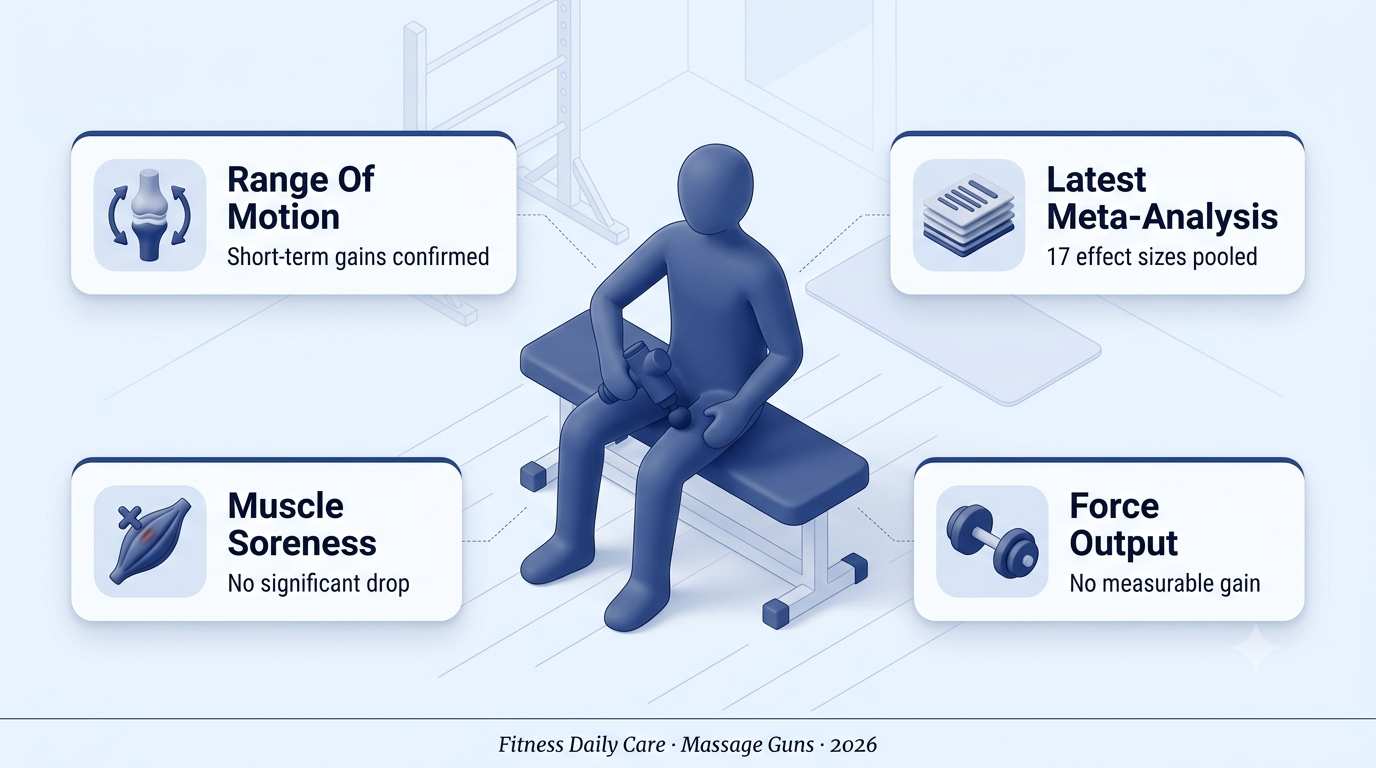
Then I went looking at the actual research, and the picture splits in two. On one side, reviews consistently find that massage guns improve short-term range of motion and make tight muscles feel looser. On the other, a recent meta-analysis pooling 17 effect sizes found they didn’t significantly reduce post-exercise soreness, and earlier reviews found no meaningful boost to muscle force or activation.
So are massage guns worth it, or just an expensive vibration habit? This article breaks down what the evidence supports, what it doesn’t, and how to use one without overselling it to yourself.
Range Of Motion Gets A Short Boost
Two 2023 systematic reviews agree that a single session of percussive therapy produces acute gains in flexibility and range of motion.
Soreness Relief Isn’t Proven
The latest pooled analysis of 17 effect sizes found no statistically significant reduction in delayed onset muscle soreness.
More Time Isn’t Better
Meta-regression suggested that excessive treatment duration may be linked to higher soreness scores, not lower ones.
Skip It Before Power Work
Reviews don’t recommend massage guns before strength, balance, agility, or explosive activities, where they showed no benefit and sometimes harm.
What A Massage Gun Is Actually Doing
The BasicsMassage guns deliver rapid bursts of pressure to muscle and connective tissue, a method called percussive therapy. The theory is that this increases blood flow, reduces tissue tension, and helps muscles recover faster after hard training.
The key word there is theory. Research on handheld percussive devices only took off in the past few years, and the findings so far are more mixed than the marketing suggests.
Where The Research Is Solid: Range Of Motion
What WorksA 2023 systematic review in the Journal of Functional Morphology and Kinesiology concluded that massage guns can improve short-term range of motion, flexibility, and recovery-related outcomes such as stiffness after a fatigue protocol. A meta-analysis of acute effects reached a similar conclusion on flexibility.
One literature review even found handheld percussive devices outperformed foam rolling for increasing lower-limb range of motion, which makes them a legitimate warm-up or cool-down tool when mobility is the goal.
Where The Claims Fall Apart: Soreness And Strength
What Doesn’tAn earlier review of 39 studies found that massage guns improved flexibility and reduced soreness in some trials but did not significantly change muscle activation or force production. The more recent meta-analysis went further: pooling 17 effect sizes, it found no statistically significant reduction in post-exercise soreness (Hedges’ g = 0.14, p = 0.40).
That analysis also found percussive therapy may help countermovement jump recovery and lower creatine kinase levels, but showed no clear benefit for recovering maximal voluntary strength. And a 2023 review specifically advised against using massage guns before strength, balance, agility, or explosive activities.
How To Use A Massage Gun Without Overselling It
Practical UseIf you already own one, it’s a reasonable tool for easing tightness and improving mobility after training or before an easy session. Keep treatment brief per muscle group, use it as a comfort and mobility aid, and don’t count on it to erase soreness.
If you’re deciding whether to buy one, the research suggests the real recovery drivers still matter more: sleep, food, total training load, and rest days.
A massage gun can make a tight muscle feel better.
That’s not the same as making it recover faster.
- Use it for mobility — a tight hamstring or calf before an easy session is a fair use case
- Keep sessions short per muscle — long treatments may backfire on soreness
- Skip it before heavy, explosive, or balance-heavy work where it hasn’t shown benefit
- Don’t swap it for sleep, protein, or rest days — those drive recovery far more
- Judge it by how you feel, not by the promise of faster muscle repair
⚠️ Check With A Clinician First If
1. You have a diagnosed injury or unexplained pain. Percussing an injured area can make things worse. Get it assessed rather than massaging through it.
2. You have a circulation condition or take blood thinners. Repeated pressure on soft tissue is worth clearing with a doctor in that case.