
Post-Workout Stretching, Why It Matters More Than Pre
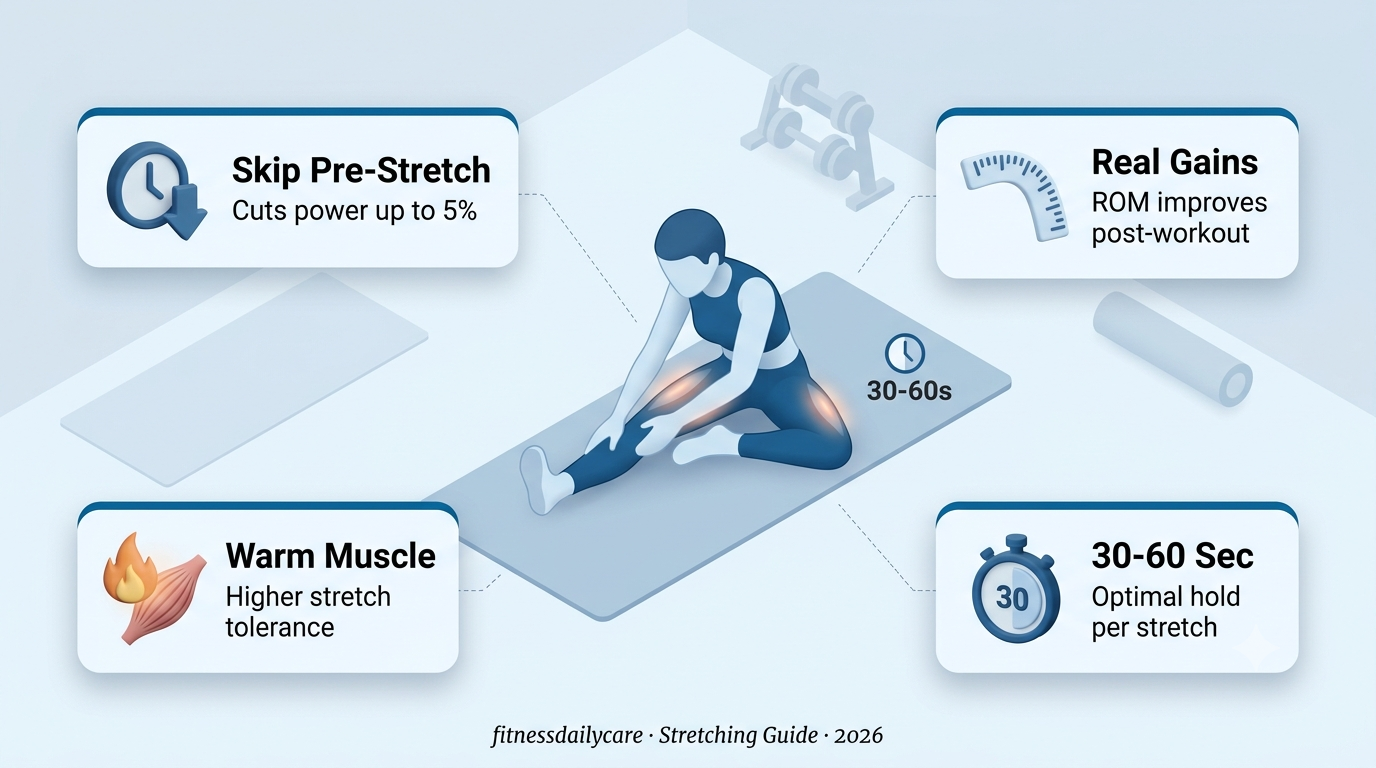
Stretching before a workout can reduce strength and power for the session. Stretching after is when flexibility actually improves. The order matters more than most lifters realize.
Post-Workout Stretching is the recovery step most lifters treat as optional and most sports scientists treat as essential. The order matters more than intensity or duration. Static stretching done before a workout — the way most gym-goers were taught in high school PE — has been shown across dozens of studies to temporarily reduce strength, power, and explosive performance for the session that follows. The same stretches done after training deliver almost all the same flexibility benefits without any of the downsides.
The confusion traces back to a mid-1990s consensus that all stretching was good, all the time, and it took the field two decades to sort out when and why that wasn’t true. A 2013 meta-analysis by Simic and colleagues in the Scandinavian Journal of Medicine & Science in Sports pooled the evidence and concluded that static stretching immediately before explosive activity — sprints, jumps, heavy lifts, throws — reduced peak performance by measurable margins. Behm et al. later refined the picture: holds under 60 seconds cause minimal harm, but the traditional “stretch and hold for a couple minutes to warm up” ritual is worse than useless before serious training.
Meanwhile, the same static stretches placed at the end of a workout become almost purely beneficial. Muscle temperature is elevated (about 2°F warmer than baseline), which increases stretch tolerance and viscoelastic deformation — the actual mechanism by which stretching produces lasting range-of-motion gains. The nervous system is transitioning from sympathetic (fight/flight) to parasympathetic (rest/digest) mode, so mobility work now doubles as a downshift signal that helps close the training session.
None of this means pre-workout mobility is bad. Dynamic warm-ups — controlled movement through progressively larger ranges — are the pre-workout format that actually works. It’s static stretching (holding a position for extended time) that belongs at the end. Post-Workout Stretching is where the flexibility investment pays off. Pre-workout is where you unintentionally cash out some of your strength for no gain.
The rest of this guide covers the five reasons this order matters, what a proper post-workout stretch protocol looks like, and the common mistakes that undo the benefits even when the timing is right.
Warm muscles = higher stretch tolerance
Post-workout muscle temperature is 1-2°F above resting baseline. This directly improves viscoelastic deformation and lowers the pain threshold for productive stretching without injury.
Pre-stretch blunts power output
Static holds before training reduce tendon stiffness and neural drive. The result: measurably lower strength, jump height, and sprint speed for the following session.
Post-stretch aids nervous system downshift
Slow static holds trigger parasympathetic activation, helping your nervous system exit workout mode. This improves post-training relaxation, sleep quality, and recovery.
Injury prevention is a myth for pre-stretch
Multiple meta-analyses have found no meaningful injury reduction from pre-workout static stretching in healthy adults. The rationale never matched the evidence.
Stretch before to warm up? No.
Stretch after to see gains? Yes.
Post-Workout Stretching: 5 Reasons Timing Beats Duration
Warm Muscles Actually Stretch Further, Safely
Muscle tissue behaves differently at different temperatures. Cold muscle is stiff, resistant to elongation, and vulnerable to microtears when forced into extended positions. Warm muscle — post-workout muscle — has already undergone the exact tissue changes that let it stretch productively: raised core temperature by 1-2°F, increased blood flow to the working areas, and more pliable connective tissue. This is the biological reason ballet dancers stretch after class, not before.
Range-of-motion gains from stretching depend on something called viscoelastic deformation — the mechanical property of tissue that allows it to lengthen when held under tension and gradually retain some of that new length. Viscoelastic deformation happens faster and more completely when tissue is warm. Cold-muscle stretching either produces trivial gains or pushes tissue past its yield point into injury territory. Warm-muscle stretching is the sweet spot where flexibility actually accumulates.
Post-Workout Stretching also feels different subjectively. Positions that felt uncomfortable during a pre-workout warm-up feel available and even relaxing after training. That’s not just muscle temperature — it’s also that neural inhibition (the reflexive tension that stops muscles from reaching full length) has partially released after training. Your body is more willing to let you into deep stretch positions when the workout is already behind you.
Physical therapists working with high-performing athletes often use this exact window strategically. If they need to improve a specific joint’s range of motion — say, hip flexion in a client with chronic tightness — they schedule the mobility work at the end of the session rather than the beginning. The 20-30% greater stretch tolerance available in warm muscle translates directly into faster ROM progression over weeks.
Pre-Workout Static Stretching Blunts Power
The Simic 2013 meta-analysis and follow-up studies from Behm and colleagues have made this one of the most-replicated findings in exercise science: static stretching held for 60 seconds or longer immediately before explosive activity reduces strength, jump height, sprint speed, and power output by measurable margins. The effect is small in absolute terms (typically 3-5%), but small enough matters for anyone chasing a training PR, a race time, or a sport-specific performance target.
The mechanism is two-part. First, prolonged static stretching temporarily decreases tendon stiffness, and stiff tendons transfer force better than compliant ones during rapid contractions. Second, extended stretch positions reduce the neural drive to the stretched muscle for a short window afterward — the nervous system essentially downregulates output to a muscle that just signaled it was near its length limit. Neither effect is desirable at the start of a workout.
The practical solution has become the standard recommendation among coaches and physical therapists: replace pre-workout static holds with dynamic warm-ups. Leg swings, hip circles, walking lunges, arm circles, high knees, torso rotations — these prepare the same tissues for exercise without the strength cost. Save static stretching for the post-training window when the power output no longer matters.
Slow Stretches Downshift Your Sympathetic Drive
Training pushes your autonomic nervous system into sympathetic dominance — the “fight or flight” state where cortisol is elevated, heart rate variability compresses, and the body prioritizes readiness for physical demand. This is the exact state you want during a workout. It’s also the state you want to exit efficiently after one, because the ability to shift back to parasympathetic dominance (“rest and digest”) is what drives recovery, sleep quality, and long-term training capacity.
Post-Workout Stretching, done slowly with deep breathing, is one of the most effective ways to accelerate that autonomic downshift. Long holds combined with intentional exhale patterns activate the vagus nerve, which is the master switch for parasympathetic transition. This is why yoga cool-downs feel different from just sitting on a bench — the specific combination of slow stretching and breathing produces a measurable HRV response you can track on a wearable.
Athletes who skip stretching often report the sensation of feeling “wired” for hours after training. That’s not imagination. It’s residual sympathetic activation that hasn’t been signaled to downregulate. A 10-minute post-workout stretch routine — even a short one — solves this reliably by giving the nervous system the exit ramp it needs.
This effect stacks with sleep quality on training days. Evening lifters who transition directly from workout to shower to bed often have fragmented sleep or delayed onset — the residual sympathetic drive interferes with the parasympathetic activation needed for restful sleep. A 10-minute stretch routine bridging the workout and the wind-down window reliably improves sleep onset by 10-15 minutes on training days, according to consumer wearable data patterns.
The Recovery Benefit Is Real, But Not Where You Think
The most common reason people cite for stretching — “to prevent injury” — is actually the weakest one, at least for pre-workout stretching. Multiple large-scale reviews have failed to find meaningful evidence that static stretching before exercise reduces acute injury rates in healthy adults. The idea sounded intuitive and got repeated for decades before the data caught up.
But Post-Workout Stretching does contribute to injury prevention through a different mechanism: over-time preservation of tissue quality and range of motion. Athletes who maintain full ROM through their joints move more efficiently, recruit fewer compensatory patterns, and expose their bodies to less repetitive stress at extremes of motion. A regular cool-down stretch routine — sustained over weeks and months — gradually builds the mobility reserve that protects against overuse injuries and movement dysfunction.
The recovery benefit for delayed onset muscle soreness (DOMS) is modest but real. Research consistently shows a small reduction in reported muscle soreness in the 24-48 hours after training when a post-workout stretch routine is followed. It won’t eliminate soreness — that’s overwhelmingly driven by the eccentric phase of the workout itself — but it can shave 10-20% off the peak intensity, which for anyone training frequently is meaningful.
The 30-60 Second Hold Rule
The dose-response research on static stretching has converged on a fairly narrow window. Holds shorter than 20 seconds provide only transient relief — the tissue lengthens temporarily but returns to baseline within minutes. Holds between 20 and 30 seconds start to produce measurable ROM gains but leave meaningful improvement on the table. Holds in the 30-60 second range are where lasting flexibility change actually happens, and holds beyond 90 seconds show diminishing returns without added benefit.
The practical recommendation used by most sports medicine clinicians: 30 seconds for smaller muscle groups (calves, hip flexors, wrists), and 45-60 seconds for larger ones (hamstrings, hip external rotators, thoracic spine). Repeat each stretch 2-3 times per session. Total time investment is 8-12 minutes for a comprehensive Post-Workout Stretching routine that hits all major muscle groups worked during that day’s training.
This is where most gym-goers get it wrong even when they do stretch. The 15-second casual hold most lifters use as a “cooldown” is genuinely not enough to trigger lasting change. If you’re going to invest the time in stretching, the difference between a 15-second hold and a 30-second hold is the difference between temporary relief and actual flexibility gain. Sixty seconds is where the biggest bang-for-buck happens for the tighter areas most desk-bound adults carry chronically.
Physical therapists and sports medicine researchers now describe the 30-60 second range as the “viscoelastic sweet spot” — long enough for the tissue’s mechanical properties to shift into productive lengthening, short enough that fatigue and boredom don’t lead to abandonment. When clients report stretching without improvement, the fix is almost always increasing hold time, not adding more stretches or sessions. Duration is where flexibility hides.
⚠ The Common Mistake: Bouncing Into Stretches
Ballistic stretching — bouncing repeatedly into and out of stretch positions — was once considered normal in warm-ups and sports drills. Modern sports medicine has largely retired it because the technique triggers the stretch reflex (a protective muscle contraction), which tightens the very tissue you’re trying to lengthen. The result: reduced flexibility gains, higher injury risk, and no meaningful performance benefit compared to static or dynamic alternatives.
For Post-Workout Stretching, the rule is simple: ease into the position, breathe out, and hold. If you feel yourself bouncing, wobbling, or repeatedly pushing further into a stretch, back off. Static stretching means static. If you want dynamic movement post-workout, walking or slow flow yoga are better tools than ballistic bouncing.
Post-Workout Stretching: The 10-Minute Cool-Down Routine
▎ The 5-Step Post-Workout Stretching Protocol
- Finish your last set → walk 3-5 minutes. Bring your heart rate down first. Trying to stretch while your pulse is still 150+ bpm blocks the parasympathetic transition and makes each hold feel harder than it should.
- Target the muscles you trained today. Leg day → hamstrings, quads, calves, hip flexors, glutes. Upper body → chest, lats, shoulders, forearms. Skip the areas you didn’t work — that’s ordinary mobility maintenance, not cool-down.
- Hold each stretch 30-60 seconds. 30 for small muscles (calves, hip flexors, forearms). 45-60 for larger ones (hamstrings, hips, thoracic spine). Anything less than 20 is temporary relief without real gain.
- Breathe out into each position. Long exhales activate vagus nerve and parasympathetic response. Never hold your breath — the reflexive tension defeats the stretch.
- Repeat each stretch 2-3 times. The second and third rounds go noticeably deeper than the first. Total routine: 8-12 minutes for comprehensive coverage. Efficient and complete.
15-second holds feel productive.
30-second holds actually work.
4 Stretching Mistakes That Undo the Timing Advantage
Rushing through 10-second holds
Ten seconds triggers virtually no lasting flexibility change. It feels productive because muscles briefly relax, but the tissue returns to baseline within minutes. Set a timer if 30 seconds feels long.
Stretching to sharp pain
Discomfort is fine. Pain isn’t. Pain triggers the stretch reflex and tightens the muscle you’re trying to lengthen. The target is 6-7 out of 10 tension, not maximal effort.
Skipping stretches for untrained days
Cool-down stretching is workout-specific. If you didn’t train today, ordinary mobility work covers the maintenance need — you don’t need the full post-workout routine.
Holding breath during stretches
Breath-holding activates sympathetic tension, defeats parasympathetic downshift, and makes each stretch feel harder than it should. Slow exhales into the position are non-negotiable.
Post-Workout Stretching · The Verdict
Warm muscles stretch better than cold ones — post-workout is biologically the ideal window for real flexibility gains, not pre-workout.
Pre-workout static stretching costs 3-5% power — Simic 2013 meta-analysis. Not a myth. Replace with dynamic warm-up.
Post-stretching helps nervous system downshift — long holds with slow exhales activate the vagus nerve and accelerate recovery.
30-60 second holds are the sweet spot — less doesn’t work, more doesn’t add. Repeat each stretch 2-3 times.
Injury prevention myth is dead — pre-stretching doesn’t prevent acute injury. Post-stretching preserves long-term movement quality instead.