
Sauna Benefits, What the Finnish
Heart Study Can’t Prove
Frequent sauna use is linked to a 63% lower risk of sudden cardiac death in Finnish data. Here’s why that number needs context, and what new mental health trials are adding.
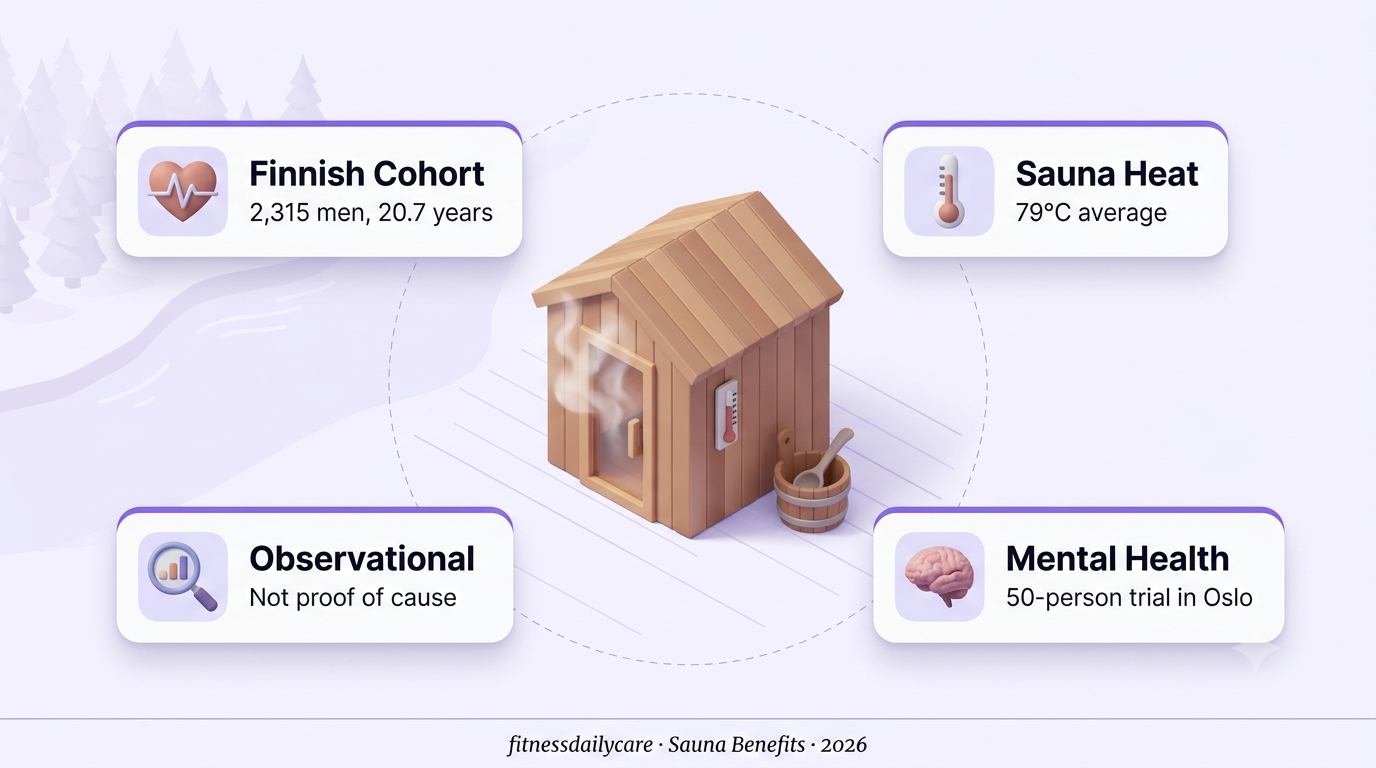
Sauna benefits look almost too good in the headline numbers. A Finnish study that followed 2,315 men for a median of 20.7 years found that those who used a traditional sauna 4 to 7 times a week had a 63% lower risk of sudden cardiac death than men who used one once a week. For fatal heart disease and death from any cause, the reductions ran roughly 40% to 50%. It’s one of the most cited findings in wellness, and it’s the reason sauna memberships keep climbing.
The catch is in how the study was built. It was observational, so it can only show that frequent sauna users died less often, not that the sauna itself is the reason. Even the comparison group used a sauna once a week, and critics pointed out that regular sauna bathing may simply be a marker of a healthier, more active lifestyle. The participants were also all Finnish men using a dry sauna at around 79°C, which is a narrow slice of the people now buying home saunas.
What’s new this month is the mental health angle. NPR reported on October 5 that researchers are now testing whether heat can ease depression, stress, and sleep problems, including a 50-person randomized trial in Oslo and NIH-funded work at UCSF. Early small studies are promising, but the scientists involved describe the field as still very early. The cardiovascular story is well known, the mental health story is just getting started.
What the Finnish study found
Among 2,315 men, sauna use 4-7 times a week was linked to a hazard ratio of 0.37 for sudden cardiac death versus once a week, a 63% lower risk.
Why it isn’t proof
It was observational. Frequent sauna users may simply be healthier or more active overall, which a letter to the journal pointed out soon after publication.
More sessions, lower risk
Risk fell in steps from 1, to 2-3, to 4-7 sessions a week, and longer sessions also showed an inverse trend, though still only an association.
The new mental health angle
Heat triggers an anti-inflammatory response similar to exercise, and animal studies hint at mood effects. Human trials are only now getting underway.
Read sauna benefits as an association, not a prescription
Mindset shiftThe 63% figure is real, but it compares frequent sauna users with men who still used one weekly, in one country, over two decades. It can’t tell you that adding a sauna to your week will cut your own risk by anything close to that.
Treat the mental health claims as promising, not settled
Early scienceResearchers at Oslo Metropolitan University are recruiting 50 people for a randomized trial pairing sauna with mental health habits, and a UCSF team has NIH funding to study heat therapy for depression, sleep, and loneliness. Small early studies reported many participants in remission, but the people running this research say it’s still the beginning.
If you try it, keep it simple and keep it safe
PracticalThe Finnish men used a traditional dry sauna for roughly 20 minutes a session. Staying hydrated, leaving when you feel dizzy, and skipping alcohol beforehand are standard precautions. People with heart conditions, low blood pressure, or who are pregnant should check with a clinician first.
Big numbers, small print.
Real enough to study, not proven enough to prescribe.
- Frequency mattered in the data — risk fell from 1, to 2-3, to 4-7 sessions a week, but only as an association
- Sessions ran about 20 minutes — at roughly 79°C in a traditional Finnish dry sauna
- Stay hydrated and skip alcohol — standard precautions before any heat exposure
- Check with a clinician if needed — heart conditions, low blood pressure, or pregnancy
- Don’t replace treatment — mental health benefits are still being tested
⚠️ What the Sauna Headlines Leave Out
1. It was observational. The study can show a pattern, not that the sauna caused the lower risk. Healthy-lifestyle differences between frequent and occasional users are a known concern.
2. The sample was narrow. The men were Finnish, used a traditional dry sauna, and even the low-frequency group used one weekly, so there was no true non-sauna comparison.
3. Mental health benefits are unproven. The trials are small or still recruiting, and heat therapy isn’t a substitute for professional care for depression.