
Love Handles Gone, 5 Things People Who Lost Them Actually Did
Flank fat is the last to go. Not because you’re doing it wrong, but because the biology is stacked against it. Here’s what actually breaks through.
Here’s the reality about love handles: they’re not there because you skipped oblique crunches. They’re there because the fat cells in your flanks are biologically designed to hold on longer than fat cells almost anywhere else on your body. Higher alpha-2 receptor density, fewer blood vessels, and a hormonal environment — cortisol and insulin — that preferentially routes excess energy to the midsection.
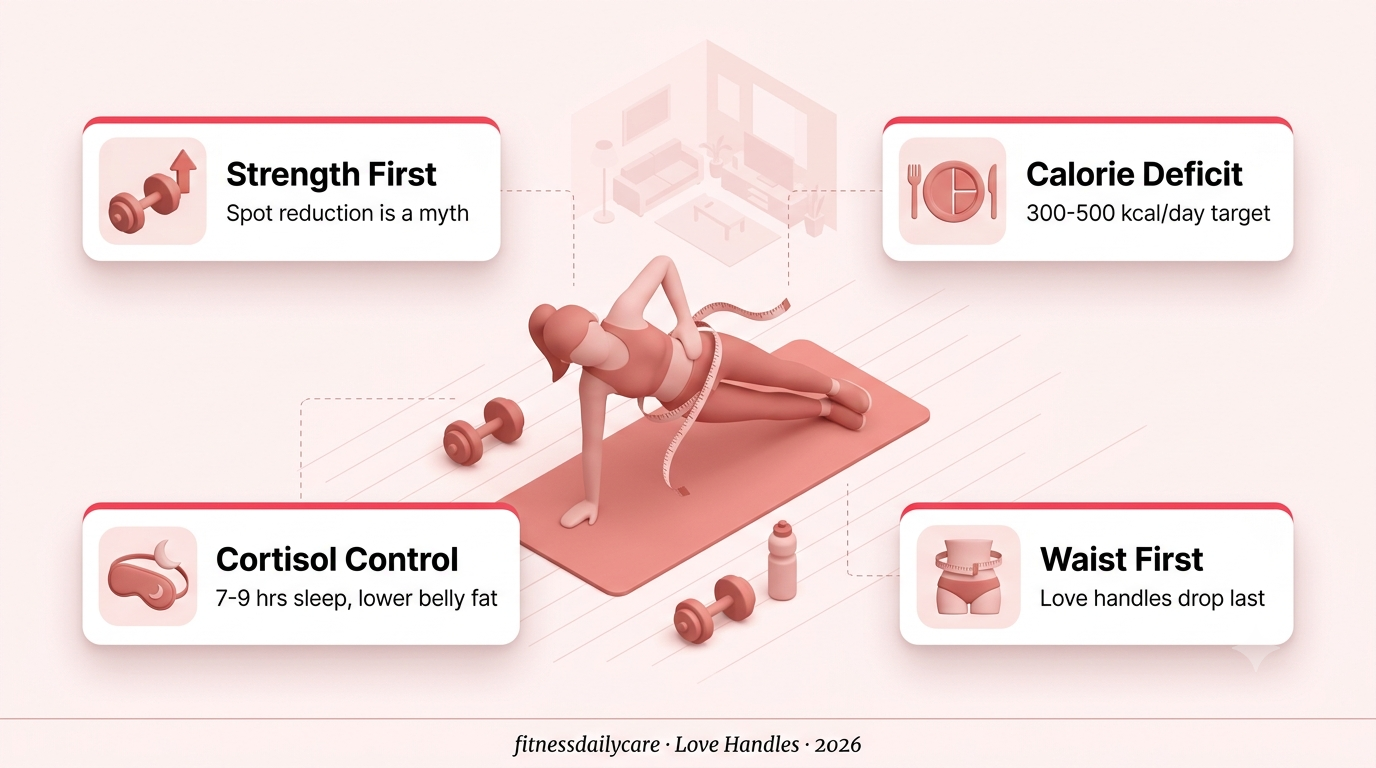
Spot reduction doesn’t work. Every major study on targeted exercise and localized fat loss confirms it. What does work is lowering overall body fat percentage to the point where the body is forced to tap into those stubborn flank reserves. And that takes the same five habits, over and over, in every person who’s actually done it.
What follows isn’t a 6-week transformation promise. It’s what the peer-reviewed research and the observable patterns in people who’ve genuinely lost their love handles have in common — and why the process takes longer than most fitness content admits.
Alpha-2 receptors block fat release
Love handle fat cells have more alpha-2 receptors (which inhibit lipolysis) relative to beta-2 receptors (which accelerate it). This unfavorable ratio means the flanks resist fat mobilization signals that work fine on arms, legs, and face.
Cortisol steers fat to the midsection
Chronic stress elevates cortisol, which preferentially drives fat storage around the abdomen and flanks (Psychosomatic Medicine 2018). Poor sleep and excess alcohol amplify the effect.
Spot reduction is scientifically dead
Every major trial on targeted exercise shows no localized fat loss. Oblique crunches build oblique muscle but do nothing to the fat layer on top. Systemic body fat reduction is the only path.
Love handles drop after everything else
Face, arms, chest, upper back all lean out before the flanks respond. This is why people quit at the 70% mark — the first areas to change aren’t the areas they care about most.
You can’t crunch your way out
of a receptor problem.
They ran a moderate calorie deficit, not a crash diet
The foundationEvery person who’s lost love handles sustained a 300 to 500 kcal/day deficit — enough to lose roughly 0.5 to 1 lb per week, not enough to trigger metabolic adaptation or crash the metabolism. Extreme deficits (1,000+ kcal) cause cortisol spikes, muscle loss, and adaptive thermogenesis — all of which preferentially preserve flank fat and strip muscle instead.
The math takes longer than most people want. At half a pound per week, noticeable love handle reduction takes 12 to 20 weeks after the face, arms, and upper body have already leaned out. Patience isn’t optional; it’s the strategy.
They prioritized full-body strength training over cardio
The muscle leverPeople who lose love handles don’t do it on the treadmill alone. They lift. Compound movements — squats, deadlifts, rows, overhead presses, lunges — build the lean mass that raises basal metabolic rate, improves insulin sensitivity, and creates the body composition shift that makes flank fat visible. More muscle means more daily calorie burn at rest, which sustains the deficit without having to eat less.
Side bends and oblique crunches have their place for core stability, but they don’t melt the fat sitting on top. The muscle underneath grows; the subcutaneous fat layer stays until the overall body fat percentage drops low enough.
They slept 7 to 9 hours and managed cortisol
The hormone environmentCortisol is the single biggest hormonal driver of midsection fat storage. Chronic sleep deprivation (under 6 hours), sustained psychological stress, and excess alcohol all elevate cortisol levels, which preferentially direct incoming calories to the abdominal and flank regions. A Psychosomatic Medicine study linked elevated cortisol directly to increased abdominal fat in otherwise healthy adults.
People who lose love handles consistently report the same three things: they prioritized sleep, they found a stress outlet (walking, lifting, meditation, whatever worked), and they cut alcohol back significantly. The flank fat didn’t budge until the cortisol environment changed.
They stayed long enough for the flanks to respond
The patience factorThis is the one nobody markets. Love handles are literally the last region to lean out for most people. Face and neck slim first, then arms and chest, then upper back, then lower belly, then flanks. If you quit at week 8 because the flanks haven’t changed, you quit right before they were about to.
The typical timeline for visible love handle reduction (from a starting point of 25–30% body fat in men, 30–35% in women) is 16 to 24 weeks of consistent deficit + training. That’s 4 to 6 months. Most programs promise results in 6 weeks and deliver arm definition, not flank loss.
They stacked NEAT on top of everything else
The free multiplierAfter the deficit, the lifting, and the sleep, what separates people who lose love handles from people who plateau is daily non-exercise activity. Walking after meals, standing desks, taking stairs, fidgeting — the invisible calorie burn that adds 200 to 400 calories per day without recovery cost. Dr. James Levine’s Mayo Clinic research found lean individuals had 350 kcal/day higher NEAT than obese subjects, independent of exercise.
Three post-meal walks per day, aiming for 8,000 to 10,000 total daily steps, is the practical target. It doesn’t replace the gym. It supplements the deficit in a way that doesn’t spike appetite like high-intensity cardio often does.
Love handles don’t resist effort.
They resist impatience.
- 300–500 kcal/day deficit — moderate, sustained, protein-anchored (0.7–1.0 g/lb)
- Full-body strength 3×/week — compounds first, progressive overload, not cardio-dominant
- 7–9 hours sleep — the cortisol control lever most people skip
- 16–24 weeks minimum — flanks respond last; quitting at week 8 is quitting before the payoff
- 8,000–10,000 daily steps — NEAT protects the deficit when the body tries to compensate
⚠️ What Won’t Work for Love Handles
1. Oblique exercises alone. Side bends, Russian twists, and bicycle crunches build the muscle underneath but do not reduce the fat layer on top. Spot reduction has been disproven in every controlled trial.
2. Waist trainers and wraps. These compress tissue temporarily and cause water loss through sweating. No fat cells are affected. The “results” disappear within hours of removing them.
3. Crash diets under 1,200 calories. Extreme deficits spike cortisol, trigger adaptive thermogenesis, and preferentially strip muscle — the exact opposite of what love handle loss requires. The flanks hold on tighter during metabolic stress.