
Shoulder Asymmetry, Why Stretching Alone Never Fixes It
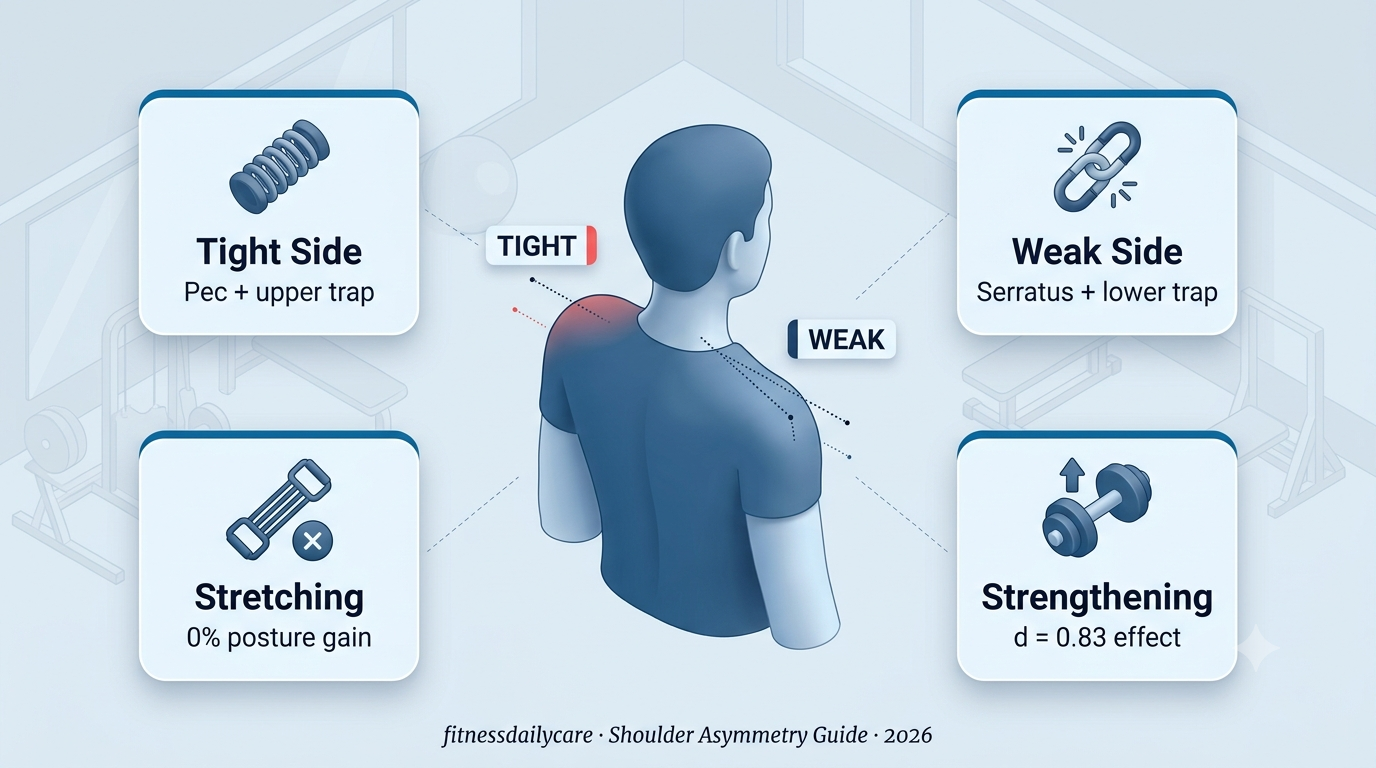
A 2024 meta-analysis of 23 trials found stretching produced 0% improvement in posture. Strengthening produced large gains. The difference is why your shoulders stay uneven.
Shoulder Asymmetry is one of the most common complaints in gym-going adults, and one of the most consistently mismanaged. The standard advice — stretch your tight side, open your chest, roll your upper traps — addresses exactly half the problem. The tight, elevated shoulder gets attention. The weak, underactive muscles on the opposite side that are actually failing to hold the shoulder in position get ignored. Three months later, the stretch feels good for an hour and then everything reverts to exactly where it was.
A 2024 systematic review with meta-analysis (Warneke, Lohmann, and Wilke, published in Sports Medicine Open) put numbers on what physical therapists have been observing clinically for decades. Pooling 23 controlled trials and 969 participants, the researchers found that neither acute nor chronic stretching produced a statistically significant change in spinal or shoulder posture. Strengthening, on the other hand, produced a large effect size of d = 0.83 — meaning the change was substantial and consistent across study populations. You cannot stretch your way to symmetry. You have to build it.
The underlying reason is structural. Shoulder Asymmetry almost always traces back to an Upper Crossed Syndrome pattern, first described by neurologist Vladimir Janda: tight pectorals and upper trapezius on one side pulling the shoulder forward and up, combined with weak lower trapezius, serratus anterior, and deep cervical flexors failing to resist that pull. Stretching the tight pectorals releases tension temporarily. But if the weak scapular stabilizers can’t maintain that released position under load, the shoulder migrates right back. You’re relaxing the chain without reinforcing the anchor.
Add dominant-hand loading patterns — the fact that most people carry, reach, type, and apply force asymmetrically for 8-12 hours a day — and you have a mechanism that actively re-creates the imbalance faster than any daily stretching routine can undo it. The intervention needs to match the scale of the problem. Stretching is a maintenance tool. Strengthening is the correction tool. Most people have the two reversed.
The rest of this guide covers the five root causes of Shoulder Asymmetry, why stretching addresses only one of them, and the specific strengthening interventions that actually hold the correction over time.
You’re relaxing the chain, not anchoring it
Stretching the tight pectoral releases tension temporarily. Without strengthening the weak serratus and lower trap to hold the shoulder blade back, the shoulder migrates forward again within hours.
The dominant-hand load re-creates it daily
8-12 hours of asymmetric loading (mouse, phone, carrying) actively rebuilds the imbalance. Stretching once or twice a day competes against continuous mechanical reinforcement of the wrong pattern.
Overstretched muscles tighten further
Muscles on the long/weak side of an imbalance tighten reflexively when stretched further — the body’s protective response. Stretching those muscles makes symmetry worse, not better.
Scapular position needs active control
The scapula is held in place by 17 muscles working in concert. Passive flexibility has almost no influence on which muscles dominate that tug-of-war. Only targeted strengthening shifts the balance.
You can’t stretch your way to symmetry.
You have to build it.
Shoulder Asymmetry: 5 Causes Stretching Doesn’t Reach
Upper Crossed Syndrome (The Root Architecture)
Vladimir Janda’s Upper Crossed Syndrome is the foundational framework for understanding most cases of Shoulder Asymmetry. The pattern is predictable: the pectorals and upper trapezius become short and overactive (they pull the shoulder forward and up). The deep cervical flexors, lower trapezius, and serratus anterior become long and inhibited (they fail to resist that pull). The result is a shoulder that sits elevated, protracted, and internally rotated on one side.
What makes this pattern resistant to stretching is the inhibition component. Inhibited muscles don’t just need to be lengthened — they need to be reactivated. A muscle that has been neurologically suppressed (through years of dominant-side overuse and habitually poor posture) won’t simply “wake up” because its antagonist was stretched. It needs direct, progressive loading that forces the nervous system to recruit it again. This is what physical therapists call neuromuscular re-education, and it requires strengthening, not stretching.
Shoulder Asymmetry corrections that skip the neuromuscular reactivation step produce temporary improvement at best. The tight pectoral gets released, feels better for a session or two, and then gets pulled forward again by the same inhibited lower trap that was failing all along. The joint returns to its previous position because the actual anchor — the weak side’s ability to hold the shoulder blade in proper position — was never addressed.
Dominant-Side Overuse and Daily Reinforcement
The most overlooked driver of persistent Shoulder Asymmetry is what happens in the 8-12 hours before and after the stretch routine. Using a mouse on the right side, carrying a bag on the left, scrolling a phone with one thumb, writing or typing with a dominant hand — these asymmetric loading patterns are constant, cumulative, and stronger than any twice-daily stretch can undo.
Research from the Journal of Athletic Training documents this specifically in overhead-sport athletes: among male tennis, baseball, and volleyball players, the scapula on the dominant side was consistently more inwardly rotated than the non-dominant side — not because of single acute events, but because thousands of sport-specific repetitions gradually remodeled scapular position over years of practice. The same principle operates on office workers: thousands of daily mouse clicks, phone scrolls, and keyboard strokes apply asymmetric forces to one shoulder repeatedly.
Stretching is a once-or-twice-daily input competing against a constant mechanical signal. The signal wins. The effective intervention addresses both sides: reduce asymmetric loading where possible (switch mouse hands for part of the day, carry the bag on alternating shoulders) and build enough strength in the weaker stabilizers that they can resist the loading without losing position even during dominant-side use.
Overstretching the Wrong Side
This is the counterintuitive failure mode that makes Shoulder Asymmetry worse in people who stretch frequently without assessment: stretching the wrong muscle group. In a typical Upper Crossed pattern, the muscles on the weak/long side (the ones holding the shoulder blade too far from the spine) are already overstretched — the body has allowed them to lengthen too far in the opposite direction of the tight side. Stretching them further activates a protective tightening reflex, which increases rather than decreases tension in those already-compromised muscles.
Most self-directed stretch routines work bilaterally — you stretch the pectoral on both sides equally, you stretch the upper trap on both sides equally. But in an asymmetric body, bilateral stretching applies the same input to a system that is already asymmetric. The tight side gets appropriate stimulus. The weak, elongated side gets a stimulus it doesn’t need and may respond to negatively.
The corrective approach: assess which muscles are short and overactive versus long and inhibited before deciding what to stretch. The short side needs release. The long side needs strengthening and potentially compression, not further elongation. Physical therapists assess this through postural observation and manual muscle testing. A reasonable self-assessment starts with identifying which shoulder is elevated (the dominant-side trap is almost always the culprit) and which direction the shoulder blade is drifting (forward drift = serratus inhibition, not a cause for more chest stretching).
Scoliosis and Leg Length Discrepancy
A percentage of Shoulder Asymmetry cases have a structural root cause that no amount of stretching or strengthening directly addresses: mild scoliosis (a lateral curvature of the spine) or a leg length discrepancy that creates a pelvic tilt. Both conditions produce cascading postural compensation up the kinetic chain, with the shoulders being the most visually obvious endpoint of that cascade.
Scoliosis is more common than most people realize — mild idiopathic scoliosis (curvature under 20 degrees) affects roughly 2-3% of the population, and many people carry a subtle curvature they’ve never had diagnosed. When the spine curves, the ribcage rotates slightly, which rotates the shoulder girdle above it. The resulting shoulder height difference isn’t primarily a muscular problem — it’s a spinal geometry problem. Strengthening and stretching can help manage associated muscle tension and compensatory patterns, but cannot correct the underlying structural asymmetry.
Leg length discrepancy produces a similar cascade via a different route. A pelvis that tilts laterally (because one leg is shorter or because one hip is functionally higher) shifts the entire spinal column sideways, which the thoracic spine compensates for with a counter-curve, which rotates the shoulder. Addressing just the shoulders while ignoring the pelvic foundation solves nothing sustainably.
Gym Patterns That Actively Create Asymmetry
The gym is often where Shoulder Asymmetry gets created and reinforced, not just where people go to fix it. A training program heavily weighted toward pressing movements (bench press, overhead press, dips, push-ups) relative to pulling movements (rows, pull-ups, face pulls) consistently develops the pectorals and anterior deltoids faster than the scapular retractors — exactly the Upper Crossed imbalance pattern. Even lifters who feel “balanced” because they train the whole body are often running a 3:1 or 4:1 push-to-pull volume ratio without realizing it.
Single-arm variations of common exercises add another layer. Most people generate slightly more force from their dominant side during unilateral pressing movements, which both builds and reinforces the dominant shoulder’s tendency to lead. Over years of training, this produces a measurably stronger and often more developed dominant shoulder — with the associated postural shift that entails.
The corrective program doesn’t require abandoning pressing movements. It requires adjusting the ratio. Physical therapists working with Shoulder Asymmetry in gym athletes typically prescribe a 2:1 or 3:1 pulling-to-pressing ratio until symmetry improves, along with single-arm exercises starting on the weaker side and matching the stronger side’s volume to the weaker side rather than the reverse.
⚠ When Shoulder Asymmetry Needs a Professional, Not a Program
Most exercise-based Shoulder Asymmetry improves with the stretch-and-strengthen approach over 4-12 weeks. But some presentations warrant clinical evaluation before starting a self-directed correction program. See a sports medicine physician or physical therapist if the asymmetry is accompanied by radiating pain down one arm, numbness or tingling in the hand, persistent headaches at the base of the skull, or any sharp joint pain with shoulder movement.
These symptoms suggest nerve involvement, cervical disc issues, or rotator cuff pathology that exercise alone won’t resolve and may worsen if loaded aggressively. Shoulder height difference that doesn’t change at all with deliberate postural correction (even momentarily) is also worth evaluating — it may indicate structural causes that need imaging to diagnose properly.
Shoulder Asymmetry: The Stretch-Then-Strengthen Protocol
▎ The 5-Step Correction Sequence (4-8 Weeks)
- Identify what’s tight vs what’s weak. Stand sideways to a mirror. The elevated shoulder: upper trap and pec are usually tight → stretch these. The side where the blade drifts forward: serratus and lower trap are weak → strengthen these. Never stretch the weak, elongated side.
- Release the tight side first. Pectoral stretch (doorway, 45 sec hold × 3), upper trap stretch (ear to shoulder, 45 sec × 3), and levator scapulae stretch. Do this daily as a pre-activation step, not as the primary intervention.
- Activate the weak side. Wall slides (serratus anterior), prone Y-T-W raises (lower and mid trap), and face pulls (rear deltoid + external rotators). 3 sets × 12-15 reps, unilateral where possible, starting on the weak side.
- Adjust your gym ratio. 2:1 pull-to-push ratio for 8 weeks minimum. Add one extra set of rows or pull-ups for every set of bench press or overhead press. Start all unilateral exercises on the weaker side; match the stronger side to the weaker side’s performance.
- Address the daily loading pattern. Switch mouse hand for 30 minutes daily. Alternate bag-carrying shoulder. Adjust monitor height and position (see Monitor Position guide). Environmental changes remove the signal that re-creates the imbalance overnight.
Stretch the tight side.
Strengthen the weak side. Do both.
4 Correction Mistakes That Keep Shoulders Uneven
Stretching both sides equally
Bilateral pectoral stretches feel thorough but apply the wrong stimulus to the weak/elongated side. Assess first, then stretch only the confirmed tight side. The other side needs loading, not lengthening.
Doing strengthening on both sides equally
Starting both sides at the same load hides the asymmetry. Always begin unilateral exercises on the weaker side and match the stronger side to that performance — never the reverse.
Skipping scapular stabilizers for global exercises
Rows and pull-ups help but don’t isolate the serratus anterior or lower trapezius specifically enough for correction. Wall slides and Y-T-W raises target the specific muscles that hold scapular position.
Fixing the gym but not the daily environment
Three sets of corrective exercises can’t offset 8 hours of asymmetric loading at the desk. Environmental changes (mouse hand, bag shoulder, monitor position) are part of the protocol, not optional extras.
Shoulder Asymmetry · The Verdict
Stretching alone produces 0% posture improvement — Warneke 2024 meta-analysis, 23 trials. Strengthening produces large gains (d = 0.83).
Upper Crossed Syndrome is the root pattern — tight pec/upper trap vs inhibited lower trap/serratus. Both sides need different interventions.
Don’t stretch the weak side — overstretched inhibited muscles tighten reflexively. Assess before stretching. The weak side needs loading, not length.
Daily loading patterns re-create the asymmetry — mouse, bag, phone, dominant-hand tasks compete continuously with twice-daily stretches. Address the environment.
Gym push/pull ratio matters — reverse to 2:1 pull-to-push for 8 weeks. Start all unilateral moves on the weak side. Match the strong side to the weak side’s load.