
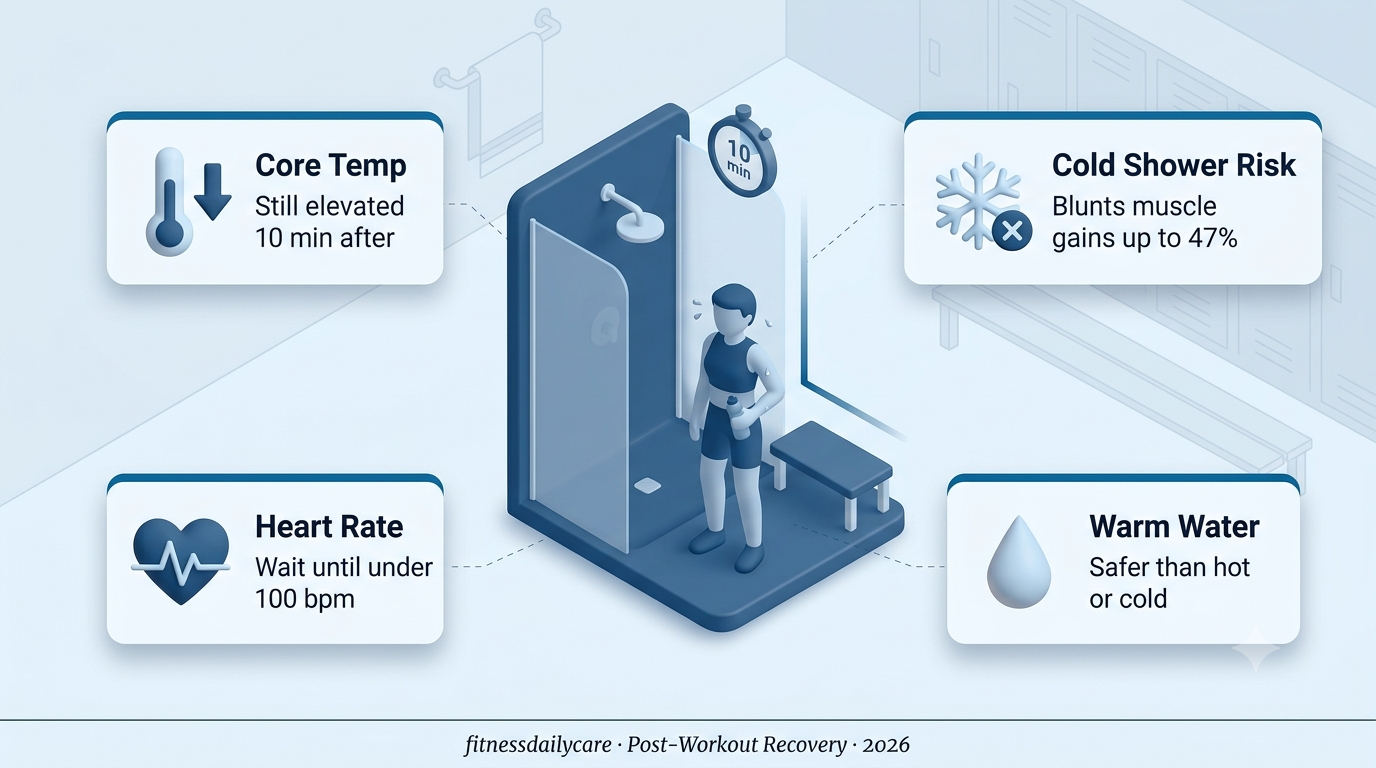
Post-Workout Shower, Why You Should Wait 10 Minutes
Stepping into a shower right after the last set feels efficient. Physiologically, it’s the moment your blood pressure, muscle repair signals, and heart rate are least prepared for the shock.
The Post-Workout Shower feels like the finish line, but physiologically it’s still the middle of your session. When you rack the last set and head straight to the locker room, your heart is still beating close to 130-150 beats per minute, your core temperature is still climbing (not falling), your blood vessels are wide open to dump heat, and your central nervous system is in a heightened sympathetic state. The workout in your head is over. The workout in your body has another 15-20 minutes to run.
Stepping under water in that state is what dietitians and exercise physiologists call a “thermal insult” — a sudden temperature change your body has to react to while it’s already managing another one. Cold water triggers rapid vasoconstriction. Hot water triggers vasodilation on top of already-dilated vessels. Both directions can spike or crash blood pressure fast enough to cause dizziness, and in a small percentage of people with underlying cardiovascular vulnerabilities, worse. The American Heart Association has flagged this specifically as a reason cool-down protocols exist at all.
Then there’s the muscle side. If you’re the kind of lifter who ends every session with a cold shower because it “feels like an ice bath,” a 2015 Journal of Physiology paper has some bad news. Researchers followed 21 men through 12 weeks of resistance training. Half got cold water immersion after each workout. Half got active recovery. The active recovery group ended the study with significantly more muscle fiber growth, more myonuclei per fiber, and more strength — a gap researchers traced back to how cold water blunts the anabolic signaling that drives muscle protein synthesis for hours after training.
The finding has since been replicated in follow-up studies and expanded in a 2024 European Journal of Sport Science meta-analysis pooling multiple resistance-training cold-immersion trials. The pattern is consistent: acute cold exposure after lifting suppresses the mTORC1 signaling pathway, dampens satellite cell activity, and reduces the ribosomal biogenesis needed for long-term hypertrophy. What feels refreshing in the moment costs you compound interest over months.
None of this means showers are bad. It means timing and temperature matter more than most lifters realize. The 10-minute rule that follows isn’t fitness-influencer folklore. It’s the buffer window your body needs to safely transition from working out to washing off — and to protect the recovery you just triggered.
Heart rate still 130-150 bpm
Even after “resting” for 60 seconds, cardiac output stays elevated for 10-15 minutes as your body clears metabolic byproducts and returns oxygen debt to normal.
Core temperature rising
Your internal temperature actually peaks 5-10 minutes AFTER you stop moving — not during exercise. Showering during that window works against your natural cooling.
Blood vessels wide open
Peripheral vasodilation is what lets heat escape through your skin. Sudden hot or cold water disrupts this process and can drop blood pressure fast.
Anabolic signaling active
The mTOR pathway and inflammation cascade that drive muscle repair are firing hardest in the first 30-60 minutes post-lift. Cold water suppresses both.
The workout in your head is over.
The workout in your body has 15 more minutes.
Post-Workout Shower: 5 Reasons the Timing Matters
The Fainting Risk Nobody Warns You About
When you finish a hard set, your blood vessels are dilated to shed heat, your heart rate is elevated, and your blood pressure is temporarily lower than resting baseline (a normal post-exercise response called post-exercise hypotension). Step into a shower in this state — especially a cold or very hot one — and the sudden temperature shock forces vessels to constrict or dilate rapidly. In some people, the resulting blood pressure swing is enough to trigger presyncope (near-fainting) or actual loss of consciousness.
The American Heart Association specifically warns that “if your heart rate and body temperature are both high after a workout and you skip the cooldown process, you could pass out or feel sick.” This isn’t a warning aimed at high-risk cardiac patients only. It applies to healthy adults doing normal gym workouts, and it’s the reason you occasionally read about someone collapsing in a gym locker room.
A 10-minute cool-down — light walking, gentle stretching, or simply sitting and rehydrating — lets your cardiovascular system return closer to baseline before adding the temperature stress of a Post-Workout Shower. It’s a small time cost with an outsized safety return.
Why You Sweat Again After the Shower
Here’s a counterintuitive fact about exercise physiology: your core temperature keeps rising for 5-10 minutes after you stop moving. The heat generated during your workout takes time to dissipate outward through your skin, and until that process completes, your internal temperature actually stays elevated or even climbs slightly. Showering during that window — before your body has finished its natural cooling process — is what causes the annoying “sweat again after I towel off” experience most gym-goers know all too well.
The fix is patience. If you give your body 10-15 minutes to complete its own thermoregulation before stepping under water, your core temperature will have started genuinely dropping, and the shower becomes the last step in cooling down rather than a temperature interruption. You’ll also spend less time drying off (nothing more annoying than putting on clean clothes over slowly-drying sweat).
This is especially important in humid environments where sweat evaporates less efficiently. If you’re training in a warm garage gym or during summer months, the cool-down window may need to extend to 20 minutes before a Post-Workout Shower makes sense. Watch for the moment your skin stops feeling sticky — that’s the tell that your core has finished its cooling cycle.
Cold Water Blunts Your Gains for Hours
The Roberts study from 2015 didn’t just show that cold water immersion reduces muscle growth — it quantified the gap. After 12 weeks of identical resistance training, the group that used cold water after each session ended the study with substantially less type II fiber growth, fewer myonuclei added per fiber, and less strength gain than the group doing active recovery instead. The differences held up across statistical adjustments and have since been replicated in multiple follow-up studies.
The mechanism isn’t just about “inflammation being bad.” The initial inflammatory response after resistance training is a critical signal that drives satellite cell activation and muscle protein synthesis. Cold water dampens that inflammation, which feels good subjectively but blunts the exact anabolic cascade your workout was trying to trigger. Muscle protein synthesis rates stay suppressed for up to 5 hours after cold exposure. That’s 5 hours of blunted repair from a shower that felt refreshing.
This doesn’t mean cold showers are forbidden for lifters. It means they should be timed and dosed intentionally. Save cold exposure for hours after training (or for rest days) if muscle growth is the priority. If your Post-Workout Shower routine has been ice-cold for years and your gains have stalled, this is worth examining before you blame your program.
Your Skin Is Uniquely Vulnerable Right Now
Sweat is slightly acidic, and it sits on your skin for the duration of your workout with any bacteria that were already on the surface. That’s a normal state — your skin barrier handles it fine most of the time. But add hot water immediately after training, when pores are already dilated and skin is warm and permeable, and you set up conditions for two annoying but common issues: acne breakouts along the back and shoulders, and folliculitis (small red bumps that look like acne but are actually infected hair follicles).
The fix isn’t complicated: cooler starting water temperature, gentle antibacterial cleanser for sweaty areas, and enough cool-down time for pores to return closer to normal before you scrub. Dermatologists working with athletes routinely see clients whose “gym acne” resolves entirely when they change nothing except adding a 10-minute wait and dropping the water temperature from hot to warm.
For lifters who wear compression clothing or heavy layers, this matters even more. The combination of trapped sweat, friction, and immediate hot water is a near-perfect recipe for bacterial and fungal skin issues along the trunk. A brief cool-down and change out of soaked clothing before showering solves most of these problems without requiring any skincare product changes.
Water Temperature Shapes Your Recovery Window
The final overlooked factor: showers don’t just clean you off, they shift your autonomic nervous system state. Warm showers activate the parasympathetic (“rest and digest”) system, which is exactly what your body wants after intense training. Cold showers spike sympathetic activation and release catecholamines — great for a morning wake-up, potentially disruptive after an evening workout when you’re trying to wind down toward sleep.
This matters because sleep is when most of the actual muscle repair, tissue healing, and hormonal recovery happens. Anything that delays or fragments post-workout sleep is working against your training investment. Evening lifters who take cold showers immediately after training often report feeling “wired but tired” for hours afterward — the physical fatigue is there, but the nervous system arousal from cold exposure is preventing them from actually falling asleep at a normal time.
The Post-Workout Shower closest to bedtime should be intentionally warm (not hot), taken 60-90 minutes before you plan to sleep. The gradual body temperature drop that follows a warm shower actually mimics the natural pre-sleep temperature curve and often improves sleep onset. Cold showers should be reserved for morning workouts or well-timed exposure hours before sleep.
Athletes who track sleep quality with wearables often catch this pattern themselves once they look at their data. A late cold shower routinely shows up as delayed sleep onset, more time in light sleep stages, and reduced overall recovery scores compared to nights following a warm evening shower. The subjective feeling of “clean and refreshed” masks what’s happening in the autonomic nervous system.
⚠ Straight From Hot Yoga or Sauna to Shower Is Even Worse
Everything above applies double if you’ve been in high-heat environments like hot yoga, sauna, or a summer outdoor run. In those cases, your core temperature is significantly higher than after normal gym training, and your blood vessels are maximally dilated to shed heat. Jumping straight into a shower — especially a cold one — can produce sharp blood pressure swings and, in worst cases, cardiac events even in otherwise healthy individuals.
The rule after any heat-heavy activity: sit in ambient air-conditioned space for 10-15 minutes minimum, sip cool water, wait until you’ve genuinely stopped sweating, and then take a lukewarm (not cold) shower. If you feel dizzy, lightheaded, or nauseated after your workout, do NOT step into a shower — sit down, get water, and wait until the symptoms fully clear.
4 Shower Habits That Look Harmless But Aren’t
Blasting the water hot to “loosen muscles”
Very hot water on top of already-dilated post-workout vessels causes rapid blood pressure drops. What feels relaxing initially is why you feel lightheaded stepping out. Start lukewarm and warm gradually.
Scrubbing hard on breakout-prone areas
Aggressive scrubbing after a workout damages the already-vulnerable skin barrier and makes bacne worse, not better. Use gentle pressure. The wait and temperature choice matter more than scrubbing intensity.
Cold shower right before evening bed
Even a “wake-up” cold shower an hour before sleep can disrupt onset by spiking sympathetic activation. If you have to shower late, keep it warm and end warm. Save cold exposure for morning routines.
Standing under the water instead of drying off
Prolonged hot water exposure dries out skin and hair over time. 5-10 minutes total is plenty. Longer just strips natural oils and doesn’t add cleansing benefit past the first few minutes.
Post-Workout Shower: The 10-Minute Rule in Practice
▎ The 5-Step Post-Workout Shower Routine
- Finish your last set → walk 3-5 minutes. Slow, easy pace. Let your heart rate start dropping from the peak. This is the single most important step — never skip it.
- Sit and rehydrate for 5 minutes. 300-500 ml of water or an electrolyte drink. Change out of your soaked shirt. Your core temperature is still normalizing; give it space.
- Confirm the readiness check. Can you carry on a normal conversation? Have you stopped visibly sweating? Is your skin no longer sticky? If yes to all three, you’re ready.
- Start the Post-Workout Shower at lukewarm. Body-temperature water first — never hot, never cold from the start. Wash off sweat with gentle antibacterial cleanser on the trunk.
- Optional contrast finish. Last 30-60 seconds cool (not ice cold) if desired. Skip this entirely if muscle growth is the priority or if you’re headed to bed within 90 minutes.
Match water temperature to your goal.
Warm for muscle. Cold for endurance.
Post-Workout Shower · The Verdict
Wait a minimum of 10 minutes after your last set before showering. Heart rate, core temperature, and blood pressure need time to settle before a temperature shock.
Cold shower after lifting blunts muscle growth — Roberts 2015 documented an ~17% type II fiber growth gap over 12 weeks. Not a myth. Real hypertrophy cost.
Skip hot water on entry. Start lukewarm, then adjust. Sudden hot water on top of vasodilated vessels drops blood pressure and worsens post-exercise dizziness.
Skin needs a buffer window too. The bacne fix for most lifters isn’t a new body wash — it’s waiting for pores to close before showering, and starting cooler.
Evening lifters need warm showers. Cold exposure spikes sympathetic activation and delays sleep, working against the recovery your training just triggered.