
Grip Training, Why It’s Not Just About Your Hands
Every 5 kg of lost grip strength is linked to a 16% higher risk of dying from any cause. The Lancet said it first. The gym still hasn’t caught up.
Grip Training used to be dismissed as a fringe hobby for climbers and armwrestlers. Then the Lancet published a study in 2015 that changed the entire conversation. Researchers running the Prospective Urban Rural Epidemiology (PURE) trial had followed 139,691 adults across 17 countries and measured one thing that had nothing to do with cardiology: how hard they could squeeze a handgrip dynamometer.
The results were startling. Every 5-kilogram drop in grip strength was associated with a 16% higher risk of death from any cause. Cardiovascular mortality climbed 17%. Heart attack risk rose 7%. Stroke risk rose 9%. When the researchers compared their handgrip data to systolic blood pressure — the metric doctors have been checking at every appointment for a century — grip strength predicted mortality more accurately.
That single Lancet paper reframed how researchers think about muscle strength. It stopped being a “gym metric” and started being a general biomarker of physiological reserve — the body’s ability to withstand and recover from stress, illness, and aging. Weak hands, it turned out, meant more than weak hands. They signaled a system running out of buffer.
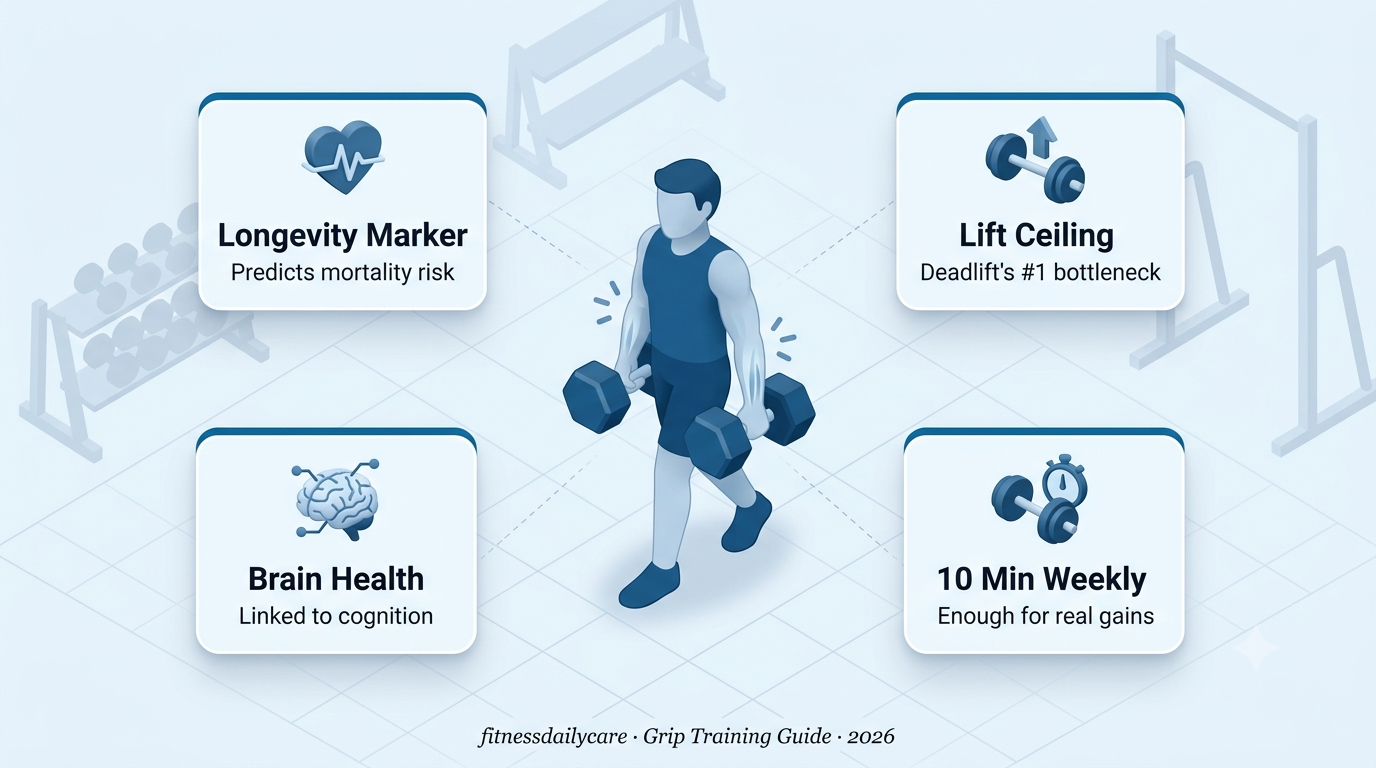
Fast forward to today, and Grip Training has quietly become one of the highest-return activities you can add to a workout program. It costs 10 minutes a week. It uses cheap equipment (or none at all). It unlocks the ceiling on every pulling exercise in the gym. And it correlates with outcomes most people didn’t associate with their forearms — brain health, injury resistance, and the ability to keep functioning independently in later decades of life.
The problem is that “just add grip work” sounds too simple to be interesting. So most lifters wear straps, skip it, and wonder why their deadlift stalls at 315 pounds while their back and legs feel fresh. This is the guide to why that’s a mistake — and what to actually do about it.
Beats blood pressure as a longevity marker
The PURE cohort showed grip strength as a more accurate predictor of cardiovascular death than systolic BP. The UK Biobank study on 500,000 adults later confirmed the same pattern.
Grip is the deadlift ceiling
The bar drops from your hands before your back or legs give out. Every pulling exercise — rows, pull-ups, farmer’s walks — fails at the fingers first when grip work is neglected.
Linked to brain and cognitive health
Meta-analyses have found consistent inverse associations between grip strength and dementia risk, cognitive decline, and depression, though causality remains under study.
Protects tendons and joints
Strong forearms stabilize the elbow and wrist during any loaded movement. Weak grip predicts elbow tendinopathies and wrist strain in both lifters and racket-sport athletes.
Weak hands don’t just mean weak hands.
They signal a system running out of buffer.
Grip Training: 5 Benefits That Have Nothing to Do With Your Hands
A Biomarker Stronger Than Blood Pressure
The most surprising finding from the PURE study wasn’t that grip strength predicted death — physiologists had suspected this for decades. It was that grip strength did the job better than the metric doctors have been tracking since blood pressure cuffs were invented. In head-to-head statistical comparisons across nearly 140,000 people, a handgrip dynamometer reading predicted cardiovascular mortality with higher accuracy than systolic BP.
The mechanism isn’t fully understood, but the leading explanation is that grip strength reflects total-body muscle mass and neuromuscular function — two systems tightly coupled to metabolic health, insulin sensitivity, inflammation, and cardiac output. In other words, weak hands are a downstream signal that upstream systems are struggling. Blood pressure captures one variable. Grip strength captures many at once.
What this means practically: adding Grip Training to your program isn’t just about lifting heavier weights. It’s about building a physical reserve the same way retirement savings build a financial reserve. You don’t need the buffer until you suddenly, urgently, need it.
Population-level analyses from other cohorts have consistently reinforced this pattern. A UK Biobank study of nearly 500,000 adults published in the BMJ found similar inverse relationships between grip strength and cardiovascular mortality, cancer mortality, and respiratory disease outcomes. The signal is robust enough that some longevity researchers now recommend annual dynamometer testing as a low-cost health screen — arguably more informative than routinely rechecking a normal blood pressure.
The Real Reason Your Deadlift Stalled
Ask a hundred intermediate lifters why their deadlift has plateaued and most will blame their back, their legs, or their programming. But watch them fail a heavy pull and the pattern is unmistakable: the bar rolls out of their fingers while their trunk and hips still have plenty of force to give. Grip fails first. Everything else stops working.
This isn’t a minor limitation — it’s the primary ceiling on pulling strength for most gym-goers. Every rep of every row, pull-up, kettlebell swing, and farmer’s carry is bottlenecked by how hard your fingers can hold the load. Even worse, wearing lifting straps to bypass the problem means the bottleneck never gets addressed. Straps let you train around weak grip; they don’t build it. Six months later, the raw pull still fails at the same weight.
Structured Grip Training removes the ceiling. Two short sessions per week — 10 to 15 minutes each, using nothing more exotic than a heavy dumbbell and a pull-up bar — is usually enough to add measurable weight to a stalled deadlift within a month. The bigger muscles were already there. The hands just had to catch up.
The specific mechanism is worth understanding. When you attempt a heavy pull, your central nervous system checks whether it can safely produce the required force. If the weakest link (usually your grip) sends a signal that it’s about to fail, the CNS shuts down output from the bigger muscles too — a protective reflex that prevents the bar from crashing down or spinal injury from a sudden collapse. Strengthen the grip and this protective governor lifts, letting the back and legs actually express what they can already produce.
The Cognition and Mood Connection
Population studies have consistently found that people with stronger grips also tend to score better on cognitive tests, have lower rates of dementia, and report fewer depressive symptoms. The association holds even after controlling for age, education, income, and general physical activity — which is why researchers keep taking it seriously despite the obvious question of “does grip cause brain health, or do healthier brains just happen to have stronger grips?”
The most likely answer is that both share upstream causes: healthy nervous system function, adequate blood flow, and preserved muscle mass all contribute to both grip and cognition simultaneously. Grip Training isn’t a memory pill. But it may be a way to preserve the underlying systems that keep both hands and minds sharp with age.
Even the acute effects are interesting. Neurological research on grip and reaction time suggests that regular hand training has small but measurable benefits for motor coordination, which is one of the earliest capacities to decline in mild cognitive impairment. Building it now is easier than rebuilding it later.
The Independence Test You Take Every Day
Grip strength is the metric you use dozens of times a day without noticing. Opening jars, carrying grocery bags, turning door handles, using tools, holding onto handrails, carrying a toddler, wrestling with a suitcase — all of these are grip tasks. When they start becoming difficult, most people blame “getting older” and adapt by asking for help or buying jar openers. What’s actually happened is that grip strength has crossed a functional threshold, and every daily task on the wrong side of that line is a signal.
This is why physical therapists working with older adults use grip strength as one of their primary functional independence markers. Once grip drops below a certain point, the ability to live alone safely starts to erode — not because of any single dramatic failure, but because a hundred small tasks become slightly harder every week.
The good news: grip strength responds well to training at any age. Even people in their 70s and 80s can build meaningful grip strength with consistent, appropriate training. It’s not one of those capacities that requires being young to develop. It’s just one that most people never bother with until they’ve already lost enough to notice.
Occupational therapists sometimes describe grip strength as “the last capacity to go and the first one to come back.” Meaning: strength decline usually starts in the legs and core years before it reaches the hands, so once you notice grip weakness the underlying reserve loss has already progressed further than you can see. But hand strength also responds to loading faster than most tissues, which means dedicated Grip Training can produce visible functional gains within weeks — long before other strength markers catch up.
Elbow, Wrist, and Shoulder Stability
Weak grip isn’t just a strength limitation — it’s a joint stability problem. The forearm muscles that flex your fingers also cross the elbow joint, and the extensor muscles on the back of the forearm attach directly to the tendons involved in “tennis elbow.” When these muscles are underdeveloped, the tendons take stress they shouldn’t during any loaded movement — even pushing exercises like the bench press, where you’d think grip wouldn’t matter.
Racket sport athletes have known this for decades. Tennis players, badminton players, and squash players train grip specifically because they’ve watched what happens to teammates who don’t: recurring elbow pain, wrist strain, and rotator cuff issues that trace back to unstable distal joints under repeated impact. In the gym, the same principle applies to anyone doing heavy pulling.
Beyond the direct joint protection, Grip Training also improves shoulder mechanics on any hanging or pulling movement. When your hands can grip the bar with confidence, your shoulders don’t have to compensate by shrugging up or letting the shoulder blade drift out of position. That single change downstream prevents a lot of shoulder impingement.
⚠ The Straps Trap
Lifting straps are useful tools — for a small number of people, in a small number of situations. Elite powerlifters preparing for a peak meet use them to preserve grip for the platform. Bodybuilders use them on max-effort back work when the bigger muscles need to fail before the fingers do. Both are legitimate uses.
The problem is that recreational lifters have started using straps on every warm-up set and every working set, and then wonder why their grip stays stuck at the same level year after year. Straps are a bypass, not a training tool. Every rep pulled with straps is a rep your grip did not learn from. Reserve them for the top 10% of your heaviest work, and let everything else train your hands honestly.
4 Grip Training Mistakes That Undo Your Effort
Only training crush grip
Hand grippers are convenient but only work one type of grip. Missing support and pinch work leaves two-thirds of your grip system undertrained. Cover all three types weekly for real transfer to lifts and daily tasks.
Doing grip work before big lifts
Fatigued hands can’t hold heavy loads. Any dedicated grip work placed before deadlifts, rows, or pull-ups will reduce your working weight on the main movement. Always finish sessions with grip, never open with it.
Ignoring the thumb
Most lifters never train the thumb directly. Under heavy loads, the bar rolls toward the fingertips and grip fails not because fingers are weak — but because thumb pressure gave out first. Plate pinches fix this specifically.
Chasing time without adding load
Dead hangs help, but hanging for 3 minutes with the same bodyweight for months isn’t progressive overload. Add a weight vest or hold a small dumbbell between your feet once you can hang comfortably for 60+ seconds.
Grip Training: The 10-Minute Weekly Protocol
▎ 5 Exercises That Cover Everything
- Farmer’s walk · 3 rounds × 30-50 feet. Grab the heaviest dumbbells or kettlebells you can carry with a strict grip. Walk until your hands feel like giving out. This is the single highest-return grip exercise in existence.
- Dead hang · 3 sets × 30-60 seconds. Just hang from a pull-up bar. Build up gradually — start where you are, add 5-10 seconds each week. Elite target is 2+ minutes of continuous hang for most adults.
- Plate pinch · 3 sets × 15-20 seconds per hand. Hold two 5-10 kg plates together, smooth sides out, pinched between thumb and fingers. Trains the pinch grip and specifically the thumb, which is the weakest link for most lifters.
- Double overhand deadlift · applied during your normal deadlifts. Use a straight overhand grip (no mixed, no straps) for all warm-up sets and any working set below 90% of max. Free daily grip stimulus without adding a session.
- Fat Gripz on rows and curls · 1-2 exercises per session. Slide these thick rubber grips onto any dumbbell handle to instantly increase bar diameter. Turns a normal accessory exercise into a compound grip stimulus.
Straps let you train around weak grip.
They do not build it.
Grip Training · The Verdict
Grip strength predicts mortality better than blood pressure — every 5 kg drop links to 16% higher all-cause death risk (PURE study, 139,691 adults).
It’s the deadlift ceiling — bar rolls out of your fingers before your back or legs fail. Fix grip, unlock every pulling lift.
Correlates with brain and cognitive health — not because grip causes it, but because both share the same underlying nervous system reserve.
Straps are a bypass, not training — reserve them for max-effort work only. Every strap rep is a rep your hands don’t learn from.
10 minutes twice a week is enough to start. Farmer’s walks, dead hangs, plate pinches. That’s the whole starter program.