
Hyrox Training, What First-Timers
Actually Need to Know
8km of running, 8 fixed stations, the same format in every city on earth. Here’s what actually happens on race day.
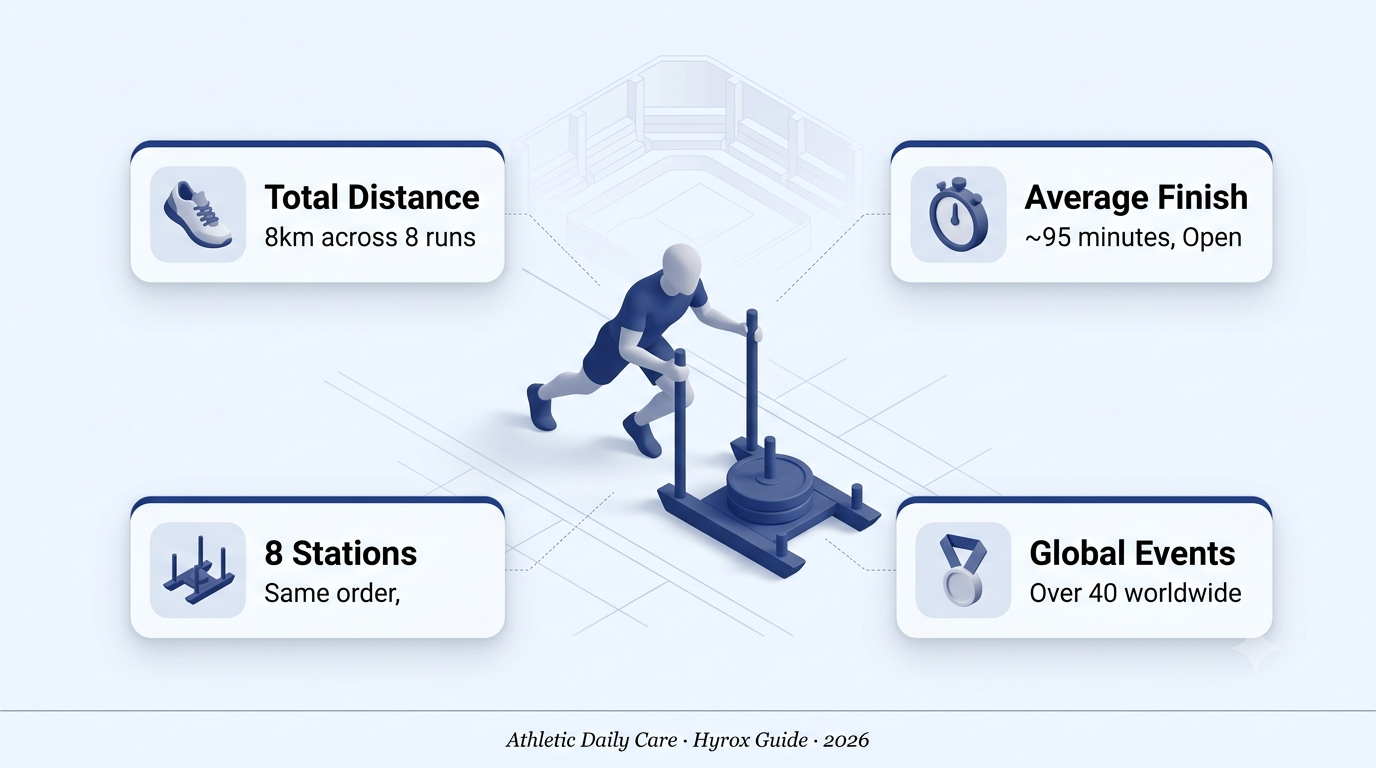
Hyrox training is the one topic that’s come up in almost every conversation I’ve had at the gym this year. It’s a standardized indoor fitness race — 8 kilometers of running broken into 1km segments, each followed by a functional workout station, always in the same order, in every city from Seoul to Berlin.
What surprised me looking into the actual race data is how approachable it is. The average Men’s Open finish sits around 1 hour 35 minutes, and the average Women’s Open finish is close behind at roughly 1:38. You don’t need to be a marathoner or a competitive lifter — you need a base level of running fitness and the ability to move under fatigue.
This guide breaks down exactly how the race works, what each of the 8 stations demands, what a realistic first-time goal looks like, and how to start training for it without overhauling your entire routine.
Same Race, Every City
8km of running in 1km segments, interleaved with 8 fixed workout stations. No surprises in sequence, worldwide.
It’s Beginner-Friendly
You don’t need a running or CrossFit background. Consistency and basic fitness get most first-timers to the finish line.
Train The Gaps, Not Just Strength
Grip endurance, sled work, and running under fatigue matter more than raw one-rep max numbers.
Solo Isn’t Your Only Option
Doubles splits the station work between two athletes using a “You Go, I Go” format — a lower-pressure entry point.
The Race Format, Station By Station
The BasicsEvery Hyrox race follows the identical sequence: SkiErg → Sled Push → Sled Pull → Burpee Broad Jumps → Rowing → Farmers Carry → Sandbag Lunges → Wall Balls, with a 1km run before each one. That’s 8km of total running plus roughly 700 meters of extra movement through the transition zone, known as the “Roxzone.”
The order isn’t random. Stations 1–3 hit pushing and pulling strength while your legs are still fresh. Station 4 (Burpee Broad Jumps) is widely considered the toughest aerobic moment in the race. Station 5 (Rowing) offers a seated, strategic recovery window. Stations 6–7 grind down your grip and legs under accumulated fatigue, and Station 8 (Wall Balls) finishes you off when there’s almost nothing left in the tank.
What A Realistic First-Time Goal Looks Like
BenchmarksBased on aggregated race data, first-timers in Men’s Open typically finish between 1:40 and 1:50, and first-timers in Women’s Open typically finish between 1:45 and 2:00. Breaking 1:30 as a man or 1:38 as a woman on your first attempt is a genuinely strong result.
The biggest gap between first-timers and repeat racers isn’t fitness — it’s pacing and transitions. Athletes who’ve raced before know exactly how hard to push each 1km run so they still have something left for the next station.
The Hyrox Training Gaps Most People Miss
Train SmartRegular gym training rarely prepares you for two things: sled work and running on tired legs. Sled pushes and pulls use muscles most lifters don’t train directly, and running immediately after a strength station feels completely different from running on fresh legs.
Grip endurance is the other quiet limiter. Farmers Carry and Sandbag Lunges both demand a grip that’s already been taxed by the SkiErg and Sled Pull earlier in the race.
A Simple Weekly Structure To Start With
Getting StartedA beginner-friendly week doesn’t require 6 sessions. Two structured runs (one easy, one with intervals), two full-body strength sessions that include sled or carry work, and one session combining both at lower intensity is enough to build real race readiness over 8–12 weeks.
Race-day nutrition and shoes matter less than most first-timers assume — consistent training volume over several weeks is what actually moves your finish time.
Hyrox doesn’t punish weakness.
It punishes whatever you didn’t train.
- Practice sled pushes and pulls — most gyms rent or own sled equipment, use it monthly at minimum
- Run on tired legs at least once a week — short strength circuit into a timed run
- Train grip endurance — farmer carries, dead hangs, sandbag holds
- Pace your first 1km conservatively — adrenaline makes race-day runners start too fast
- Consider Doubles for your first race — splitting station work lowers the pressure without lowering the fun
⚠️ Two Common First-Timer Mistakes
1. Sprinting the first 1km. Race-day adrenaline makes the opening run feel easy. Athletes who go out too fast consistently lose more time on later stations than they gained early.
2. Skipping sled training entirely. Sled Push and Sled Pull are unlike anything in a typical gym routine. Showing up without ever having touched a sled is the single biggest predictor of a rough race.