
GLP-1 Users Move Less Without Knowing, Why the Scale Stalls
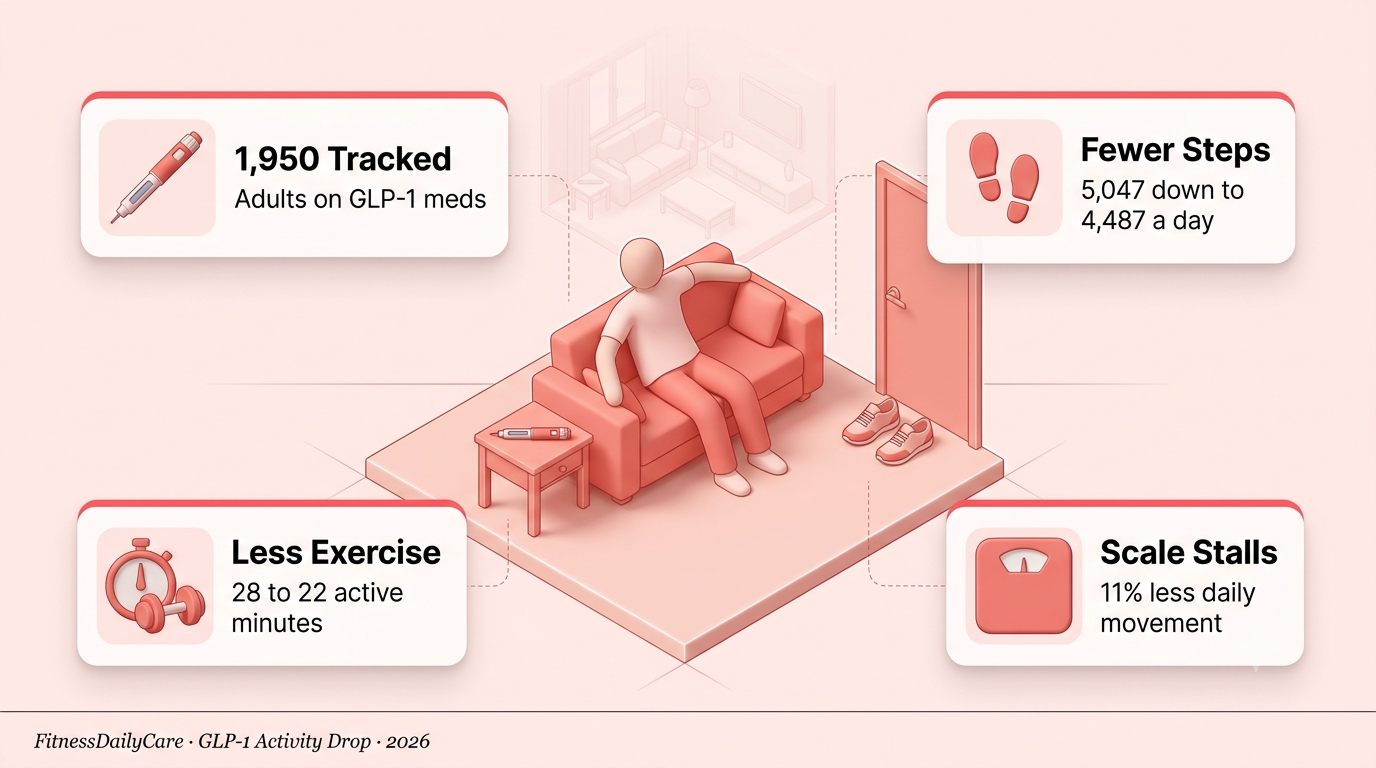
A new study tracked 1,950 people on Ozempic and Wegovy. Their daily steps dropped, their active minutes fell, and almost none of them noticed.
Here is the assumption almost everyone makes about weight-loss drugs: lose the weight, and you will naturally start moving more. Lighter body, easier to walk, more energy, right? A large new analysis presented at ENDO 2026, the Endocrine Society’s annual meeting, just put that assumption on a scale and it did not survive.
Researchers pulled wearable fitness-tracker data from 1,950 adults with obesity who started a GLP-1 medication, then narrowed to the 753 who had enough continuous data to analyze. The direction was the opposite of what most people expect. Daily steps fell from 5,047 to 4,487. Moderate-to-vigorous activity slid from 28 minutes a day to 22. Nobody was told to move less. They just did.
This matters because of where the lost weight actually comes from. When you drop pounds on a GLP-1 without training and without protecting your activity, a meaningful share of that loss is muscle, not just fat. Less movement accelerates that problem, and it is a big reason the scale eventually parks itself and refuses to budge. Here is what the data shows and, more usefully, what to do about it.
Weight loss makes you move more
The intuitive belief is that a lighter body walks and exercises more. The wearable data found no evidence of that after GLP-1.
Movement quietly went down
Steps fell 5,047 to 4,487 and active minutes 28 to 22. Small daily numbers that stack up fast over a month.
Muscle and metabolism
Less movement plus appetite suppression means more of the weight lost can be muscle, which slows your metabolism.
Exercise is not optional
The researchers were blunt: people on these drugs need deliberate activity built in, not left to happen on its own.
Exercise cannot be optional for people taking these medications.
Set a daily step floor and defend it
Do This FirstThe decline in the study was not a workout problem, it was a background movement problem. Those are the incidental steps, fidgeting, and standing that researchers call NEAT, and they can account for a few hundred calories a day. When appetite drops on a GLP-1, that low-effort movement is the first thing to fade without you noticing.
Pick a floor you will actually hit, something like 7,000 to 8,000 steps, and treat it as a non-negotiable, the same way you treat the shot. A cheap tracker or your phone is enough to make the invisible visible.
Lift something heavy two or three times a week
Muscle InsuranceThis is the single highest-value move on a GLP-1. Resistance training is what tells your body to hold onto muscle while it sheds fat. Without it, DEXA-scan data from semaglutide trials has shown that a large share of the weight lost can be lean mass, not just fat, and muscle is exactly what keeps your resting metabolism up.
You do not need to become a powerlifter. Two to three short full-body sessions a week built around squats, presses, rows, and hinges covers most of the benefit.
Push protein higher than feels normal
Eat For MuscleGLP-1 drugs shrink your appetite, so total food drops, and protein is usually the first thing to slide. That is backwards for what you want. Aim for roughly 0.7 grams of protein per pound of goal body weight (about 1.6 g/kg), spread across your smaller meals so muscle has the raw material to survive the deficit.
Track movement and muscle, not just the scale
Right MetricThe scale cannot tell you whether you lost fat or muscle, and it will happily show a “win” that is partly muscle loss. Watch the inputs you control instead: steps, training sessions, and protein. If those three hold steady, the body-composition part of the equation takes care of itself.
⚠ Three traps this study exposes
1. “The drug does the work, so I can coast.” The medication suppresses appetite. It does nothing to protect your muscle or your activity. Those are still on you.
2. Reading a stalled scale as “the drug stopped working.” Often the real issue is a slower metabolism from lost muscle and lost movement, not the medication failing.
3. Assuming you would notice if you slowed down. The whole point of this study is that people did not notice. The decline was measured on wearables, not self-reported.
The drug lowers the number on the scale.
Only you decide whether that number is fat or muscle.