
Bulk Up Calories,
I Tested 3 Surplus Levels
for 12 Weeks
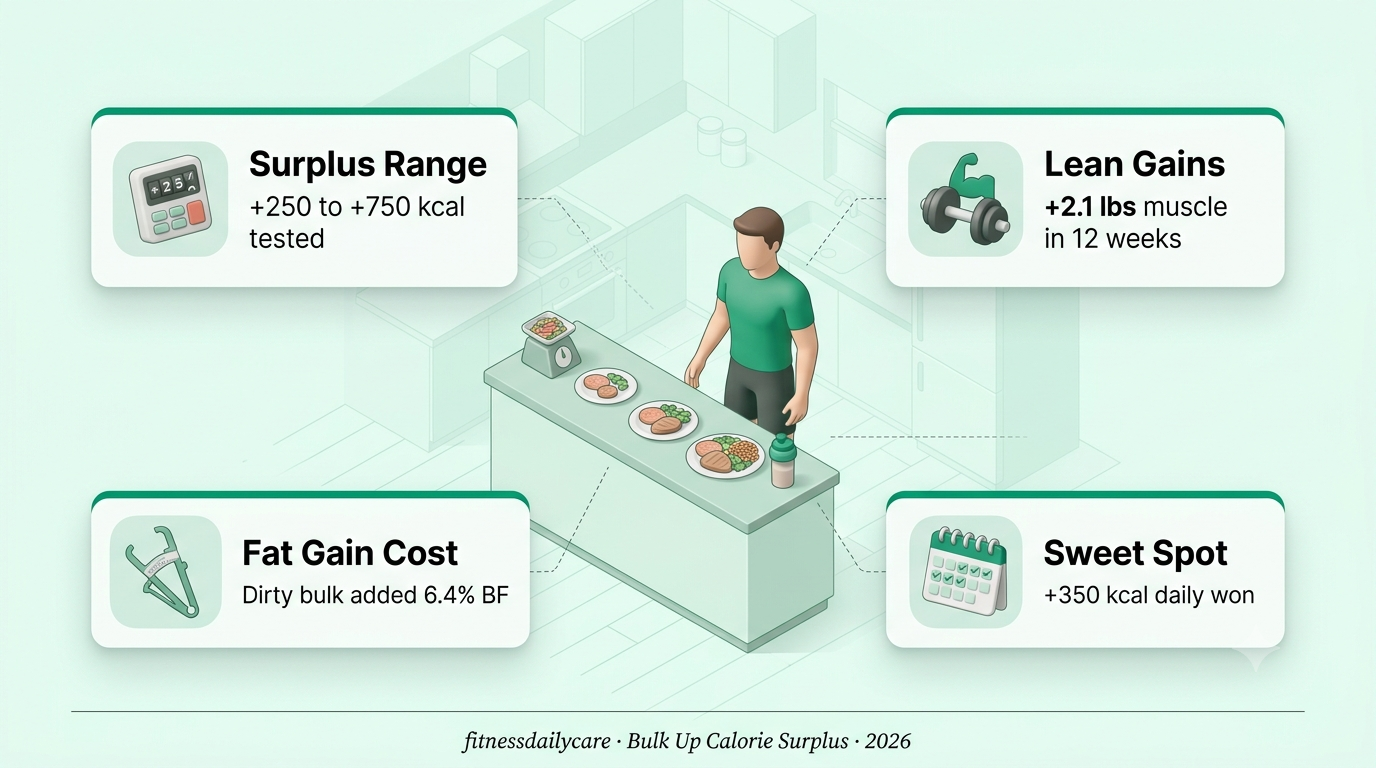
+250, +500, +750 kcal over 12 weeks. The winning number wasn’t the biggest one
Every bulking guide online repeats the same number: eat 500 calories above maintenance. I followed that rule for years and kept ending each bulk 10 lbs heavier but only 3 lbs stronger.
So this spring I decided to test it properly. I ran three consecutive 4-week blocks at three different surplus levels — +250, +500, and +750 kcal/day — while keeping training volume, sleep, and protein locked at 180g. Weighed food. Tracked body composition with DEXA every 4 weeks. No estimates, no eyeballing.
What I found lined up with a 2023 University of Stirling study on small vs large surpluses: the biggest surplus didn’t build the most muscle. It built the most fat. Below is what actually worked, and the surplus number I’ll be running for every bulk from now on.
+200–350 kcal wins for most lifters
Research on trained lifters puts the muscle-optimizing surplus at 100–300 kcal, not the classic +500. My +250 block matched that.
The +500 rule wastes calories
Above ~+350, extra calories almost linearly convert to fat. You cannot force muscle growth past your body’s synthesis ceiling.
Aim for 0.25–0.5% bodyweight/week
For a 180 lb lifter that’s 0.45–0.9 lb/week. Faster than 1 lb/week and you’re gaining mostly fat.
Advanced lifters need even less
Year 1 lifters can push +300–500. Year 3+ should stay closer to +100–200. Your ceiling drops as you get bigger.
Above a fairly low threshold,
extra calories increase fat gain
almost linearly
Find your maintenance first, not your surplus
Start HereAny surplus number is meaningless without knowing your true maintenance. Track your intake and weight for 10–14 days at your normal eating. If weight is flat, that’s your maintenance. Add your surplus on top of that number, not a calculator estimate.
Set surplus by training age, not by feel
The NumberThe evidence-based ranges: beginners (0–1 yr training) +300–500 kcal, intermediates (1–3 yr) +200–350 kcal, advanced (3+ yr) +100–200 kcal. If you’ve been lifting seriously for two years and you’re eating +500, you’re just building a fat pantry.
Weigh weekly, adjust every 2 weeks
The LoopTake a morning weight 4–5 days per week, average it, and compare week-to-week. Target gain is 0.25–0.5% of bodyweight per week. Gaining faster? Cut 150 kcal. Gaining nothing after 2 weeks? Add 150 kcal. That’s the whole adjustment protocol.
Lock protein at 0.8–1.0 g per lb bodyweight
Non-negotiableWithout adequate protein, every extra calorie routes to fat. A 180 lb lifter needs 145–180g protein daily, spread across 3–5 meals of 30–50g each. This is the one macro that has to be right before the surplus number matters.
- Maintenance calibrated — 10-14 day tracking, not calculator estimate
- Surplus matched to training age — beginner +400, intermediate +300, advanced +150
- Protein locked — 0.8–1.0 g/lb bodyweight, spread across meals
- Weekly weight average tracked — target 0.25–0.5% bw/week
- Adjustment every 2 weeks — +150 or −150 kcal based on trend
⚠️ Bulking traps that ruined my earlier attempts
1. Trusting the mirror over the scale. Muscle takes weeks to visibly change. Chasing the pump instead of tracking data means you’re guessing.
2. “Just eat more” advice from big lifters. A 220 lb bodybuilder’s +500 is proportional. Your +500 might be a 25% surplus, which is dirty-bulk territory.
3. Ignoring cardio during bulk. 2–3 low-intensity sessions weekly keeps insulin sensitivity high, which improves the muscle-to-fat partition.
You can force calories in.
You cannot force muscle to grow
past its synthesis ceiling.