
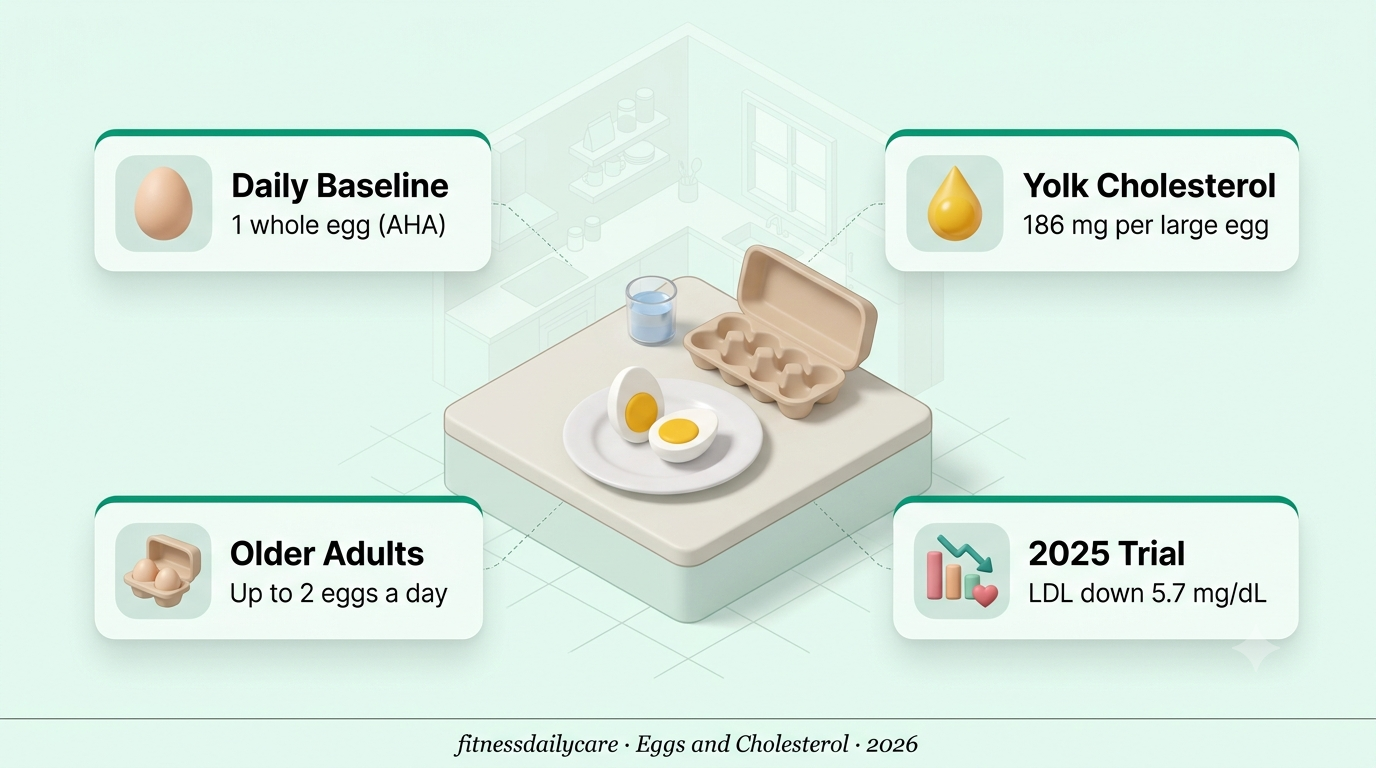
Eggs and Cholesterol, 1 a Day Is Where the Evidence Is Strongest
What the American Heart Association advisory, a 2025 randomized trial, and a large US cohort each say about eggs, and where they disagree.
Eggs and cholesterol are the one nutrition topic that keeps flipping sides. One headline says breakfast is safe again, and a week later another warns that a few yolks a day will damage your arteries.
Both headlines come from real research, which is why the confusion never fades. In 1968 the American Heart Association advised limiting whole eggs to about three a week, and that advice shaped how a generation shopped for breakfast. Later reviews found little link between eggs and heart disease in healthy adults, yet newer cohort data still showed a modest signal at higher intakes.
So this guide skips the shouting. It covers what the AHA advisory concluded, what a 2025 randomized trial added, where a large JAMA cohort study raised flags, and who genuinely needs to be careful.
4 Findings That Reset the Egg Debate
The short version of decades of back and forth.The weekly egg cap is gone
The 2015 Dietary Guidelines Advisory Committee dropped dietary cholesterol as a nutrient of public health concern, and AHA advice now centers on overall eating patterns.
Yolk cholesterol nudges LDL only a little
An AHA meta-regression predicted that every extra 100 mg of dietary cholesterol a day lifts LDL by about 1.9 to 4.6 mg/dL.
Saturated fat was the bigger lever
In a 2025 crossover trial, saturated fat intake tracked with LDL, while dietary cholesterol did not.
The plate matters more than the egg
In the American diet, cholesterol and saturated fat rise together because eggs often arrive with bacon or sausage.
The egg is rarely the problem.
The plate around it usually is.
How to Eat Eggs: 5 Evidence-Based Rules
Each rule comes with the study or guideline behind it.Make one whole egg your daily default
AHA baselineOlder adults with normal cholesterol can stretch to two
Older adultsFix the side dishes before you cut the egg
Saturated fatCount your total dietary cholesterol
300 mg benchmarkPersonalize if your risk is higher
Higher riskRead the 2025 trial with these caveats
- It was funded by the Egg Nutrition Center, a division of the American Egg Board.
- It enrolled 61 adults, and a news summary reports that 48 finished all three diets.
- Each diet lasted five weeks and measured LDL, not heart attacks or strokes.
- Participants had baseline LDL below 135 mg/dL, so the result may not apply if yours is high.
Your egg-friendly breakfast checklist
One egg a day is a baseline,
not a loophole for a three-yolk scramble.
The Verdict on Eggs and Cholesterol
- Healthy adults: one whole egg a day fits the AHA’s heart-healthy pattern.
- Older adults with normal cholesterol: up to two eggs a day is acceptable.
- Saturated fat moves LDL more than yolk cholesterol, so fix the side dishes first.
- Intakes near 300 mg of cholesterol a day showed a modest risk signal in a large US cohort, though it was observational.
- With diabetes, heart disease, or high LDL, get a personal limit from your clinician.
3 More Evidence Checks for Your Plate
Eggs and Cholesterol FAQ
Quick answers to the questions people ask most.Can I eat eggs every day if my cholesterol is high?
The AHA’s one-egg-a-day statement applies to healthy individuals. If your LDL is already elevated, the safe number depends on your overall diet and risk, so ask your clinician before making eggs a daily habit.
Do egg whites contain cholesterol?
No. The cholesterol sits in the yolk, which is why egg whites are a popular way to add protein without adding to your cholesterol count.
Does the way I cook eggs matter?
Yes. A British Heart Foundation dietitian pointed out that how eggs are cooked and what comes with them matters as much as how many you eat. Frying in butter or pairing eggs with processed meat adds saturated fat.
Does shrimp count toward my egg limit?
For cholesterol purposes, yes. The AHA advisory treats about 3 ounces of shrimp as equivalent to one whole egg, so count them together when you plan your day.
Editor’s note: sources
- American Heart Association science advisory on dietary cholesterol and cardiovascular risk (Circulation, 2019), via the American College of Cardiology summary.
- Carter et al., randomized crossover trial of egg cholesterol and saturated fat, American Journal of Clinical Nutrition, 2025.
- Zhong et al., dietary cholesterol, egg consumption, and cardiovascular disease, JAMA, 2019.