
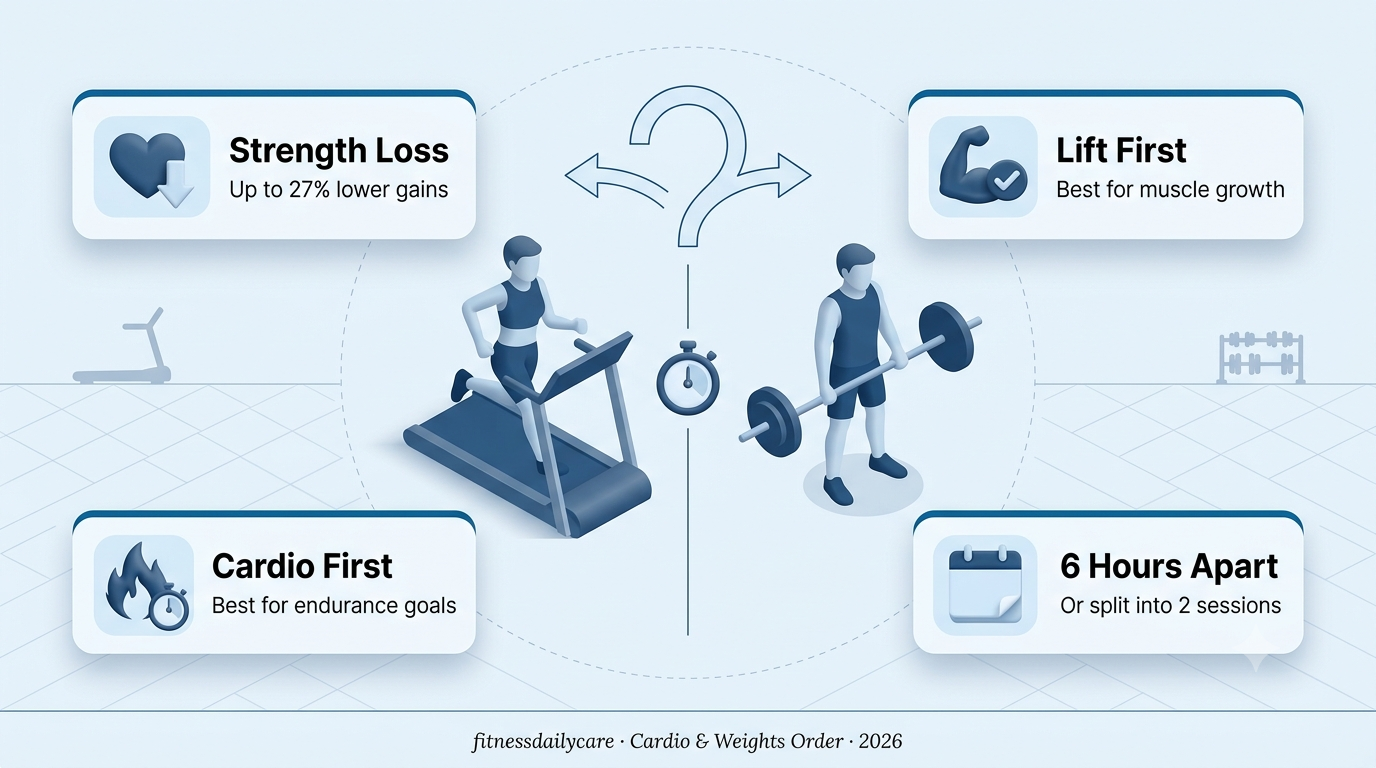
Cardio Before or After Weights, The Order That Actually Matters
Whether you should run first or lift first depends on one question: what do you actually want to get better at? Here’s what 40 years of research says.
Cardio Before or After Weights has been debated in gyms for 40 years, and the answer keeps changing. In 1980, exercise physiologist Robert Hickson published the first study on what would later be called “the interference effect” — the finding that lifters who added endurance training gained significantly less strength than lifters who didn’t. Gym floor wisdom crystallized: cardio kills your gains, so lift first, or don’t do cardio at all.
That advice ruled bodybuilding for decades. Then the meta-analyses started showing up. By 2012, the picture was already messier than “cardio kills gains.” By 2021, a systematic review published in Sports Medicine went further: for hypertrophy — for actual muscle size — the interference effect essentially isn’t real for most people. Untrained lifters barely see it. Trained lifters see it only when they cram both types of training into the same session while pushing volume to the recovery limit.
The nuance most gym-goers still miss: what does survive the newer research is a small, specific interference on power and explosive strength — technically, the rate of force development (RFD). Sprint athletes, Olympic weightlifters, and anyone who competes on how fast they can generate force still need to separate their cardio and lifting sessions. Everyone else has more freedom than the old rule suggested.
Meanwhile, the fitness industry kept selling the same 1990s advice — “never do cardio before lifting” and “always lift on empty for muscle” — long after the research pointed elsewhere. Popular myths outlive their evidence base by 15-20 years in most fields, and gym programming has been no exception. The rules feel intuitive, they get repeated by influencers, and by the time updated meta-analyses arrive most people have already internalized the wrong version.
So Cardio Before or After Weights isn’t a moral question. It’s a goal question. What do you want your body to get better at? Answer that, and the order writes itself.
The interference effect is real — but small
Modern meta-analyses find only trivial effects on muscle growth and max strength when cardio is added to lifting. It’s not zero, but it’s not the gym-wrecker gym broscience made it out to be.
Order matters most when goals conflict
Whichever training type comes second suffers slightly more fatigue interference. So if muscle is the priority, lift while fresh. If cardio performance is the priority, run while fresh.
6 hours of separation solves it
When cardio and weights are split into different sessions with 6+ hours between them, the interference effect essentially disappears for both strength and power outcomes.
Power athletes get a stricter rule
Sprinters, jumpers, and Olympic weightlifters see a real hit to their rate of force development from concurrent training. For them, separate days — not just separate sessions — is the safest bet.
The interference effect is real.
For most of us, it just isn’t scary.
Cardio Before or After Weights: The Answer By Goal
If You Want to Build Muscle → Lift First
For anyone whose primary goal is hypertrophy — bigger arms, thicker legs, more visible definition — the sequence is clear: strength training first, cardio after (or on a separate day entirely). The reason isn’t magic; it’s mechanical. Heavy lifting activates the mTOR pathway, which triggers muscle protein synthesis — the actual process that grows muscle. Doing cardio first partially blunts that pathway before the lifting stimulus arrives.
Practically, lifting when fresh means you can generate more force per rep, complete more quality sets before form breaks down, and maintain the intensity that drives progressive overload. Cardio after a lifting session still delivers cardiovascular benefits — VO2 max improves, calories burn, heart health builds — but it doesn’t compete with muscle growth signals the way pre-lifting cardio does.
The exception for muscle-focused lifters: light Zone 2 cardio (easy walking, casual cycling) can be done before lifting as a general warm-up without meaningful interference. It’s high-intensity intervals and prolonged endurance work before lifting that most compromises the hypertrophy signal.
The timing detail that helps most muscle-focused lifters: think of the pre-lifting warm-up cardio as a “circulation primer” rather than a real cardio session. Five to ten minutes at a pace where you can still hold a conversation easily is the sweet spot. Long enough to loosen up joints and get blood moving to working muscles, short enough that it doesn’t shift the body’s hormonal signaling away from anabolic pathways.
If You Want to Run Faster or Farther → Cardio First
For runners, cyclists, triathletes, and anyone chasing a specific endurance goal — a race, a distance milestone, a heart-rate zone improvement — the order flips. Cardio Before or After Weights becomes cardio-first, every time. Endurance adaptations depend on your ability to sustain aerobic effort at controlled intensities, and lifting-induced fatigue will drag your pace and heart rate down within the first 10 minutes if you try to do it the other way around.
The physiology mirrors the muscle side. Endurance training activates the AMPK pathway, which drives mitochondrial biogenesis — the creation of new energy-producing units in muscle cells. This is what makes you “fitter” at aerobic exercise. Lifting first partially dampens AMPK signaling for the cardio session that follows, and it leaves your legs pre-fatigued, so your body downgrades pace targets to match the leftover energy.
Endurance athletes who need strength work should either place it after their cardio session (accepting a small hit to lifting quality) or move it to a separate day. Most serious endurance programs treat lifting as a supplementary session — 20-30 minutes, 2-3 times per week — precisely because the primary goal dictates that cardio owns the fresh-body slot.
What most endurance athletes get wrong is skipping strength work entirely rather than accepting the compromise. Long-distance runners in particular tend to view any resistance training as “wasted energy that could go into more mileage.” But research on running economy consistently shows that heavy strength work (even just 2 sessions per week) improves aerobic performance by making each stride more efficient. The trick is treating it as maintenance rather than progression — enough to build durability without stealing recovery from mileage volume.
If You Want to Lose Fat → Order Barely Matters
Here’s where the internet gets it most wrong. Countless articles claim fasted cardio in the morning burns more fat, or that lifting first “empties your glycogen” so cardio afterward torches more calories. Both claims are technically true and practically meaningless — the differences are so small that they get erased entirely by any variation in weekly food intake, sleep, or non-exercise activity.
For fat loss, total weekly calorie expenditure and dietary consistency matter roughly 100 times more than the order within a single workout. What that means: the correct answer to Cardio Before or After Weights for fat loss is whichever order you’ll actually stick with for six months. The order that best fits your schedule, energy levels, and personal preference is the winning order.
That said, one small edge does exist for lifting-first: it protects lean muscle mass while you’re in a calorie deficit. Fat loss is fastest when total body mass drops but lean tissue is preserved, and lifting first ensures you have the energy to hit meaningful loads. The energy cost is roughly the same either way; the muscle-sparing effect is what tips the scales.
The other overlooked variable is appetite. Post-lifting hunger tends to be sharper and easier to overshoot with food, while post-cardio hunger (especially at moderate intensity) can be surprisingly muted for the first hour. For lifters trying to eat at a modest deficit, ending on cardio can help delay eating just enough that the next meal lands at a natural mealtime rather than as an urgent snack. Small effect, but consistent across weeks it adds up.
Split the Sessions — 6+ Hours Apart
The single most effective answer to the whole Cardio Before or After Weights question isn’t a sequence at all. It’s a separation. When cardio and lifting are split into different sessions with at least 6 hours between them, the interference effect essentially vanishes — for hypertrophy, for max strength, and even for power outcomes. Multiple 2021 meta-analyses confirmed this specifically.
Practically, that looks like a morning cardio session (30-60 minutes) and an evening lifting session (45-75 minutes), with a full workday in between for muscle glycogen to replenish and central nervous system fatigue to clear. Athletes who compete in both endurance and strength sports have used this template for decades because it’s the only way to preserve peak performance in both areas simultaneously.
The catch is time. Two separate gym trips per day is not realistic for most working adults. That’s why the “priority-first” answer above (lift-first for muscle, cardio-first for endurance) exists as a practical compromise. But if your schedule allows the split — even for the days that matter most — take it.
One workable middle path for people who can’t do two full gym trips: cardio at home in the morning (30-40 minutes on a stationary bike, treadmill, or a brisk outdoor walk-run) and lifting at the gym in the evening. The morning session doesn’t need to be intense — Zone 2 heart rate is fine, and often better for recovery than harder efforts. It costs nothing extra in schedule (many people already walk or commute) but delivers the full separation benefit for the evening lifting session.
Special Case: If You Train for Explosive Speed
Sprinters, jumpers, throwers, Olympic weightlifters, football players, and anyone whose sport rewards how fast they can generate force operate under a stricter rule. Modern research is clear: rate of force development (RFD) — the neural quality behind explosive movements — remains sensitive to the interference effect even when hypertrophy and max strength don’t. For these athletes, Cardio Before or After Weights isn’t just about order; it’s about total exposure.
The safest protocol for power-focused athletes is to keep cardio work minimal in volume and intensity, and to schedule it on days when heavy lifting isn’t happening. Aerobic conditioning still matters — it supports recovery between explosive efforts — but the high-volume steady-state work that recreational lifters treat as normal cardio can meaningfully blunt an athlete’s ability to produce force quickly.
The mechanism appears to involve residual fatigue in the corticospinal pathway, which affects how fast motor units can be recruited. Even a day or two after a hard endurance session, power output on the same muscles can be measurably reduced. This is why elite sprinters generally don’t do jogging as a warm-up.
Practical example: sprint coaches typically schedule any aerobic conditioning work — if it happens at all — as a separate, low-priority session two to three days before competition-relevant training. What looks like ordinary jogging to a recreational lifter is treated as a fatigue investment by an athlete whose performance depends on peak neural output.
⚠ Common Mistake: The “Get It All Done” Session
The trap most gym-goers fall into isn’t picking the wrong order — it’s cramming both training types into a single 90-minute session, both at high intensity, and calling it efficient. This is exactly the scenario where the interference effect shows up most strongly, because it stacks two competing recovery demands on top of each other with zero time to buffer between them.
If your schedule genuinely forces both cardio and weights into one session, keep the second component to under 20 minutes and clearly submaximal in effort. A hard 45-minute lifting session followed by 15 minutes of easy walking or spin bike work at Zone 2 heart rate is fine. A hard 45-minute lifting session followed by a hard 30-minute HIIT block is where you lose gains in both directions and get tired for tomorrow’s workout too.
4 Timing Mistakes That Undo the Best Order
Going straight from treadmill to squat rack
Zero recovery buffer between blocks stacks fatigue signaling. Even 10 minutes with water and a small carb snack lets the nervous system reset enough to preserve performance on the second component.
Doing HIIT as a “cardio warm-up”
Sprints, intervals, and burst work don’t warm up the body — they pre-fatigue it. If lifting is the priority that day, save any high-intensity intervals for a separate session or the very end of the workout.
Skipping food between blocks
Cardio depletes glycogen quickly. Following it with lifting on empty stores means force output drops sharply after the first few sets. A small carb-and-protein snack in the buffer window keeps working muscles fueled.
Ignoring how tomorrow feels
A combined session that feels productive in the moment can still leave you too depleted for tomorrow’s session. Track weekly volume, not just single-workout output. Recovery accumulates across days.
▎ 60-Second Decision Tree
- If muscle growth is your #1 goal → Lift first, cardio after (max 20 min, low intensity). Best case: cardio on separate days.
- If endurance performance is your #1 goal → Cardio first, lift after (20-30 min compound moves, moderate intensity).
- If fat loss is your #1 goal → Whichever order you’ll actually stick with. Weekly diet and total volume matter far more than order.
- If you have 6+ hours between sessions → Use them. Split cardio and lifting into different sessions. Interference effect drops to near zero.
- If you’re a power/speed athlete → Minimize concurrent cardio volume. Keep steady-state work off heavy lifting days entirely.
Whichever training goal is
your #1, put it first.
Cardio Before or After Weights · The Verdict
The old “cardio kills gains” rule is mostly dead — 2021 meta-analyses found no meaningful interference on muscle size for recreational lifters.
Goal decides order. Muscle → lift first. Endurance → cardio first. Fat loss → whichever you’ll do consistently.
6 hours of separation kills the interference effect entirely — if your schedule allows two sessions, use it.
Explosive power athletes are the exception — cardio still costs them measurable rate of force development. Separate days, not just sessions.
The worst case is stacking both at high intensity in one session. Whatever you do second, keep it short and submaximal.