
Blood Sugar Spikes,
The Meal Order Trick That Cuts Them 37%
Same calories, same food, different sequence. Peer-reviewed data from Cornell says the order you eat matters more than most people think.
Here’s a fact that doesn’t get enough airtime. If you eat the exact same meal — same calories, same protein, same carbs, same fat — but change the order you put things in your mouth, your blood sugar can respond completely differently. Not by 5%. Not by 10%. By roughly a third.
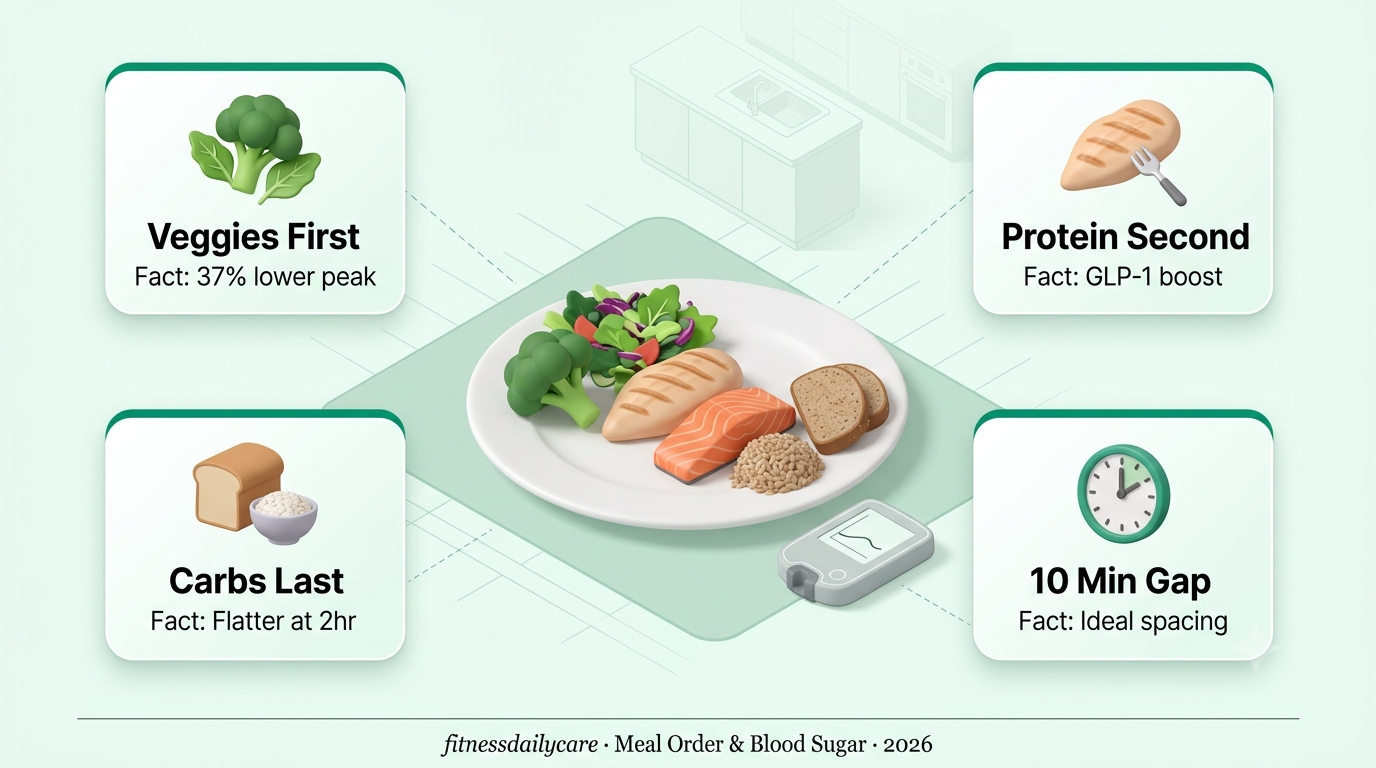
The finding comes from a Weill Cornell study led by endocrinologist Alpana Shukla, published in Diabetes Care back in 2015. Eleven adults with type 2 diabetes ate an identical 628-calorie meal (bread, orange juice, chicken, salad, broccoli) on two separate days. Only the sequence changed. When carbs came last, glucose peaked 28.6% lower at 30 minutes, 36.7% lower at 60 minutes, and 16.8% lower at 120 minutes. Insulin followed a similar pattern.
Since then, the “veggies first, carbs last” trick has been repeated in prediabetes, gestational diabetes, and healthy adults with CGMs. It’s not a fad. It’s one of the most reproducible free interventions in modern nutrition research — and with 115 million US adults now living with prediabetes (per CDC), it matters more than ever.
Why food order changes glucose
Fiber and protein slow gastric emptying and trigger GLP-1 release, blunting the carb spike that follows.
Shukla 2015, replicated since
Cornell’s 11-subject crossover trial has been reproduced in prediabetes (2019) and gestational diabetes (2024).
Order: veggies → protein → carbs
Eat non-starchy vegetables first, then protein, then starches. Wait ~10 minutes between if possible.
Not a cure, a modifier
Sequencing helps postprandial spikes. It doesn’t replace medication, fiber intake, weight loss, or activity.
Start with non-starchy vegetables
STEP 1Salad greens, broccoli, cucumber, bell peppers, roasted zucchini, sautéed spinach — anything low in starch. Aim for a real portion, not a garnish. Roughly 2 cups raw or 1 cup cooked (about 100g / 3.5 oz) is what the trials used. Chew, swallow, then move on. Soluble fiber from these vegetables physically slows glucose absorption from whatever comes next.
Move to protein and fats next
STEP 2Grilled chicken, eggs, salmon, tofu, Greek yogurt, cheese — pick your protein. Fats from olive oil, avocado, or nuts count too. Protein amplifies the effect Step 1 started: it stimulates GLP-1 and PYY, the same appetite and glucose-regulating hormones that GLP-1 drugs like Ozempic mimic. Cornell’s follow-up study showed insulin secretion actually improved when protein came before carbs.
Save carbs for last (and lower the total)
STEP 3Rice, pasta, bread, potatoes, sweet drinks, dessert. Whatever the fastest-digesting carbohydrate in your meal is — that’s the “last” item. By the time it hits your gut, the fiber and protein ahead of it are already slowing digestion and priming insulin. The spike is smaller and slower. As a nice side effect, most people find they naturally eat less of the carb portion because they’re already partly full.
Add a 10-minute walk after (optional bonus)
STACKIf you want to compound the effect, walk for 10 minutes after eating. A 2025 Scientific Reports study found even a brief post-meal walk immediately after a glucose load significantly lowered the peak. Combined with sequencing, most CGM users see their post-lunch curve flatten dramatically — often the difference between a 40 mg/dL spike and a 90 mg/dL one.
Same calories. Same food.
Different order, different metabolism.
- 1st — Non-starchy vegetables: greens, broccoli, cucumber, roasted peppers (~100g / 3.5 oz)
- 2nd — Protein and fats: chicken, fish, eggs, tofu, Greek yogurt (~25–35g / 1 oz protein)
- 3rd — Starches and sugars: rice, bread, pasta, potatoes, dessert, sweetened drinks
- Bonus — Vinegar (1 tbsp diluted) before a meal cuts glucose response ~20% (meta-analysis, 2017)
- Bonus — 10-minute walk after eating stacks with sequencing for the flattest curve
⚠️ WHAT MEAL ORDER WON’T DO
1. It’s not a diabetes cure. Sequencing reduces spikes, but it doesn’t lower fasting glucose or A1c on its own without other lifestyle changes.
2. It doesn’t override huge carb loads. Eating a whole pizza with veggies first is still a huge glycemic hit. The trick modifies the response, not the ceiling.
3. Skip the influencer hype. Some social-media claims (“cuts glucose 73%”, “reverses insulin resistance in a week”) aren’t supported. The real effect is meaningful but modest — around 20–40% peak reduction, per peer-reviewed data.