
Nicotine-Free Vapes Aren’t Safe,
Here’s What’s Still in the Vapor
Removing nicotine removes the addiction. It doesn’t remove formaldehyde, diacetyl, or heavy metals — all of which are still generated the moment you heat the liquid.
The nicotine-free vape is built on a persuasive half-truth: remove the addictive substance, remove the harm. The logic is intuitive, the marketing is clean, and millions of people — especially young adults who never smoked — have concluded that a nicotine-free vape is essentially just flavored air. The Cleveland Clinic, the FDA, the American Lung Association, and peer-reviewed pulmonology research all point to the same conclusion: it isn’t. Nicotine is one component of the hazard. The other components — the carrier liquids, the flavoring chemicals, the metal coils, the byproducts of heating — are all still present, all still inhaled, and all still capable of causing lung injury.
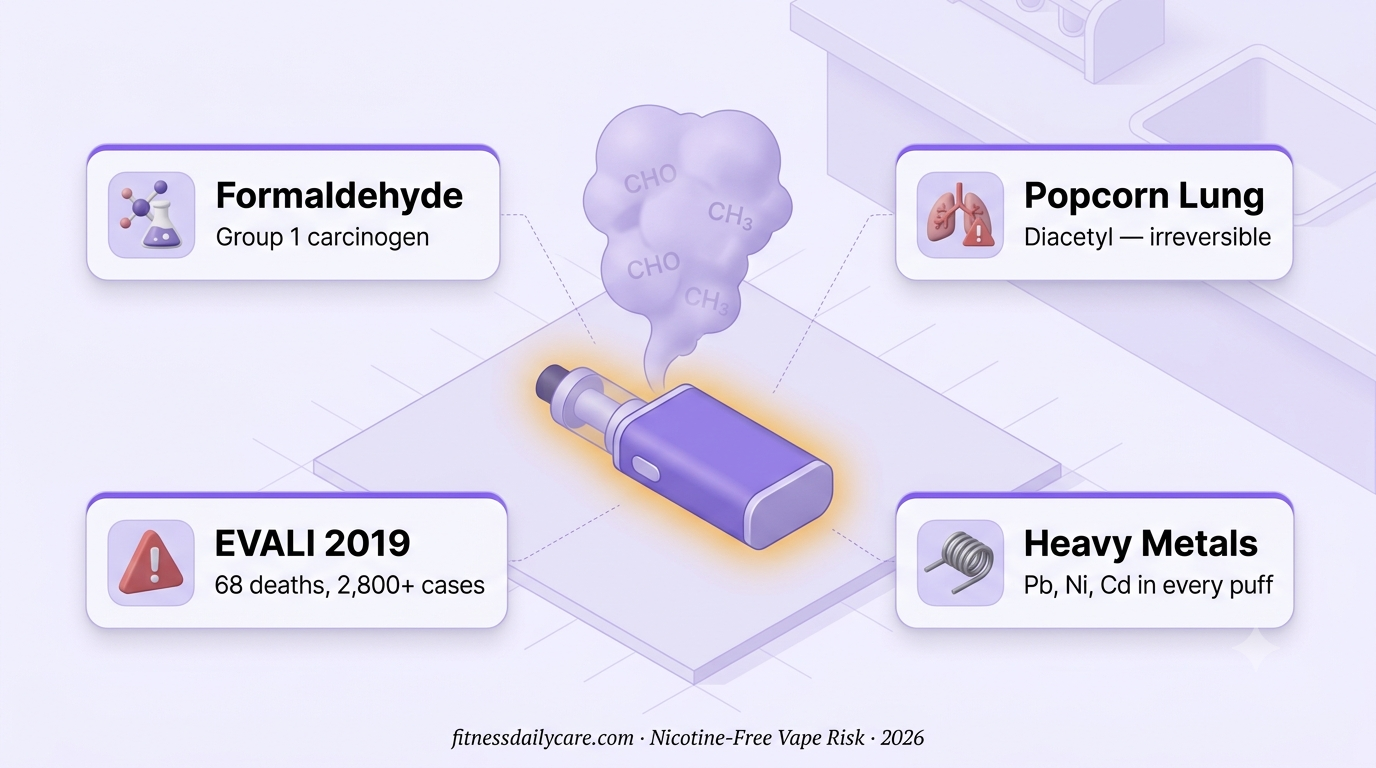
Here is the chemistry that the marketing doesn’t address. Every vape device — nicotine-containing or nicotine-free — operates by heating a liquid, typically composed of propylene glycol (PG) and vegetable glycerin (VG), to produce an aerosol. When PG and VG are heated to the temperatures common in commercial vape devices, they break down into carbonyl compounds: formaldehyde, acetaldehyde, and acrolein. Formaldehyde is classified as a Group 1 human carcinogen by the International Agency for Research on Cancer. Acetaldehyde is classified as a Group 2A probable carcinogen. These are not contaminants from low-quality manufacturing — they are thermal decomposition products of the base liquid used in every vape product, with or without nicotine. The FDA specifically notes that while VG is generally recognized as safe for ingestion, studies suggest that breathing heated VG can damage airways and liver, and may increase cancer risk. Add flavoring chemicals, heavy metals from the heating coil, and the ongoing uncertainty about long-term inhalation effects of ingredients deemed safe for eating, and the nicotine-free label covers a small fraction of the actual chemical exposure.
This piece breaks down the four specific chemical hazards that survive the removal of nicotine, the EVALI crisis that demonstrated what happens when those hazards go unmonitored, and what the FDA and Cleveland Clinic actually recommend for people considering nicotine-free vaping as a “safe” alternative. Nothing in this article argues that nicotine-containing vapes are safer — they are not. The argument is that nicotine removal doesn’t produce a safe product. It produces a product with the addiction removed and much of the chemical exposure intact.
“Safe to eat” doesn’t mean safe to inhale
Both PG and VG carry FDA GRAS (Generally Recognized As Safe) status for food use. The same FDA notes that inhaling heated VG may damage airways and liver, and may increase cancer risk. Different biology, different risk.
Some “nicotine-free” products contain nicotine
Testing has found trace nicotine in products labeled nicotine-free, due to manufacturing variability and cross-contamination. The label is not always accurate, and no FDA pre-market review is required for these products.
Flavoring chemicals are the least regulated variable
Hundreds of flavoring compounds are used across products. Diacetyl is the most documented hazard, but its substitutes (acetoin, 2,3-pentanedione) may be equally harmful. Most have never been tested for inhalation safety.
Long-term effects are unknown by definition
Modern vaping emerged around 2010. The oldest heavy users have less than 15 years of exposure data. Tobacco took 30+ years of research to establish its full carcinogenic profile. The vaping data window is still too short.
Removing nicotine removes the addiction.
It doesn’t remove the vapor.
And the vapor was never just flavored air.
What a Nicotine-Free Vape Still Puts in Your Lungs
Formaldehyde and Acetaldehyde — The Carcinogen Problem
CarcinogensWhen propylene glycol and vegetable glycerin are heated to the temperatures typical of a modern vape device — usually between 150°C and 300°C — they undergo thermal decomposition. The products include formaldehyde, acetaldehyde, and acrolein. This is not a matter of manufacturing quality or low-grade ingredients. It is a predictable chemical reaction that occurs whenever these carrier liquids are heated to aerosol temperature. Formaldehyde (IARC Group 1, known human carcinogen) and acetaldehyde (IARC Group 2A, probable human carcinogen) are produced in every vape device, regardless of nicotine content. The concentrations vary with device temperature, coil type, and puffing behavior — but the compounds are always generated. Higher-wattage devices that produce larger clouds generate more formaldehyde per puff, and longer, more frequent puff sessions compound the cumulative exposure significantly over weeks and months of daily use.
A peer-reviewed study of nicotine-free e-cigarette aerosols found that lung fibroblasts and epithelial cells exposed to PG/VG aerosol and tobacco-flavored aerosol (both nicotine-free) showed increased IL-8 secretion — a key marker of pulmonary inflammation — compared to air-exposed controls. The tobacco-flavored group also showed reduced cell numbers in fibroblasts, suggesting cytotoxicity. The mechanism is the same whether nicotine is present or not: it is the carrier aerosol and flavoring chemicals doing the inflammatory work, not the nicotine. This is the core scientific argument against the “nicotine-free equals safe” framing that drives most of the marketing in this product category.
Diacetyl and Popcorn Lung — The Irreversible Damage
IrreversibleDiacetyl is a flavoring compound responsible for the buttery, creamy taste profile found in dessert, custard, and some fruit vape flavors. When inhaled repeatedly, diacetyl causes bronchiolitis obliterans — scar tissue formation in the tiny airways of the lung that produces progressive, irreversible obstruction. The condition earned the name “popcorn lung” when it first appeared in workers at microwave popcorn factories who inhaled diacetyl aerosol during manufacturing. The American Lung Association describes it as a serious lung disease with no cure.
In 2025, the case of a 17-year-old American high school student who developed bronchiolitis obliterans after three years of flavored e-cigarette use attracted significant attention from pulmonologists and public health researchers. Her condition is permanent and progressive. Many vape manufacturers have voluntarily removed diacetyl from their formulations following regulatory pressure, but substitutes including acetoin and 2,3-pentanedione have been introduced, and ScienceAlert’s 2025 pulmonology review noted that these alternatives may be equally harmful and have not been tested for long-term inhalation safety. The regulatory gap remains: no pre-market safety review of vape flavoring compounds is required in the US, and product reformulation often outpaces testing.
Heavy Metals — What the Coil Puts in the Vapor
#3 HazardVape devices heat e-liquid by passing electrical current through a metal resistance coil, typically made of nichrome (nickel-chromium alloy), stainless steel, or kanthal. At operating temperature, these coils leach metal ions into the aerosol. Independent testing has detected lead (Pb), nickel (Ni), chromium (Cr), cadmium (Cd), cobalt (Co), and copper (Cu) in vape aerosols, at concentrations that in some cases exceed EPA occupational exposure limits. A 2024 scoping review in NCBI found that structural elements of vaping devices released these metals into aerosol across multiple product types, with concentrations influenced by device age, operating temperature, and e-liquid pH.
Lead and cadmium are particularly concerning — both are known human carcinogens and have no safe threshold for inhalation. Nickel and chromium (the predominant coil materials) are associated with lung and nasal cancer in occupational exposures. The key distinction between food safety and inhalation safety applies here too: inhaled metals are not filtered through the gastrointestinal tract and liver before entering the bloodstream. They deposit directly in lung tissue and are absorbed through the alveolar surface into systemic circulation. This is a fundamentally different and more hazardous exposure route than the same metals in food or water.
The consumer cannot see, taste, or smell heavy metal particles in vapor. There is no sensory signal that the exposure is occurring. Product quality control is inconsistent across the largely unregulated disposable vape market, and there is no requirement for manufacturers to publish coil material composition or aerosol metal testing results. Independent testing conducted by research groups has shown wide variation in metal concentrations across devices from different manufacturers, with some products producing aerosol metal concentrations that significantly exceed safe workplace exposure limits over typical daily use patterns.
Vitamin E Acetate and EVALI — What Killed 68 People
Documented DeathsIn 2019, a national lung injury outbreak in the United States produced 2,807 hospitalizations and 68 confirmed deaths. CDC investigation identified vitamin E acetate — a thickening agent used in some vape products, particularly THC cartridges — as the primary culprit. When inhaled and heated, vitamin E acetate produces ketene, a highly toxic gas that causes severe chemical pneumonitis and acute respiratory failure. The EVALI outbreak illustrated in the starkest possible terms what happens when an additive considered safe for topical or dietary use is introduced into vape products without adequate inhalation safety testing.
The lesson from EVALI extends beyond vitamin E acetate specifically. The outbreak happened because a new additive entered widespread use without pre-market inhalation safety evaluation. The same regulatory gap that allowed vitamin E acetate into millions of products still exists for the hundreds of other flavoring compounds, “wellness” additives (CBD, melatonin, vitamins), and functional ingredients currently being added to nicotine-free vapes marketed as health-adjacent. Each new additive is effectively a real-world inhalation trial conducted on the consumer population, with results that may take years to surface. Nicotine-free products are not exempt from this problem — they are often the category with the most novel additive experimentation, precisely because the absence of nicotine allows manufacturers to market them more broadly and to health-oriented consumer segments.
⚠️ Who Is Most at Risk From Nicotine-Free Vapes
1. Non-smokers who have never used tobacco. The FDA is explicit: adults who do not currently use tobacco products should not start using any vaping product. A non-smoker using a nicotine-free vape is adding chemical exposure with no compensating reduction in a prior greater harm.
2. Adolescents and young adults under 25. The developing airway and brain are more vulnerable to chemical insults. Youth vaping rates remain high despite regulatory efforts. Daily nicotine vaping among current youth vapers rose from 15% in 2020 to 29% in 2024 (JAMA Network Open). The nicotine-free category is often the entry point.
3. People with asthma, COPD, or existing respiratory conditions. Even mild airway inflammation from vaping can trigger exacerbations. PG/VG aerosol has been shown to increase airway reactivity in vitro, and people with pre-existing bronchial hyperreactivity are at higher risk from the carrier aerosol regardless of nicotine content.
4. Pregnant women. The FDA advises against any vaping product use during pregnancy. Fetal development is sensitive to carbonyl compounds, heavy metals, and volatile organic compounds — all present in nicotine-free vapor.
If You’re Using It to Quit or to Cope, Here’s What Actually Works
For most people using a nicotine-free vape, the underlying goal is one of three things: the oral fixation and sensory habit without the nicotine, a tool to manage stress or anxiety, or a social behavior. Each of these is a real and understandable need. None of them requires inhaling a chemical aerosol to address. The alternatives below are not the moralistic “just quit” prescription — they are practical evidence-based substitutes for each specific use case, drawn from behavioral health, addiction medicine, and stress physiology research. People who approach quitting with a specific replacement for each trigger function — not just a general “I’ll stop” intention — have measurably higher success rates. The specificity matters because vaping serves different functions for different people at different moments of the day, and a single-tool quit strategy leaves the other functions unaddressed and the person vulnerable to relapse at exactly those moments.
- For the oral fixation habit. Sugar-free gum, toothpicks, flavored herbal teas, or chewing on cinnamon sticks. These address the physical oral behavior loop without chemical inhalation. Most ex-smokers who successfully quit report that the oral substitution phase lasts 2 to 4 weeks before the behavior urge subsides.
- For stress and anxiety management. Box breathing (4 counts in, 4 hold, 4 out, 4 hold) activates the parasympathetic system through the same slow inhalation-exhalation pattern that vaping produces — without the chemical aerosol. 5 minutes produces measurable heart rate variability improvement. The “exhale” effect of vaping that feels calming is almost entirely a breathing pattern effect, not a nicotine effect in a nicotine-free product.
- For the social ritual. Cold sparkling water in a bottle, coffee, or any beverage that occupies the hand-to-mouth behavior in social settings. The social function of vaping is the shared ritual and the hand occupation — both are transferable.
- For genuine quit-smoking support. FDA-approved cessation tools — nicotine replacement therapy (patch, gum, lozenge), varenicline (Chantix), bupropion — have decades of safety and efficacy data. A nicotine-free vape is not a cessation tool. It maintains the behavioral loop without addressing the pharmacological withdrawal.
- For curiosity about the sensation. There is no safe version of inhaling a heated aerosol into the lungs. The nicotine-free framing has created the impression that the vapor itself is neutral. It isn’t. If the goal is pure sensory experience without risk, none exists in this category.
No nicotine doesn’t mean no risk.
It means no addiction label
on the same chemical exposure.