
10-Minute Post-Meal Walk, What It Really Does for Fat Loss
The cheapest metabolic tool in fitness. Blood glucose, NEAT, and why walking right after eating beats any other timing.
Here’s the reality about a post-meal walk: it’s not a calorie-burning strategy. A 10-minute stroll burns roughly 30 to 40 calories — barely a tablespoon of peanut butter. The value of a post-meal walk lives somewhere else entirely: in the glucose curve you reshape, the NEAT calories you stack over weeks, and the digestive and sleep cascade you set off by staying upright after eating.
A Sports Medicine 2023 meta-analysis pooled eight randomized controlled trials and found something consistent: walking immediately after eating had a significantly larger effect on postprandial glucose than walking before the meal or waiting an hour. The timing matters more than the intensity. You don’t need to power walk. You need to move — within the first 15 minutes after your last bite — and do it for at least 10 minutes.
What follows is what the research actually shows about post-meal walking, glucose transporters, NEAT, and why three 10-minute walks per day may matter more for body composition than one 30-minute gym session on the treadmill.
GLUT4 transporters move to muscle surface
Muscle contractions during walking after a meal physically move glucose transporters (GLUT4) to the cell surface, pulling glucose out of the bloodstream independently of insulin. This is the same pathway exercise scientists study in diabetes research.
The glucose peak window is 30–60 minutes
Postprandial glucose peaks roughly 30–60 minutes after eating. Walking in the first 15 minutes catches the upslope, blunting the spike before it reaches maximum. After 60 minutes the window largely closes.
A post-meal walk quietly boosts daily burn
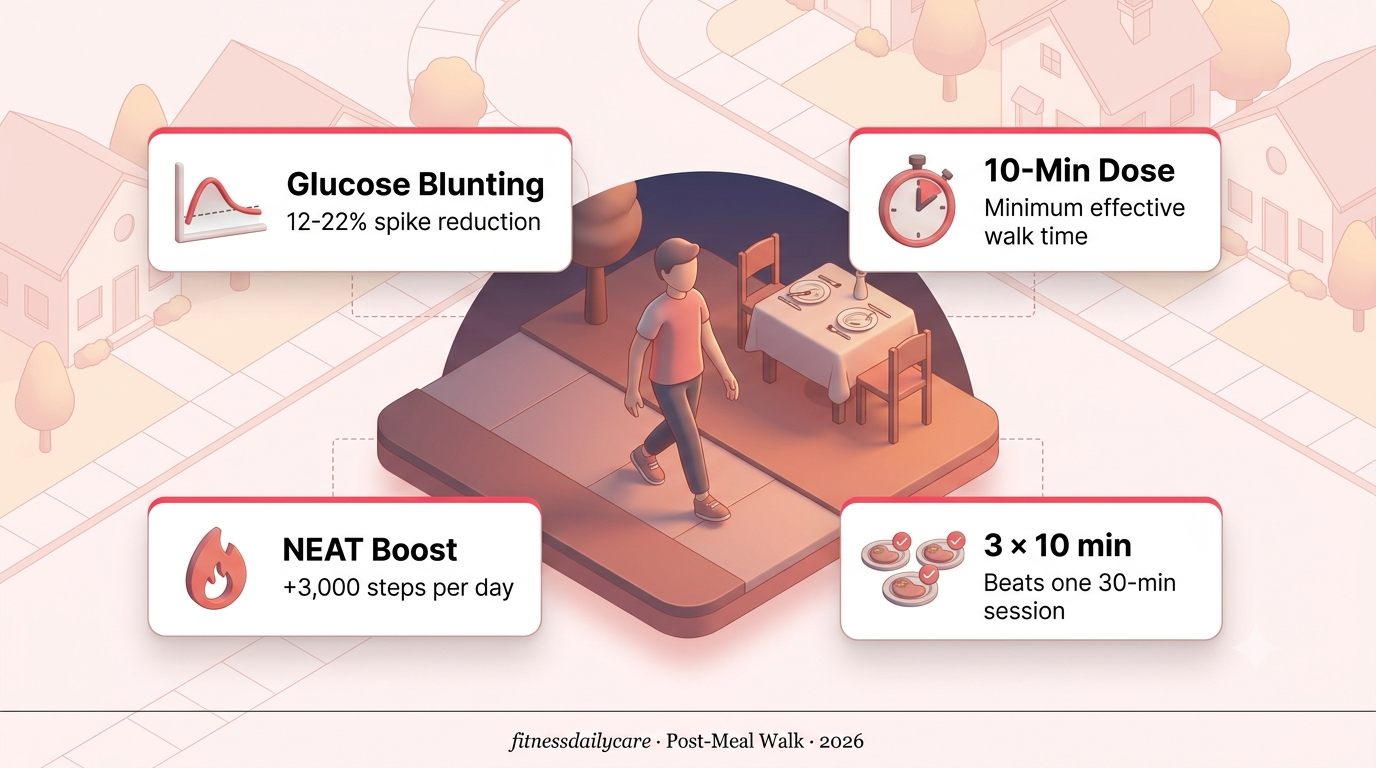
Dr. James Levine’s Mayo Clinic research found lean individuals had 350 kcal/day higher NEAT than obese counterparts. Three 10-minute walks after eating per day add ~3,000 steps and ~100–120 extra calories — the easiest NEAT lever available.
Three 10-min walks beat one 30-min session
A Diabetologia 2016 study found three 10-minute walks after meals reduced daily blood glucose more effectively than a single 30-minute walk at any arbitrary time. Splitting wins because it catches each meal’s glucose spike individually.
Walk before you scroll.
Walk before you sit back down.
Postprandial glucose drops 12–22%
The headline effectAcross multiple trials, a 10- to 15-minute walk immediately after eating reduced peak blood glucose by 12 to 22% depending on meal composition and walking intensity. The Nutrients 2022 trial found the effect held for both high-carb and mixed meals. On a CGM, you can literally watch the spike flatten in real time — the after-dinner mountain turns into a gentle hill.
NEAT stacks silently over weeks
The compound effectThree after-meal walks per day = roughly 3,000 additional steps and ~100–120 extra calories. That’s ~700–840 calories per week, or ~3,600 per month — roughly one pound of fat. It’s not dramatic per day, but it compounds without recovery cost, without gym time, and without the appetite spike that high-intensity cardio often triggers.
Gastric emptying speeds up
Digestive benefitGentle walking promotes gastric motility — the rhythmic contractions that move food from stomach to small intestine. This reduces bloating, shortens the heaviness window, and lowers reflux risk by helping clear stomach contents before you sit or recline. If you’ve ever felt sluggish after a big meal, the fix isn’t digestion time. It’s movement.
Insulin sensitivity improves meal by meal
Metabolic trainingEach post-meal walk trains your muscles to absorb glucose more efficiently. Over weeks, this improves baseline insulin sensitivity — your cells respond to smaller insulin signals and need less of it to clear the same glucose load. The result: lower average insulin levels throughout the day, which creates a metabolic environment more favorable for fat oxidation.
Evening walk resets the cortisol curve
Sleep benefitAn after-dinner walk in the evening helps lower cortisol, promotes the natural cortisol-to-melatonin handoff, and creates psychological distance from the meal-to-couch loop that drives late-night snacking. Studies on post-dinner walking consistently find improved subjective sleep quality and reduced sleep-onset latency in the range of 5–15 minutes.
Start with one post-meal walk after dinner
Minimum viable doseDon’t try to walk after every meal on day one. Start with dinner — the largest meal for most people, the one closest to bedtime, and the one where glucose blunting and NEAT matter most. Once the after-dinner walk is automatic (usually 2 weeks), add lunch. Breakfast can follow later if you want it.
10 minutes is the floor, not the ceiling
DurationThe glucose-blunting effect appears at 10 minutes and strengthens up to about 30 minutes. If you have time and energy, walk longer. But the marginal return per minute drops after the first 10–15 minutes, so the minimum effective dose is short and manageable for almost everyone.
Walk at conversation pace, not cardio pace
IntensityA brisk pace (3–4 mph) is ideal, but even a slow stroll works. The meta-analysis found intensity was not a significant moderator — timing mattered more than speed. If you’re walking with a partner and can hold a conversation, you’re in the right zone. This isn’t a workout. It’s a metabolic reset.
Pair it with kitchen cleanup
Habit stackingThe behavioral sequence matters: finish eating → clear dishes → load dishwasher → put on shoes → walk. That’s 5 minutes of upright movement before you even leave the house, plus the walk itself. You’ve covered 15–20 minutes of post-meal movement without planning a single thing.
Track steps, not calories burned
The right metricCalorie-burned estimates from fitness trackers are wildly inaccurate for walking (±30% error is common). Daily step count is a far more reliable and reproducible metric. Aim for a 2,000 to 3,000 step increase from baseline — that’s roughly what three walks after meals add — and track the weekly average rather than daily noise.
The walk doesn’t burn dinner.
It changes what the body does with it.
- Walk within 15 minutes of your last bite — the glucose spike peaks at 30–60 min
- 10 minutes minimum — the floor for meaningful glucose blunting
- Conversation pace — intensity is not the driver; timing is
- Start with dinner only — add lunch and breakfast once the habit is automatic
- Track daily step count — aim for +2,000 to 3,000 steps from baseline
⚠️ What a Post-Meal Walk Doesn’t Do
1. It doesn’t replace exercise. A 10-minute walk is NEAT, not training. You still need resistance training for muscle preservation and higher-intensity cardio for cardiovascular fitness. The walk is additive, not a substitute.
2. It doesn’t neutralize a bad diet. Walking after a 1,200-calorie fast-food meal doesn’t undo the surplus. It improves glucose handling of whatever you ate, but calorie balance still drives fat loss over time.
3. If you have foot, knee, or hip pain that makes walking uncomfortable, consider standing, gentle stretching, or seated leg movements as alternatives. The core principle is muscle contraction, not walking specifically.