
Weekend Catch-Up Sleep,
Here’s What It Actually Recovers by 90 min
90,903-person UK Biobank data shows heart disease risk drops 20% with weekend catch-up sleep. But 2+ hour shifts backfire. What science actually says about sleeping in.
For years, sleep scientists told the public a firm line: weekend catch-up sleep cannot pay back the sleep debt you accumulate during the week. The recent evidence complicates that. Two large accelerometer-based cohort studies from the UK Biobank — one presented at the 2024 European Society of Cardiology Congress with 90,903 adults, one preprinted in 2025 with 83,776 adults tracked over 8 years — both show that people who sleep 1 to 1.5 hours longer on weekends have measurably lower risk of cardiovascular disease and dementia than those who do not catch up. The heart disease effect is a 20% relative risk reduction. The dementia effect is a 36% reduction, and 51% for people who sleep less than 8 hours on weekdays. These are not small numbers, and they force a real reconsideration of the older advice.
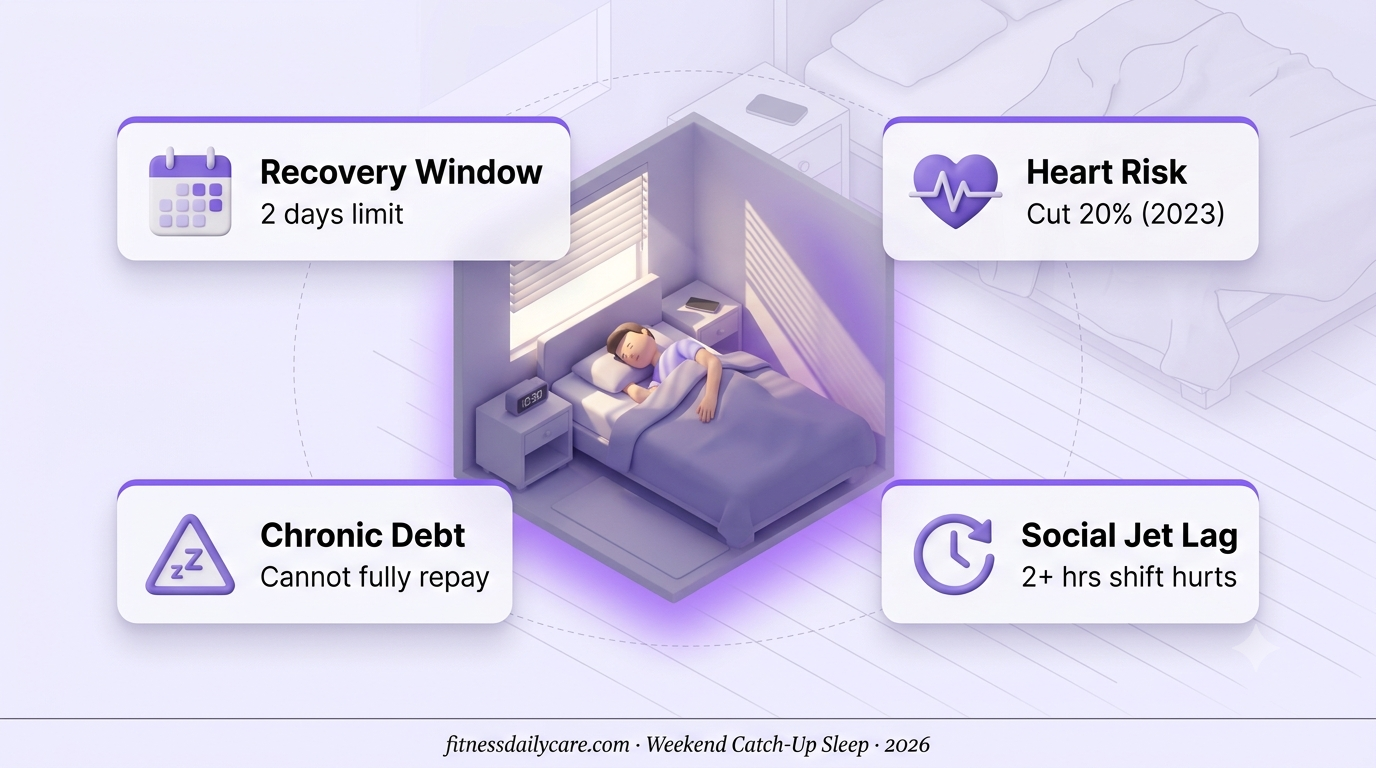
So the popular sleep advice needs an update. Weekend catch-up sleep is not useless. It is protective — within a specific window. The best available data points to a sweet spot of roughly 60 to 90 minutes of extra weekend sleep. Once the difference between your weekday and weekend sleep goes above 2 hours, the picture flips. Social jet lag begins to disrupt circadian rhythm, insulin sensitivity drops, and metabolic markers worsen. A landmark 2019 Current Biology study by Depner and colleagues showed that ad libitum weekend recovery sleep did not fully repair the metabolic dysregulation caused by chronic weekday sleep restriction. So the effect is real but bounded.
This piece walks through what the current evidence actually shows about weekend catch-up sleep — the specific benefits, the specific ceilings, when it stops helping and starts hurting, and the 90-minute protocol most sleep researchers would endorse today. All numbers come from peer-reviewed research or major cardiology conference presentations, with citations laid out in the editor’s note. This is not the “sleep is sacred, never touch it” position and it is not the “sleep in as late as you want” position. It is the middle ground the 2024 and 2025 data actually support.
It’s protective, not neutral
90,903-person UK Biobank data shows catch-up sleep is associated with lower cardiovascular disease risk. Older “you can’t pay back sleep debt” claims oversold the case.
Benefits peak around 60-90 minutes
The dementia study shows the largest protection at 1-1.5 hours extra. Below 30 minutes, minimal effect. Above 2 hours, benefits flatten and social jet lag risks rise.
Effect is largest for the sleep-deprived
People sleeping under 7 hours on weekdays get the biggest benefit from catch-up. If you already sleep 8 hours nightly, weekend extra hours add little.
Metabolic recovery is incomplete
Depner et al. 2019 (Current Biology) showed catch-up sleep does not fully repair insulin sensitivity or weight gain from chronic weekday sleep restriction. It’s a partial patch.
Catch-up sleep is not useless.
It is protective — within a specific window.
The window is about 90 minutes.
The 4 Things Weekend Catch-Up Sleep Does
Cardiovascular Risk Drops Meaningfully
#1 BenefitThe clearest single piece of evidence came out of the 2024 European Society of Cardiology Congress in London. Researchers led by Yanjun Song at Fuwai Hospital used accelerometer-measured sleep data from 90,903 UK Biobank adults tracked over 14 years. They split participants into four quartiles of weekend catch-up sleep. The top quartile — the group that slept the most extra hours on weekends — had a 19 to 20% lower risk of developing heart disease over the follow-up period. The effect includes ischemic heart disease, atrial fibrillation, heart failure, and stroke.
Here is the crucial subgroup finding: the effect was strongest for people already sleep-deprived during the week. Among adults who slept under 7 hours on weekdays, catch-up sleep produced the full 20% risk reduction. Among adults who already got sufficient weekday sleep, the extra hours added marginal protection. So the intervention is dose-dependent on your baseline. If your weekday sleep is chronically short, catch-up meaningfully protects your heart. If your weekday sleep is already 8 hours, catch-up delivers less because there is less debt to repay.
Worth noting: not every dataset agrees. A separate 2024 UK Biobank analysis published in the journal SLEEP examined 70,000+ adults with device-measured sleep data and did not find a significant reduction in mortality or CVD from weekend catch-up specifically. The likely reason for the discrepancy is methodology — the ESC 2024 study used quartile comparisons and focused on the biggest catch-up group, while the SLEEP study used a different exposure definition. What both studies agree on: adequate consistent sleep is protective. Where they diverge: whether extra weekend sleep on its own reduces long-term risk. The most defensible read of the combined evidence is that moderate catch-up is at worst neutral and at best meaningfully protective for the sleep-deprived — which is enough to justify doing it within the 90-minute limit.
Dementia Risk Drops Sharply at the Right Dose
#2 BenefitA 2025 UK Biobank preprint tracked 83,776 adults aged 50 and older with accelerometer sleep data over a median 8-year follow-up. Weekend catch-up sleep of 1 to 1.5 hours per day was associated with a 36% lower risk of all-cause dementia compared to no catch-up (hazard ratio 0.64). Among participants who slept under 8 hours on weekdays, the effect was even larger — a 51% reduction (hazard ratio 0.49). The dose-response was clearly inverted-U shaped: 0.5 to 1 hour of catch-up showed weaker effects, 1.5 to 2 hours showed diminished protection, and over 2 hours showed no meaningful benefit compared to baseline.
The 90-minute ceiling matters. Excessive weekend catch-up disrupts circadian rhythms and produces what researchers call social jet lag — the mismatch between your body clock and your social schedule. Higher day-to-day sleep timing variability has been independently linked to vascular risk factors and increased dementia risk. So sleeping 4 or 5 extra hours on Saturday to make up for a rough week may feel great in the moment but does not confer the same brain-health protection as a more modest catch-up.
Why exactly 90 minutes and not more? The current hypothesis among sleep researchers is that up to 90 minutes of catch-up largely fits within the flexibility of your existing circadian rhythm — your body can absorb the extra sleep without shifting your central clock significantly. Beyond that threshold, the wake-time shift starts pulling your entire rhythm later, which then disrupts your evening melatonin release, your Sunday night sleep onset, and your Monday wake time. So 90 minutes is not just an arbitrary number but the approximate boundary between “recovery” and “clock disruption.” Individual chronotype varies (night owls can tolerate slightly more shift; morning larks less), but the population-level ceiling is well-defined in the data.
Cognitive and Mood Symptoms Do Improve
#3 BenefitBeyond the long-term disease outcomes, weekend catch-up sleep produces measurable short-term benefits on cognitive performance and mood. Sleep researchers have shown that one or two nights of extended sleep after a week of restriction restore reaction time, sustained attention, and self-reported alertness closer to baseline. Emotional regulation, particularly the amygdala’s reactivity to negative stimuli, also improves. Adolescents show a related pattern — a 2026 study reported that teens who slept longer on weekends had significantly lower rates of depression, and a 2025 study found that 2 extra weekend hours reduced anxiety in the same age group.
This is why the Monday morning after a well-slept weekend genuinely feels different from the Monday after another 6-hour weekend. Your subjective sense of “recovery” is not entirely wrong. What the newer data adds is that this subjective recovery translates to real long-term cardiovascular and cognitive protection when the catch-up amount is moderate. The subjective and objective are indeed aligned, within reasonable limits.
One implication worth flagging: the emotional-regulation benefit is often larger than the physical-performance benefit. Athletes who chronically restrict weekday sleep and catch up on weekends typically report better mood on Monday than better strength or endurance in the gym. Strength and coordination benefit some from recovery sleep, but the emotional systems recover faster and more visibly. This tracks with the underlying neuroscience — the amygdala and prefrontal cortex respond quickly to sleep restoration, while muscle protein synthesis and hormonal repair need more sustained recovery windows.
Metabolic Recovery Is Only Partial
#4 RealityHere is the important limit. A 2019 Current Biology study by Depner and colleagues at the University of Colorado ran a controlled in-lab experiment. Adults were assigned to chronic weekday sleep restriction with ad libitum weekend recovery sleep, repeated over multiple cycles. The finding: weekend recovery sleep did not prevent metabolic dysregulation caused by the recurring pattern of insufficient sleep. Participants still showed disrupted glucose metabolism, reduced insulin sensitivity, and weight gain compared to well-rested controls. In other words, you cannot use weekend catch-up as a substitute for adequate weekday sleep on the metabolic side.
Additional research shows social jet lag — the difference between weekday and weekend sleep timing — is independently associated with metabolic syndrome, higher fasting glucose (roughly 3 to 5 mg/dL per hour of social jet lag), and insulin resistance. The mechanism appears to be circadian misalignment: your peripheral clocks (liver, pancreas, muscle) get out of sync with your central clock, and glucose processing suffers. This is not fixed by more sleep. It is fixed by more consistent sleep timing, which is a much harder ask than sleeping in on Saturday but is the actual root of the metabolic problem.
⚠️ When Weekend Catch-Up Sleep Backfires
1. When the difference exceeds 2 hours. A 2-hour or greater gap between weekday and weekend sleep timing is the operational definition of social jet lag used in most research. Above that threshold, benefits diminish and metabolic risks appear. If you consistently sleep 6 hours on weekdays and 10 hours on Saturday, that is social jet lag — not restorative catch-up.
2. When it destroys Sunday night sleep. Sleeping until noon on Saturday or Sunday delays your circadian clock. You will not feel sleepy at your usual Sunday bedtime, and Monday morning becomes a hard reset. The result is often worse weekday sleep than you started with — a “Monday tax” that undoes the weekend benefit within 48 hours.
3. When it becomes a substitute, not a supplement. Catch-up sleep works as a bounded recovery tool, not as a replacement for adequate weekday sleep. The Depner 2019 data shows chronic reliance on this pattern still produces metabolic damage. If you find yourself needing 3+ hours of catch-up every weekend, the actual problem is your weekday sleep, not your weekend recovery.
4. In shift workers and rotating schedules. If your weekday and weekend schedules already differ dramatically (night shifts, on-call rotations), adding more variability with extended weekend sleep amplifies circadian disruption. Shift workers benefit more from consistency within their imposed schedule than from weekend catch-up.
The Weekend Sleep Protocol Sleep Researchers Actually Recommend
The version below reflects what the 2024 and 2025 evidence actually supports — bounded weekend catch-up as a legitimate recovery tool, with a hard ceiling to prevent social jet lag. It is not the older “never sleep in” line, and it is not the “sleep in as long as you want” line. It is what the current large-cohort data would endorse. If you are a chronically sleep-restricted adult who cannot easily add hours during the week (parents, healthcare workers, students, high-demand jobs), this protocol is the closest thing sleep science currently has to a permission slip. If you already sleep 8 hours nightly, most of this does not apply to you — just keep doing what you are doing.
- Cap the catch-up at 90 minutes. If your weekday wake time is 6:30 a.m., aim for weekend wake around 8:00 a.m., not 11:00 a.m. This is the single most important rule.
- Go to bed earlier, not just wake later. The best catch-up strategy shifts bedtime forward by 30 to 60 minutes and wake time back by 30 to 60 minutes. Splitting the extra sleep across both ends of the night is easier on your circadian rhythm than pushing wake time alone.
- Protect Sunday night sleep aggressively. Sunday night is the weakest link. Avoid caffeine after noon, no screens after 9 p.m., cool room, dark blackout. If you must choose between sleeping in on Sunday or falling asleep on time Sunday night, pick Sunday night.
- Nap under 30 minutes. A 20 to 25-minute afternoon nap on Saturday or Sunday can add to your catch-up total without disrupting the following night’s sleep. Longer naps roll into slow-wave sleep and produce grogginess.
- Fix Friday night first. Most sleep-restricted adults are worst on Friday night — they stay up late thinking they will catch up Saturday. Going to bed on time Friday and sleeping until 8 a.m. Saturday delivers more recovery than staying up until 2 and sleeping until noon.
- Track for 4 weeks. Use any sleep tracker (phone, Apple Watch, Oura, Whoop) to record actual sleep duration. If weekend catch-up consistently exceeds 2 hours, your weekday sleep is the actual problem — not your weekend recovery.
- Prioritize weekday consistency long-term. Weekend catch-up is a bounded recovery patch, not a fix. The permanent solution is 7 to 8 hours of nightly sleep on a consistent schedule. Use catch-up when weekday life is not cooperating, and work on the weekday sleep in parallel.
You cannot pay back years of sleep debt.
You can pay back last week.
The receipt is 90 minutes.