
Cortisol Face Isn’t Real,
It’s These 4 Things Instead
Cushing’s syndrome affects 3 in a million. Your morning puffy face is almost always four other things — and the fix takes 20 minutes, not a supplement stack.
The phrase “cortisol face” wasn’t invented by a doctor. It was invented by TikTok. Over the past two years, millions of videos have promoted a specific claim: that chronic stress raises your cortisol high enough to give you a swollen, rounded face — and that the fix is a supplement stack, a “cortisol detox,” or a morning routine sold in the caption. The claim is compelling because it converts a personal aesthetic complaint into a medical-sounding condition. It also happens to be wrong in almost every case.
Endocrinologists, dermatologists, and internal medicine physicians have been public about this. The actual condition of true cortisol-driven facial swelling is called Cushing’s syndrome, and it is medically diagnosed. Its incidence is roughly 2 to 3 new cases per million people per year — Cushing’s disease specifically has a prevalence of about 40 per million. Statistically, if you are reading this piece, you almost certainly do not have it. What you probably do have is a normal, reversible morning puffiness driven by four lifestyle factors that nothing on your algorithm is selling. The gap between what TikTok is describing and what medicine actually recognizes is enormous, and it matters because the wrong framing sends people toward the wrong fix. If your face is puffy from sodium and alcohol, no adrenal-support supplement in the world will help you. What will help is skipping the late pizza and drinking a glass of water.
This piece breaks down what actually causes cortisol face when you look in the mirror at 7 a.m., what the endocrinologists at Ohio State, Cleveland Clinic, and Mayo Clinic actually say about it, the three genuine warning signs that mean you should see a doctor, and a 20-minute morning routine that resolves puffiness faster than any supplement in a TikTok caption. Everything below is drawn from peer-reviewed clinical research and physician-authored guidance, not the algorithm.
“Cortisol face” is not a medical term
No physician diagnoses “cortisol face.” The actual condition is Cushing’s syndrome, and it requires a blood test, urine test, or dexamethasone suppression test — not a phone camera and a filter.
Stress affects skin, but not like that
Dermatologist Whitney Bowe notes that chronic stress inhibits collagen, hyaluronic acid, and ceramide production. The effect is subtle aging over years, not a puffy face overnight.
Fluid retention is mostly diet and sleep
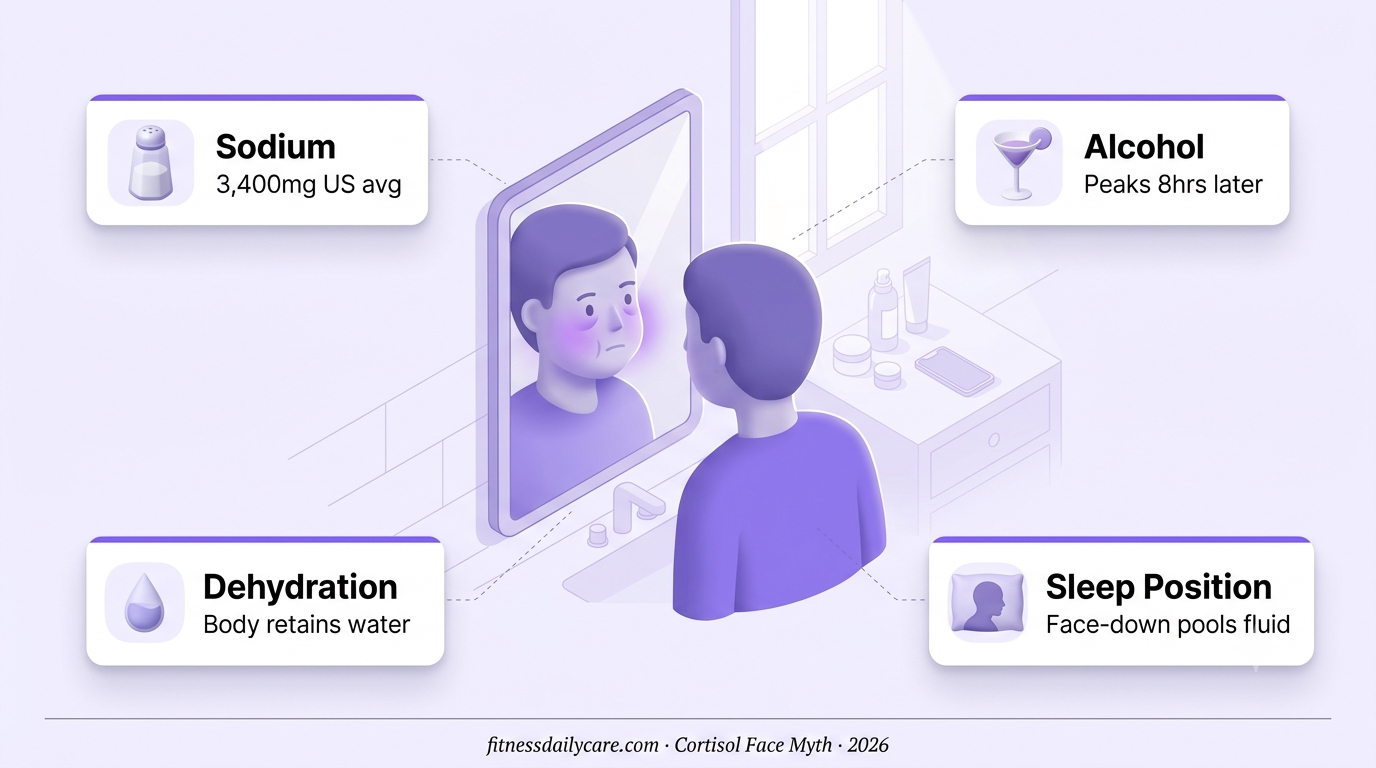
The four dominant morning-puffiness drivers are sodium, alcohol, sleep position, and dehydration. All four are behavioral, all four fix in hours to a day.
Real Cushing’s has other signs
Weight gain in the abdomen, thin skin that bruises easily, purple stretch marks, muscle weakness, and high blood pressure appear together with facial fullness. A puffy morning face alone is not it.
You don’t have cortisol face.
You had takeout and slept face-down.
That’s it.
What Cortisol Face Actually Is
Sodium From Last Night’s Dinner
#1 CauseThe FDA reports that Americans average about 3,400mg of sodium per day, nearly 50% above the 2,300mg upper limit. About 90% of US adults regularly exceed the cap. But the specific issue for morning face puffiness is not your daily average — it’s the last meal you ate before bed. A takeout dinner, a bag of chips during a show, a late slice of pizza, a couple of soy-sauced dumplings, or a restaurant burger can each deliver 1,500 to 2,500mg in one sitting. That is enough to trigger measurable overnight fluid retention.
The mechanism is straightforward. When sodium concentration rises in your extracellular fluid, your kidneys retain water to dilute it. That extra water distributes throughout your body, but it shows up most visibly in areas with loose connective tissue — under the eyes, cheeks, jawline. This is exactly the pattern the “cortisol face” videos are pointing at. It is also exactly what a bowl of ramen at 9 p.m. does to any healthy person. Cleveland Heart notes that most sodium-driven puffiness resolves within 24 to 48 hours of returning to normal intake, which is why the same face that looked “cortisol-y” on Monday morning often looks fine by Tuesday.
A pattern most people miss: sodium in packaged foods is much higher than most people estimate. A single Chipotle burrito bowl can carry 2,000mg of sodium. A serving of frozen pad thai clears 1,600mg. A Subway footlong is often 1,400mg. Bread by itself averages 200mg per slice. Two slices of pizza clear the entire daily upper limit. So the “healthy” dinner of a frozen entree and some bread can hit 2,400mg in one meal — nothing salty on the plate, no visible salt shaker action, but the number is still there. This is the reason otherwise health-conscious people wake up with a face that looks like it belongs to someone stressed out of their mind.
Alcohol And the ADH Rebound
#2 CauseAlcohol is the second biggest single driver of the specific puffiness that people call cortisol face. The mechanism is not the alcohol itself — it is what your body does after the alcohol. When you drink, ethanol suppresses antidiuretic hormone (ADH), the hormone that tells your kidneys to hold water. So you urinate more and become mildly dehydrated within a few hours. That is well known.
The part most people miss: about 6 to 8 hours later, usually while you are asleep, ADH rebounds strongly. Your kidneys now retain water aggressively to compensate for the dehydration. That retained fluid pools in soft tissue overnight, and you wake up with a visibly rounder, puffier face. Board-certified endocrinologists point to this ADH cycle as the single most consistent cause of the “moon face” appearance people misattribute to cortisol. The face you see in the 7 a.m. mirror after a Saturday night out is the ADH rebound, not a stress hormone problem.
The type of drink matters less than most people think. A cocktail with a salted rim compounds sodium retention, but a glass of wine, a couple of beers, or a few shots of tequila all produce the same ADH cycle. Volume matters more than category. Two drinks generally produce a mild version. Four or more drinks produce very visible next-morning puffiness in almost everyone. This is also why the “cortisol face” appearance is often worst on Sunday mornings — Saturday night is when most people consume the most alcohol, and Sunday morning is when the ADH rebound peaks. If you notice your face looks different specifically after weekend drinking, that is your answer. No adrenal test needed.
Sleep Position And Pillow Height
#3 CauseGravity spends the entire day pulling fluid downward. When you lie flat for 7 or 8 hours, that fluid has nowhere to drain from your face, especially if your head is not elevated relative to your heart. Face-down sleepers get the most pronounced puffiness because the loose connective tissue under the eyes and around the jaw fills with lymphatic fluid overnight. Side sleepers often notice more puffiness on the side they slept on. Back sleepers with a flat pillow get diffuse, all-over facial rounding. This is a purely mechanical process — no hormones involved.
The fix is boring and effective. Sleeping with your head slightly elevated (a second pillow, or a wedge, so the head sits 3 to 4 inches above heart level) allows gravity to drain fluid away from the face overnight instead of into it. Vein specialists and sleep medicine physicians agree on this one: it does more for morning facial puffiness than any topical product on the market. It also happens to reduce snoring and mild acid reflux for many people, which is a useful side effect.
Pillow choice also matters. A pillow that is too flat allows the head to drop below heart level; a pillow that is too high creates a sharp angle at the neck that restricts lymphatic drainage from the face. The right height keeps the neck in a neutral line with the spine while elevating the head slightly. Memory foam pillows tend to hold the position better than down; too-soft down flattens under weight through the night. If you consistently sleep face-down, changing pillow height alone will not fix it — face-down is the single worst sleep position for morning puffiness, regardless of pillow. Gradual transition to side sleeping (using a body pillow to hug on the preferred side) is the usual fix.
The Dehydration Paradox
#4 CauseThis is the counterintuitive one, and it is the reason so many “cortisol face” fixes on social media do not work. When people notice morning puffiness, the instinct is to drink less water. That backfires. When you are chronically underhydrated, your body activates the same water-retention response that fires after alcohol — kidneys hold on to fluid to protect blood volume. Face and undereye puffiness increase, not decrease. The Mayo Clinic and dermatology reviews consistently point to increasing daily water intake as the correct move for mild dependent edema.
There is a common pattern here worth flagging. Coffee-heavy mornings, low water intake through the day, salty lunch, alcohol at night, and 6 hours of sleep face-down on a flat pillow will produce a visibly puffy face by morning in virtually anyone. The person then blames stress and cortisol, buys ashwagandha, and does not change any of the five actual drivers. The face stays puffy. The pattern continues. Nothing about that has anything to do with cortisol.
⚠️ When Facial Swelling Is Actually Cushing’s
1. Facial fullness is not the only symptom. Real Cushing’s syndrome shows up as a cluster. If your face has changed shape and you also have unexplained weight gain concentrated in the abdomen and upper back (buffalo hump), that pattern is worth a doctor visit. Facial change in isolation is almost never Cushing’s.
2. Skin changes accompany the face change. Skin that bruises very easily, purple or reddish stretch marks (especially on the abdomen, hips, or thighs) wider than a finger, thin fragile skin, and slow wound healing are hallmark Cushing’s signs. These reflect actual cortisol-driven collagen breakdown.
3. Systemic signs are present. High blood pressure, high blood sugar or new-onset diabetes, muscle weakness (especially in the thighs and upper arms), irregular or missed periods, low libido, mood changes, and unusual fatigue that developed alongside the facial change all point toward endocrine evaluation.
4. Long-term steroid use. Prednisone or other corticosteroids taken for weeks or months can cause a Cushing’s-like presentation (called iatrogenic Cushing’s). If you are on steroids for asthma, autoimmune disease, or transplant, and your face is rounding, discuss with your prescribing physician — do not stop steroids on your own.
The 20-Minute Morning That Actually Debloats Your Face
Nothing on this list requires a supplement, a device, or a $60 morning routine kit. It is the sequence dermatologists and vascular specialists actually recommend for the healthy adult with mild, benign morning face puffiness. The whole thing takes about 20 minutes and works with normal circulation and lymphatic drainage rather than trying to manipulate a hormone that is not the problem. Consistency matters more than intensity. If you follow this sequence three mornings in a row, most people notice a clear difference by the fourth morning — assuming they also cut the sodium and alcohol at night. Skip the evening prevention and no amount of morning cold rolling will keep up. Think of morning routines as symptom management and evening routines as prevention: if the sink is overflowing, you can mop the floor all day, but the real fix is turning off the tap. The evening prevention piece is the tap.
One more note before the sequence itself: the biggest single reason people fail at reducing cortisol face is inconsistency. Many try the morning debloat for two days, do not see a dramatic difference, and go back to the algorithm looking for a supplement fix. Facial puffiness is a rolling average of the last 2 to 3 days of inputs, not the last hour. Give it a full week of consistent execution before evaluating whether it works. Most people are surprised by how much the face changes when the evening inputs are corrected, not just the morning outputs.
- 0-2 min. Hydrate first. 16 oz of water before coffee, before your phone. Room temperature is fine. This is the single biggest lever in the sequence.
- 2-7 min. Cold compress or ice roller. 5 minutes on the cheeks, jaw, and under the eyes. Cold constricts capillaries and reduces localized fluid. A chilled washcloth works fine.
- 7-10 min. Lymphatic massage. Light strokes from the center of the face outward and down toward the neck. 2 to 3 minutes. This moves the fluid that is pooled overnight into the lymphatic drainage system.
- 10-25 min. Cardio, any kind. 15 minutes of anything that raises your heart rate — brisk walk, jog, cycling, jumping rope. This accelerates lymphatic flow, promotes light sweating, and reduces morning puffiness faster than any topical product.
- Optional. Green tea instead of a second coffee. Mild diuretic effect without the intense dehydration cycle. Skip if you have any sensitivity to caffeine.
- Evening prevention (the actual fix). Cut sodium after 6 p.m. Limit alcohol. Elevate your head with an extra pillow. Aim for 7 to 8 hours of sleep. This is what actually keeps the puffiness from happening in the first place.
- Track for one week. Take a phone photo of your face at the same time each morning for 7 days. Most people are surprised how much the face changes with just these behavioral inputs alone.
Cortisol is essential for survival.
You do not have a cortisol problem.
You have a Tuesday morning.