
Training to Failure, Does It
Actually Build More Muscle
Grinding out that last impossible rep feels like the whole point of lifting. Fifteen pooled studies say it barely moves the needle.
Training to failure has this reputation as the “real” way to train — if you’re not grinding out a rep your body physically can’t finish, are you even trying? I used to program failure sets into almost every workout because it felt productive. Sore, shaking, done. That had to mean something.
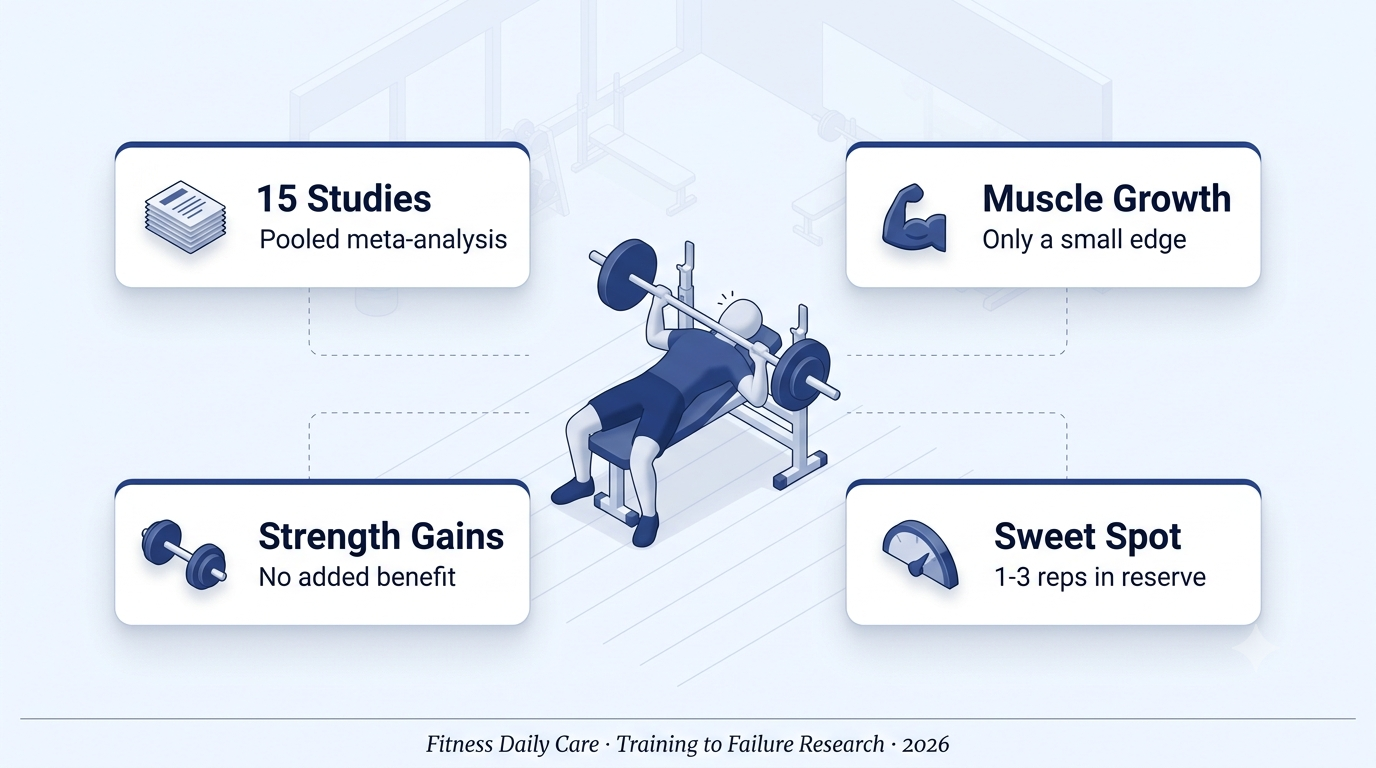
Then I actually read the research comparing failure training to leaving reps in reserve (RIR), and the picture is a lot less dramatic than the gym-bro logic suggests. A 2023 meta-analysis pooling 15 studies found that training closer to failure produced only a small edge in muscle growth — and a separate pooled analysis of 8 trials found training to failure didn’t improve strength gains at all.
So what’s actually going on, and what should you do with that last rep in your set? This article breaks down what the research says, why failure still feels important, and the practical RIR targets most evidence-based coaches now use.
Failure Isn’t Required For Growth
An 8-week randomized trial found quadriceps hypertrophy was essentially identical between a true-failure group and a 1–2 RIR group.
Strength Doesn’t Benefit At All
A meta-regression of 67 strength studies found proximity to failure had no clear relationship with strength gains.
Effort Still Matters
Mechanical tension and effort drive growth, not the literal inability to complete a rep. Training hard still beats training easy.
Use Occasional Failure Sets
Training to true failure once in a while helps you calibrate how accurately you’re estimating RIR on every other set.
What “Training to Failure” Actually Means
DefinitionsTraining to failure, also called momentary muscular failure (MMF), means performing reps until you physically cannot complete another one with proper form. Reps in reserve (RIR) describes the opposite approach — stopping a set while you could still technically perform 1, 2, or more additional reps.
Research shows most people underestimate their RIR by roughly one repetition on average, meaning a set you think is “2 reps from failure” is usually closer to failure than that.
What The Actual Studies Found
The EvidenceA 2024 randomized trial in the Journal of Sports Sciences put resistance-trained adults through 8 weeks of leg press and leg extension training, either to true failure or a 1–2 RIR target. Quadriceps hypertrophy came out essentially the same in both groups.
Zooming out, a 2024 meta-regression covering 55 hypertrophy studies and 67 strength studies found that training closer to failure helped muscle growth modestly — but had no measurable effect on strength gains. An earlier pooled analysis of 8 trials reached the same conclusion for strength specifically.
Why Failure Still Feels Like It Should Matter More
The PhysiologyMechanical tension — the force your muscle produces against resistance — is what actually triggers muscle protein synthesis at the cellular level. As a set progresses toward failure, you recruit progressively more high-threshold motor units, which is part of why failure feels so effective.
But recruitment near failure isn’t the only path to that same recruitment. Higher loads, slower tempos, and simply adding more total sets all recruit those same fibers without requiring you to hit true failure on every single set.
The Practical Rule Most Coaches Use Now
What To DoFor muscle growth, aim for roughly 1–3 RIR on most working sets — hard enough to matter, not so hard that recovery suffers. For pure strength work like heavy squats, deadlifts, and presses, 3–5 RIR preserves bar speed and technique while still driving progress.
Save true failure sets for occasional calibration — ideally the last set of an exercise, done sparingly — so you can recognize what “1 RIR” actually feels like on the sets that come before it.
The last rep you can’t finish
isn’t doing as much work as you think.
- Leave 1–3 reps in reserve on most hypertrophy sets instead of grinding every set to failure
- Leave 3–5 reps in reserve on heavy compound strength lifts
- Save true failure for isolation exercises where losing form is lower-risk (leg extensions, curls, lateral raises)
- Use one failure set occasionally to recalibrate how accurately you’re judging RIR on other sets
- Prioritize adding sets or load over adding fatigue — progressive overload beats grinding harder
⚠️ Where Failure Training Still Carries Real Risk
1. Compound barbell lifts. Squats, deadlifts, and bench press lose bar speed and technique fastest near failure, raising injury risk without a matching payoff.
2. Recovery capacity. Training to failure consistently accumulates more fatigue than RIR-based training, which can eat into your ability to recover between sessions.