
Liquid Calories, Why Your Body Doesn’t Count Them the Same
A 4-week trial gave people 450 identical calories a day, either as jelly beans or soda. The solid version got nearly fully offset elsewhere. The liquid version didn’t — and weight only rose on soda.
Liquid calories and weight loss collide in one of nutrition science’s cleanest little experiments. In 2000, researchers gave 15 adults 450 extra calories a day, every day, for four weeks — once as jelly beans, once as soda, in random order. Same calories, same sugar, same people. The only thing that changed was whether the extra energy came in solid or liquid form.
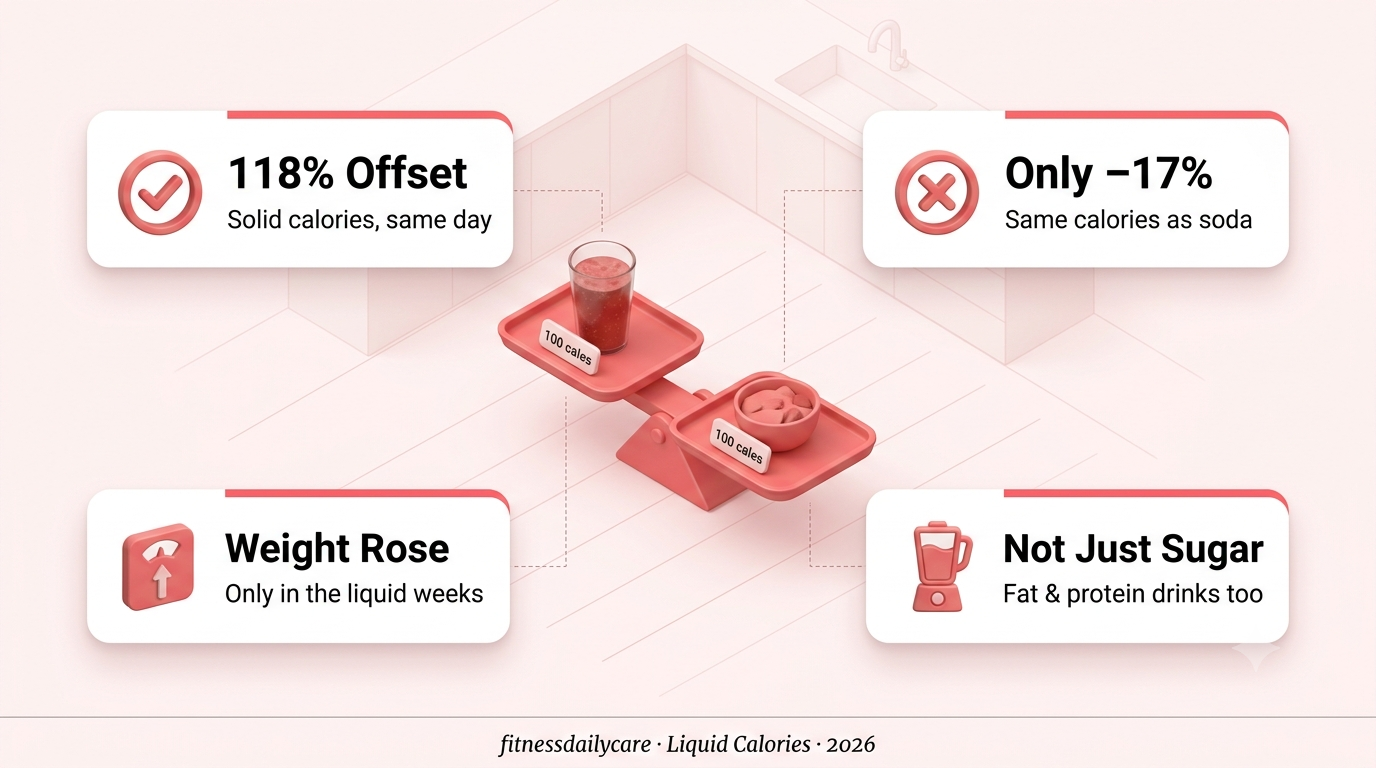
When the extra calories came from jelly beans, something automatic happened: people quietly ate less food the rest of the day. The compensation was almost exact — 118%, meaning they actually trimmed slightly more than the extra calories added. Body weight didn’t budge. When the same 450 calories came from soda, that automatic adjustment barely showed up at all — compensation measured just −17%, meaning people ate about as much other food as before and simply added the soda calories on top. Body weight and BMI rose significantly, but only during the soda weeks.
A larger follow-up trial in 2007 found the same pattern held even outside of sugar — testing carbohydrate, fat, and protein foods each in liquid and solid form. This article covers what both studies found, and what to actually do with a finding like this.
Why It Happens
Liquids skip chewing and empty from the stomach faster than solids, which appears to weaken the signals that normally trigger eating less later.
What the Trial Showed
DiMeglio & Mattes found 118% compensation for solid-form calories, but only −17% for the identical calories as soda.
The Myth This Breaks
“A calorie is a calorie, form doesn’t matter” — two controlled trials found form changed how completely the body compensated, even with identical energy content.
What Actually Works
Mourão et al. found the gap wasn’t only about sugar — protein and fat beverages also showed weaker compensation than their solid equivalents.
Solid food got offset almost exactly.
The same calories as a drink barely got offset at all.
Liquid Calories, the Practical Version
Treat Caloric Drinks as a Meal, Not an Extra
FoundationThe core issue isn’t that liquid calories are “bad” — it’s that your body is less likely to notice them and adjust. Mentally filing a smoothie, latte, or juice as “part of my food for today” rather than a free add-on closes most of that gap on its own.
Add Protein or Fiber If You Do Drink Your Calories
Mitigate the GapProtein and fiber both slow gastric emptying and support fullness signaling more than sugar alone — a protein smoothie with fiber-rich fruit behaves more like a meal than a straight juice or soda does, even at similar calories.
Watch More Than Soda — Juice and Shakes Count Too
Broaden the LensThe 2007 trial used watermelon juice, milk, and coconut milk — none of them soda. The weaker-compensation pattern wasn’t unique to sugary drinks; it showed up with protein and fat beverages too.
Swap One Liquid Calorie Source a Day
Small HabitYou don’t need to eliminate caloric drinks entirely. Replacing just one daily liquid-calorie habit — a juice with breakfast, a sweetened coffee in the afternoon — with a solid-food or non-caloric equivalent is a realistic, low-effort place to start.
- Count caloric drinks as food — mentally and in your tracking, not as a free extra
- Add protein or fiber to smoothies and shakes to improve fullness signaling
- Watch juice and milk, not just soda — the weak-compensation pattern isn’t sugar-specific
- Swap one source at a time — a realistic, sustainable place to start
- Non-caloric drinks aren’t the issue — this is specifically about calorie-containing beverages
⚠️ What This Doesn’t Mean
1. This isn’t “never drink your calories.” Shakes and smoothies are a genuinely useful way to meet calorie or protein needs for people who struggle to eat enough — the finding is about default eating patterns, not an absolute rule.
2. This is small-trial evidence for the original study. DiMeglio & Mattes tested 15 people; the 2007 Mourão trial with 120 people strengthens the pattern, but individual responses still vary.
3. Diet and non-caloric drinks aren’t implicated here. This research is specifically about beverages that contain calories — it says nothing about zero-calorie drinks.
A calorie is a calorie — until your body has to notice it.
Liquid calories are easier to miss.