
Magnesium for Sleep, What a New Trial
Actually Found
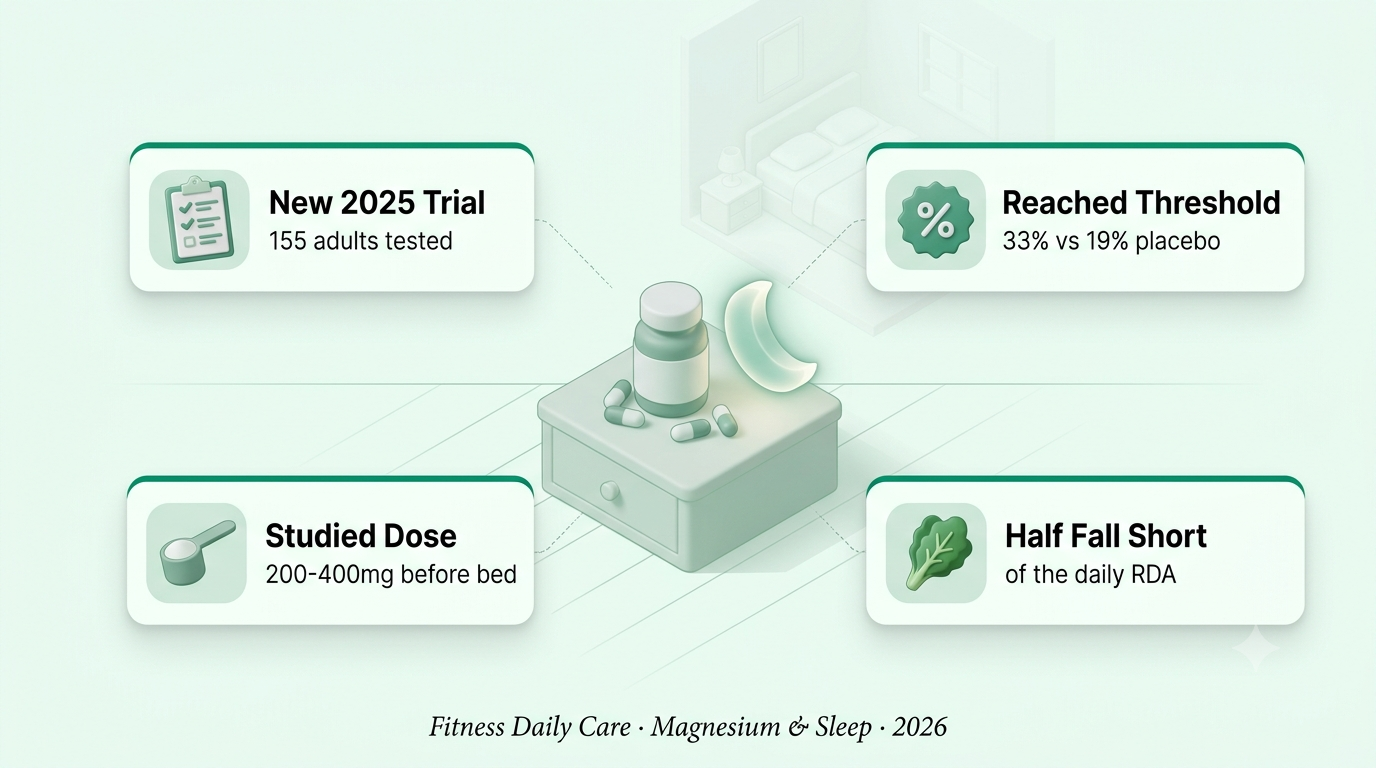
A 2025 randomized, placebo-controlled trial of 155 adults tested whether magnesium bisglycinate really changes sleep, not just anecdotes
I got curious about magnesium for sleep after seeing it mentioned everywhere this year, so I went looking for the actual trial data instead of the supplement-brand version of the story. What I found was a 2025 randomized, placebo-controlled study out of Germany: 155 adults with self-reported poor sleep, split into a magnesium bisglycinate group and a placebo group, tracked for four weeks.
The result wasn’t a miracle cure. It was a modest, measurable difference — more people in the magnesium group crossed a meaningful improvement threshold than in the placebo group. That’s a real signal, but it sits inside a body of research that’s still genuinely mixed, with some earlier trials finding nothing at all.
This piece walks through what that trial actually found, the most likely reason it might work, the dose range researchers have tested, and where the evidence still falls short of settled science.
How It May Help
Magnesium is thought to support GABA receptor activity and lower cortisol, while glycine — its carrier in bisglycinate — may lower core body temperature before sleep onset.
The Evidence Is Still Building
A systematic review of earlier trials, covering only 247 participants total, found 2 of 5 RCTs showed benefit and 3 found none.
Most People Fall Short
NIH-cited estimates suggest roughly half of US adults don’t meet the magnesium RDA, rising to 70–80% in adults over 70.
Glycinate Absorbs Better
Magnesium bisglycinate is chelated with glycine and absorbs substantially better than magnesium oxide, which research has classified as having extremely low bioavailability.
Half of us are running a mineral deficit
we’ve never once thought to check.
The New Trial, In Detail
2025 RCTThe double-blind trial randomized 155 adults reporting poor sleep into a magnesium bisglycinate arm (78 people) and a placebo arm (77 people) for four weeks. Researchers tracked how many participants crossed a pre-defined, clinically meaningful improvement threshold on a standard insomnia scale: 26 in the magnesium group did, versus 15 on placebo.
The Likely Mechanism
How It WorksMagnesium is involved in regulating neurotransmitter systems tied to relaxation, including GABA activity, and may help lower cortisol levels. In bisglycinate form, the glycine component has its own sleep-supporting property: it can help lower core body temperature just before sleep onset, a signal the body associates with falling asleep.
The Clinically Studied Dose
Dose & TimingTrials testing magnesium for sleep have generally used 200 to 400mg of elemental magnesium, taken 30 to 60 minutes before bed, with effects building over 4 to 8 weeks rather than overnight. The 2025 trial specifically used a 275mg elemental dose. Note that supplement labels often list total compound weight, not the elemental amount — a “2,500mg magnesium bisglycinate” capsule may only supply around 275mg of elemental magnesium.
Food Sources, If You’d Rather Not Supplement
Food FirstDark leafy greens, legumes, nuts, and whole grains all contribute meaningfully to magnesium intake. Reaching the studied sleep-specific dose through food alone is harder to control precisely than with a supplement, but consistently including these foods helps close the gap between typical intake and the RDA.
Magnesium isn’t a sedative.
It just removes a few of the barriers standing between you and sleep.
- Choose glycinate (bisglycinate) form — it has the most direct sleep-specific research and better absorption than oxide
- Start around 200mg elemental magnesium — check the label for the elemental figure, not total compound weight
- Take it 30–60 minutes before bed — matching the timing used in clinical trials
- Give it 4–8 weeks — effects build gradually, not overnight
- Layer in magnesium-rich food — leafy greens, legumes, nuts, and whole grains all contribute
⚠️ Where the Evidence Has Limits
1. The overall evidence is still thin. A systematic review of earlier trials, spanning only 247 total participants, found 2 of 5 RCTs showed a sleep benefit and 3 found none — this is an emerging area, not settled science.
2. It won’t fix an underlying sleep disorder. Magnesium doesn’t address sleep apnea, chronic pain, or medication-driven insomnia — see a doctor if symptoms are severe or ongoing.
3. More isn’t better. The NIH sets a 350mg/day upper limit specifically for supplemental magnesium; doses above that raise the risk of GI side effects like loose stools.