
Carbohydrate Quality Predicts How You Age,
Here’s What Harvard Found
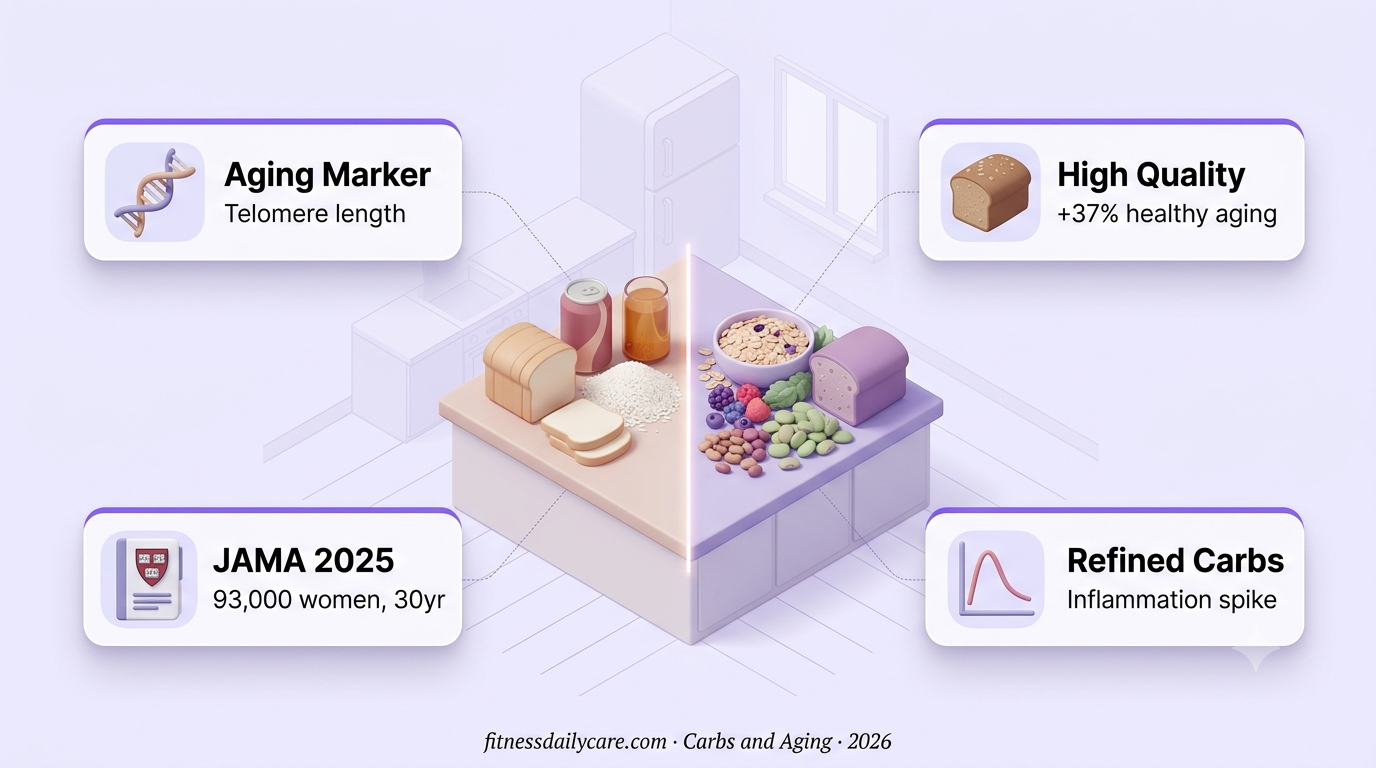
A 30-year study of 47,513 women in JAMA Network Open shows carbohydrate quality — not quantity — raises healthy aging odds by up to 37%. What you eat in your 40s determines how you age in your 70s.
The decade-long war on carbohydrates has produced a generation of adults who fear the wrong thing. Cutting carbs became a diet identity, a personality trait, a moral position. Meanwhile the actual science on carbohydrate quality and aging was pointing at something completely different: not how many carbohydrates you eat, but which kind. A landmark study published in JAMA Network Open in May 2025 — led by researchers at Tufts University and Harvard T.H. Chan School of Public Health — followed 47,513 women for more than 30 years, tracking what they ate in their 40s and 50s and measuring how well they aged into their 70s, 80s, and early 90s. The results are difficult to ignore.
Women who ate more high-quality carbohydrates — defined as carbohydrates from whole grains, fruits, vegetables, and legumes — were 6 to 37% more likely to achieve healthy aging compared to those who ate less. Fiber intake in particular was one of the strongest individual predictors. In the other direction, women who ate more refined carbohydrates — from added sugars, refined grains, and potatoes — had 13% lower odds of healthy aging. The researchers defined healthy aging as reaching age 70 without 11 major chronic diseases (including cancer, type 2 diabetes, and heart failure), without significant cognitive or physical function impairments, and with good mental health. That last criterion matters: this study was not just about living longer, it was about living well.
The study’s lead author, Andres Ardisson Korat of Tufts HNRCA, framed the takeaway clearly: “Rather than just looking at the immediate effects of these macronutrients, we wanted to understand what they might mean for good health 30 years later. Our findings suggest that carbohydrate quality may be an important factor in healthy aging.” This piece unpacks the mechanism behind that finding — what high-quality carbohydrates actually do to the biological processes that govern aging, what refined carbohydrates do in the other direction, and what a realistic translation looks like for everyday meals. All numbers come from peer-reviewed sources cited at the bottom.
Quality matters more than quantity
The JAMA study found total carbohydrate intake mattered less than type. Women eating the most high-quality carbs did best even when total carb intake was similar to those eating refined carbs.
AGEs are the mechanism behind refined carbs
Refined carbs spike blood glucose. Excess glucose binds to collagen and proteins, forming Advanced Glycation End-products (AGEs) — they cross-link collagen, stiffen tissue, and drive chronic inflammation.
Fiber is the most powerful individual predictor
Dietary fiber — not just carb quality in general — showed the strongest association with healthy aging in the JAMA data. Most US adults average 12 to 15g per day vs the 25 to 30g shown to matter.
The decision window is midlife
The study measured diet at average age 49 and tracked outcomes after 70. Midlife — not old age — is when dietary carb quality most clearly shapes long-term biological trajectories.
The question isn’t how many carbs.
It’s which carbs, eaten in your 40s,
for the person you’ll be at 75.
How Carbohydrate Quality Actually Shapes Aging Biology
High-Quality Carbs and the Fiber-Microbiome-Aging Axis
Pro-AgingThe reason fiber-rich, high-quality carbohydrates protect against aging is not a single mechanism — it is a cascade. Dietary fiber is what the gut microbiome’s beneficial bacteria eat. When fiber intake is sufficient, these bacteria ferment it into short-chain fatty acids (SCFAs) — particularly butyrate, propionate, and acetate. Butyrate has a specific and well-documented anti-inflammatory role: it inhibits NF-κB signaling (the master switch for inflammatory gene expression), reduces gut permeability, and appears to have protective effects on intestinal cells and brain cells alike. The gut-brain axis and the gut-immune axis are both downstream of this fiber-fermentation pathway.
The JAMA study authors noted that their findings “are consistent with other evidence linking consumption of fruits and vegetables, whole grains, and legumes with lower risks of chronic diseases.” The specific diseases on their healthy aging checklist — cancer, type 2 diabetes, heart failure, stroke — all have inflammation as a shared upstream driver. The fiber-SCFA-anti-inflammation pathway is not a soft association. It is a well-mapped causal pathway with peer-reviewed mechanistic backing, and it explains why fiber intake emerged as the strongest individual predictor in the 30-year data. The practical translation is that the carbohydrate sources with the highest fiber content — legumes, whole grains, berries, leafy greens, oats — are the ones that activate this pathway most consistently.
Refined Carbs, Blood Sugar Spikes, and AGEs
Pro-AgingAdvanced glycation end-products (AGEs) are the biochemical mechanism behind much of what refined carbohydrates do to aging biology. When you eat a refined carbohydrate — white bread, sweetened cereal, pastries, sugary drinks — blood glucose rises rapidly. Excess glucose molecules bind to nearby proteins and lipids through a non-enzymatic process called glycation, and over time these glycated molecules rearrange into stable, damaging structures called AGEs. Collagen is the primary target in the skin — AGEs cross-link collagen fibers, making them stiffer and reducing the skin’s ability to renew. The visible result is accelerated wrinkling and loss of elasticity. The internal result is similar stiffening in blood vessel walls, contributing to cardiovascular risk.
The connection between carbs and aging through this pathway is not speculative — it is mechanistically mapped at the molecular level. AGEs also activate cell surface receptors (RAGEs) that trigger NF-κB-mediated inflammatory signaling, perpetuating a cycle of chronic low-grade inflammation that researchers call “inflammaging” — the persistent background inflammation associated with accelerated aging. A 2024 review in Experimental Dermatology characterized AGEs as contributing to “skin dysfunction and ageing” through oxidative stress and inflammatory responses. A 2025 review on anti-glycation strategies confirmed that reducing dietary glycemic load — specifically refined and hidden added sugars — is one of the most practical interventions for reducing AGE accumulation. This is why the JAMA study’s finding of 13% lower healthy aging odds in high refined-carb eaters is mechanistically coherent, not just correlational.
Whole Grains and Chronic Disease Prevention
Pro-AgingThe specific chronic diseases on the JAMA healthy aging checklist — cancer, type 2 diabetes, heart failure, hypertension, stroke, Parkinson’s, multiple sclerosis, ALS, and others — are not random selections. They are the conditions with the strongest evidence of dietary influence, and whole grain intake has documented protective associations across several of them. Whole grains contain fiber, magnesium, B vitamins, vitamin E, and polyphenols — a nutrient matrix that refined grains lose in processing. Studies repeatedly link higher whole grain intake to lower risk of type 2 diabetes (22 to 34% risk reduction per major meta-analyses), cardiovascular disease, and all-cause mortality.
The anti-aging mechanism of whole grains is partly through the fiber-microbiome axis described above, and partly through direct nutrient effects. Magnesium, specifically, has an inverse relationship with systemic inflammation markers (CRP, IL-6) and is involved in over 300 enzymatic reactions, including DNA repair and mitochondrial function — both of which are central hallmarks of biological aging. Most American adults consume less than 60% of the recommended daily magnesium, and whole grains are one of the most practical food sources. The link between carbs and aging outcomes in the JAMA study is in large part a proxy for how much whole grain versus refined grain the participants were eating — and the direction of the association is consistent with 30 years of separate nutritional epidemiology across multiple independent cohorts.
The Midlife Window — Why Your 40s Are the Decision Point
TimingThe JAMA study design captures something important that short-term nutrition studies cannot: the lag between dietary exposure and biological outcome is measured in decades, not weeks. The study measured diet at average age 49 and tracked aging outcomes after age 70. That is a minimum 21-year lag. This is not because carbohydrate quality has no effect before your 40s — it is because the cumulative biological damage from chronic refined carb intake, or the cumulative protective effects of high fiber intake, takes decades to manifest as measurable differences in cognitive function, physical capacity, and disease-free survival.
The practical implication is that midlife — roughly age 40 to 60 — is the highest-leverage window for dietary change. Not because change before 40 doesn’t matter, but because the people most likely to be reading this in their 40s and 50s are in exactly the window where carb quality compounds into biological outcomes in their 70s. The study also found that only 7.8% of the 47,513 participants met the full healthy aging criteria — a striking baseline illustrating how rare the outcome is, and therefore how meaningful the 6 to 37% improvement from high-quality carbs actually is relative to background population rates.
⚠️ What the JAMA Study Cannot Tell You
1. It was observational, not a controlled trial. The study cannot prove causation — it shows that women who ate more high-quality carbs in midlife were more likely to age well, but other factors (total diet quality, exercise, income, healthcare access) may partially explain the association. The researchers controlled for multiple confounders but acknowledge residual limitations.
2. The sample was mostly white, educated health professionals. All participants were nurses in the Nurses’ Health Study. The results may not generalize equally across races, ethnicities, income levels, or countries. The authors explicitly flag this as a limitation and call for replication in more diverse populations.
3. Very low-carb diets are not endorsed by this study. The finding is about quality within a normal carbohydrate-containing diet, not an argument to maximize carbohydrate intake. The carb-phobia interpretation (“I knew carbs were bad”) and the carb-celebration interpretation (“eat as many carbs as you want”) both miss the point. The message is quality and fiber, not quantity.
4. Fiber supplements may not replicate food fiber effects. The study measured dietary fiber from whole food sources. The specific benefits likely depend on the complete nutrient matrix of fiber-rich foods, not just the fiber molecule in isolation. A fiber supplement does not carry the polyphenols, B vitamins, magnesium, and phytochemicals that make legumes and whole grains protective.
The Carb Quality Swap List for Everyday Meals
The following list is the practical translation of the JAMA study findings into real food decisions. Every swap below reduces glycemic load, increases fiber, and shifts the carbohydrate profile from refined to high-quality without eliminating carbohydrates from your diet. These are not dramatic interventions. They are category-level substitutions that compound over months and years into the kind of dietary pattern associated with 6 to 37% better healthy aging odds in a 30-year study. The goal is not perfection — it is consistent direction over time. Making 3 of these 7 swaps this week is more impactful than reading about all 7 and doing none of them. If you are actively trying to improve the carbs and aging equation in your own life, the most realistic entry point is picking the swap that matches your highest-frequency meal habit and starting there before adding others.
- White bread → whole grain or sourdough. Sourdough made from whole wheat has a lower glycemic index than regular whole wheat bread due to fermentation. Check that “whole grain” is the first ingredient — “wheat flour” means white flour with coloring.
- Sweetened breakfast cereal → steel-cut or rolled oats. A bowl of sweetened cereal can carry 20+ grams of added sugar. Oats plus berries delivers fiber, polyphenols, and a slow glucose curve. Add protein (nuts, seeds, Greek yogurt) to flatten it further.
- White rice → brown rice, farro, or quinoa. Brown rice has triple the fiber and more magnesium. Farro and quinoa add protein. These are not exotic foods — they’re at every mainstream grocery store and cost similarly.
- Fruit juice → whole fruit. Orange juice removes the fiber and delivers the full sugar load with a fast glucose spike. The whole orange comes with fiber that slows absorption and the full micronutrient matrix the juice lacks.
- Pasta as a carb base → legumes as a carb base. Half your plate of refined pasta once a week becomes lentils, chickpeas, or black beans. A cup of cooked lentils has 40g of carbohydrates and 16g of fiber — a carb-heavy food that behaves like a fiber bomb in your microbiome.
- Snack crackers and chips → nuts, seeds, or whole fruit. Most savory snacks are refined grain plus seed oil plus salt. Almonds, walnuts, pumpkin seeds, or apple with nut butter all deliver fiber and nutrients with a much lower glycemic impact.
- Added sugar audit once per week. Check three packaged foods you eat most frequently. Added sugar hides in granola bars, flavored yogurt, pasta sauces, salad dressings, protein bars, and plant milks. The JAMA study’s refined carb category includes added sugars — reading labels is part of carb quality management.
You don’t have to fear carbs.
You have to choose the right ones.
The 30-year data is clear on which.