
Sweating at Rest Isn’t a Sign You’re Fit,
Here’s What It Actually Means
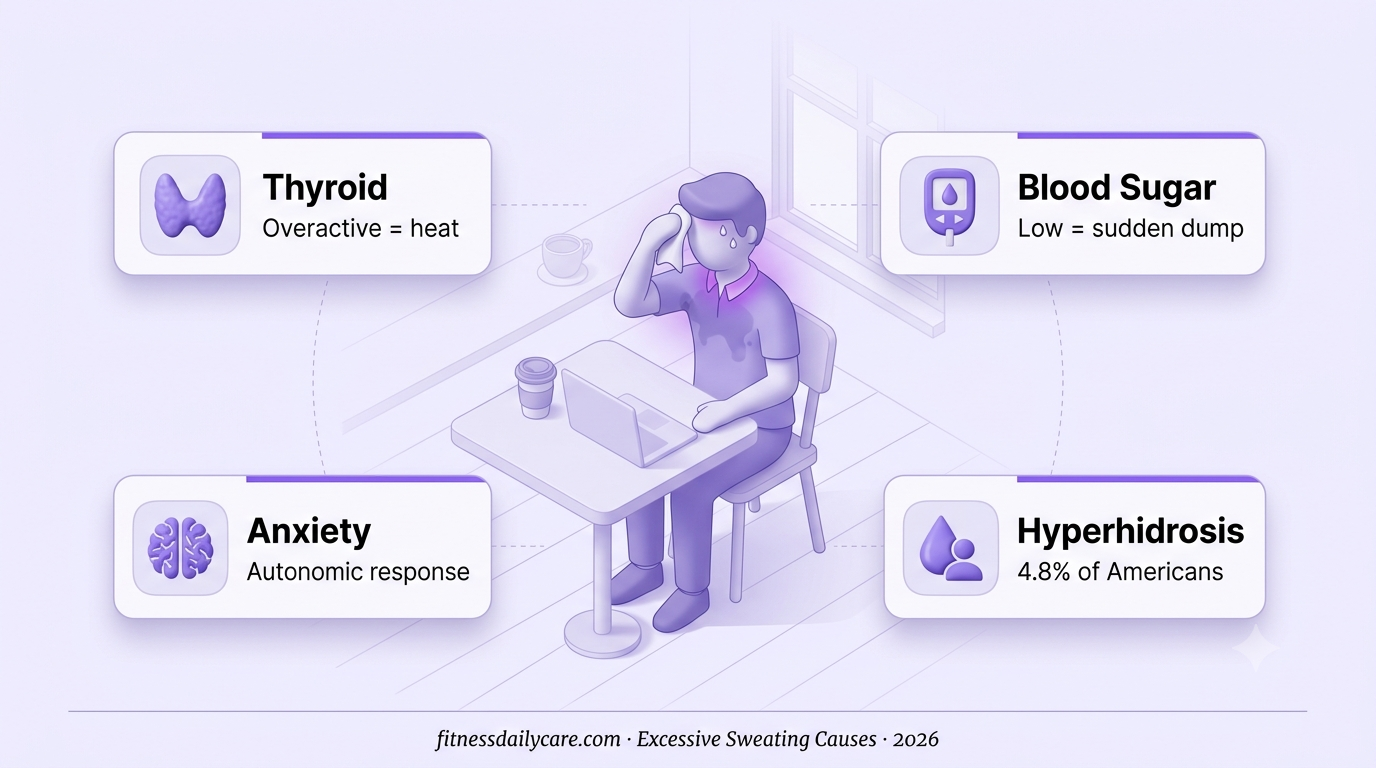
4.8% of Americans have hyperhidrosis. The old myth that “fit people sweat more” gets the physiology backwards. Three signals your body may actually be giving you.
The idea that heavy sweating at rest means you’re fit is one of the most stubbornly wrong fitness ideas in circulation. It sounds plausible — trained athletes do sweat sooner and more efficiently during exercise, so people extend that to resting sweat and assume the person soaking through a T-shirt at a cafe is somehow “detoxing” or “burning more calories.” Neither is true. Fit people are actually more thermally efficient at rest, not less. Their bodies release heat through conduction and radiation better, and they don’t need to activate the sweat response as often to stay in thermal balance. If you are sweating at rest more than the people around you, fitness is not the explanation. Something else is telling your sympathetic nervous system to fire.
The prevalence data makes this concrete. A 2016 Archives of Dermatological Research study estimated that 4.8% of the US population — approximately 15.3 million adults — meet clinical criteria for hyperhidrosis, excessive sweating beyond thermoregulatory need. Among 18 to 39 year olds, prevalence rises to 8.8%. Seventy percent of affected people report severe sweating in at least one body area, yet only 51% have ever discussed it with a healthcare professional, mostly because they assume it’s not a medical condition. That gap between prevalence and recognition is why “you’re just fit, it’s fine” often goes unchallenged for years. The underlying biology is not mysterious once you look at it — sweat glands are controlled by the autonomic nervous system, and anything that activates that system inappropriately produces excess sweat regardless of body temperature or fitness level.
This piece walks through the three most common lifestyle-driven signals behind resting sweating in otherwise healthy adults — autonomic nervous system overactivation, blood sugar dysregulation, and thyroid dysfunction — plus the red flag pattern that means a same-week doctor visit is warranted. Everything below draws from Cleveland Clinic, Mayo Clinic, peer-reviewed dermatology literature, and endocrinology guidance. This is not a substitute for medical evaluation but it should give you a much clearer sense of which lane to look in first.
Fit people sweat less at rest, not more
Trained bodies dissipate heat efficiently and stay in thermal balance longer. Resting sweat means the sympathetic system is firing for a non-thermal reason.
Anxiety and stress are the biggest driver
Chronic sympathetic activation from anxiety, caffeine, or work stress triggers cholinergic and adrenergic sweat responses even when the body isn’t hot.
Blood sugar drops trigger sweat directly
When glucose drops below 70 mg/dL, the sympathoadrenal system fires. Sweating, shakiness, hunger, palpitations arrive together. Very common after refined-carb meals.
Hyperthyroidism is under-recognized
1.3% of US adults have hyperthyroidism, 10x more in women. Excessive sweating plus rapid heart rate and heat intolerance is the classic triad. Blood test rules it in.
Fit bodies don’t sweat more at rest.
They sweat less.
The system is efficient, not overactive.
What Sweating at Rest Is Actually Telling You
Signal 1 — Autonomic Nervous System Overdrive
#1 SignalThe single most common driver of unexplained resting sweating in healthy US adults is a chronically activated sympathetic nervous system. When the “fight or flight” branch of your autonomic nervous system fires, it releases norepinephrine and epinephrine, which stimulate the eccrine sweat glands even when body temperature is normal. The sweat pattern is classically described as sudden, spread across palms, feet, forehead, and underarms, and appears in emotional or high-focus moments — right before a work presentation, during a difficult conversation, in traffic, after a caffeinated pre-workout. Cleveland Clinic and neurology reviews describe this as autonomic hyperactivity rather than as a disease of the sweat glands themselves.
The specific fitness-culture triggers here are worth naming. High-dose caffeine (300 mg+ pre-workouts, back-to-back cold brews, energy drinks) directly upregulates the sympathetic nervous system for 4 to 6 hours. Chronic sleep restriction leaves baseline sympathetic tone elevated. Anxiety and generalized stress produce a permanent low-grade activation that shows up on a normal Tuesday afternoon at the desk. Some people also have primary hyperhidrosis, a genetic condition where the sweat response is calibrated too aggressively — that is the 4.8% prevalence figure — but for most people the trigger is functional, not structural, and it responds to lifestyle changes.
The distinguishing pattern for autonomic-driven sweating is emotional and situational rather than temperature-driven. You are cool, the room is cool, nothing physically demanding is happening, and yet sweat appears — often on the palms, feet, forehead, and underarms simultaneously. This is because eccrine sweat glands in those specific areas are heavily innervated by sympathetic nerves and respond first when the fight-or-flight branch fires. If you observed yourself and noticed the sweating episodes cluster around presentations, difficult meetings, tight deadlines, or after your third coffee, that observation alone is diagnostic. The lifestyle response — lower caffeine, more sleep, address the anxiety source — will typically produce visible improvement within 10 to 14 days without any medication.
Signal 2 — Blood Sugar Dysregulation
#2 SignalWhen blood glucose falls below approximately 70 mg/dL, the sympathoadrenal system activates automatically. This is protective biology — your body is trying to raise glucose by triggering hepatic glucose release, and the sympathetic fire is what produces the classic hypoglycemia symptom cluster: sweating, shakiness, palpitations, hunger, anxiety, tingling. A 2022 review in the journal Autonomic Neuroscience characterized hypoglycemia as a paradigmatic physiological stress, precisely because it uses the same sympathetic nervous system pathway that anxiety does. From your body’s perspective, low blood sugar and a threat are indistinguishable signals.
Reactive hypoglycemia — a blood sugar drop that occurs 2 to 4 hours after a refined-carb meal — is common and under-diagnosed. The typical pattern: bagel and orange juice at 9 a.m., feeling shaky and sweating at 11:30 a.m. The insulin release from the fast carbs overshoots, glucose drops, sympathetic system fires. Fitness-culture patterns amplify this: intermittent fasting done too aggressively, low-carb dieting combined with high training loads, pre-workout with an empty stomach, or a late gym session followed by delayed food. If your sweating episodes cluster around 3 to 4 hours after eating or after long fasting windows, blood sugar is the lane to check.
The confusing thing about this signal is that it can appear even in people who do not have diabetes and who have technically normal fasting glucose readings. Reactive hypoglycemia is a functional dysregulation, not a chronic disease — it means your body’s insulin response is oversensitive to certain foods and drops glucose too far in response. Continuous glucose monitor data from healthy adults has shown that post-meal glucose swings of 40 to 60 mg/dL in either direction are surprisingly common in the general population, especially after high-glycemic meals. The physiology is intact but the calibration is off. Meal composition (adding protein and fiber, reducing refined carbs) usually normalizes it within 2 to 3 weeks.
Signal 3 — Hyperthyroidism (Endocrine)
#3 SignalHyperthyroidism affects approximately 1.3% of US adults, and Graves’ disease is the most common cause. Women are roughly 10 times more likely to develop it than men. The Cleveland Clinic lists excessive sweating and heat intolerance as core symptoms, alongside unintentional weight loss, rapid or irregular heartbeat, tremor, anxiety, and difficulty sleeping. Mayo Clinic clinical descriptions emphasize that resting sweating combined with heat intolerance is the pattern most likely to signal thyroid rather than the other lanes. The mechanism is direct: excess thyroid hormone accelerates baseline metabolic rate, which produces more internal heat, which the sweat glands work harder to dissipate.
The fitness-culture cross-over here is often overlooked. Hyperthyroidism can mimic “being in great shape” for a while — unexplained weight loss, high energy, elevated heart rate that reads like good cardio fitness on a wearable. People sometimes lose 15 to 20 pounds in three months, attribute it to their new routine, and only realize something is wrong when the sweating, hand tremor, and heart palpitations start interfering with normal life. A simple thyroid panel (TSH, free T4, free T3) rules it in or out. This is the specific lane to check if the sweating is accompanied by feeling hot when others feel cool, resting heart rate above 90, or unintentional weight loss.
One clinical detail worth flagging: TSH alone is not always sufficient in early-stage hyperthyroidism. Some cases show suppressed TSH but still-normal T4 and T3 (called subclinical hyperthyroidism), which the endocrinology literature increasingly recognizes as clinically meaningful — cardiovascular and bone-density outcomes are worse than baseline even without frank hyperthyroidism. So if TSH is low and symptoms are present, a full panel including free T3 is worth requesting rather than accepting a “your T4 is normal, you’re fine” reassurance. This matters because women in their 20s and 30s with early Graves’ disease are exactly the demographic most likely to have their symptoms initially attributed to stress or lifestyle before the endocrine cause is identified.
The “Fit People Sweat More” Myth, Corrected
Reality CheckThe myth has a small kernel of truth that gets stretched too far. Trained endurance athletes do sweat sooner and more efficiently when they exercise — their bodies anticipate heat loads better and pre-emptively activate sweating to keep core temperature stable. That is a real adaptation, and it is limited to exercise. At rest, the picture reverses. Fit bodies have better cardiovascular efficiency, lower resting heart rate, better vagal tone, and more efficient conductive heat dissipation through skin blood flow. They do not need to activate sweating at rest as often. Population data on athletes actually shows lower baseline hyperhidrosis rates than the general adult population.
So if you find yourself sweating through your shirt at a coffee shop while everyone else looks fine, the answer is not “I’m just fit.” The answer is one of the three signals above. This is not a bad thing to know — the three signals are almost entirely lifestyle-responsive or medically treatable. Autonomic overdrive responds to caffeine reduction, sleep, and stress management. Blood sugar dysregulation responds to meal composition and timing. Thyroid dysfunction responds to endocrinology treatment. The myth is the problem because it prevents people from investigating the actual cause.
⚠️ When Sweating at Rest Needs a Same-Week Doctor Visit
1. Sweating plus unexplained weight loss. If you have lost 10+ pounds in the past few months without trying, and sweating is one of the accompanying symptoms, request a thyroid panel and general workup. Hyperthyroidism, certain infections, and (rarely) lymphoma can present this way.
2. Drenching night sweats. Waking up with sheets and pajamas soaked through, multiple times per week, without an obvious heat cause. This is a specific medical red flag — infection, lymphoma, or endocrine causes all deserve evaluation. Occasional mild night sweating is not the same thing.
3. Sweating with fever, rapid heartbeat, and confusion. This can indicate thyroid storm (rare but life-threatening hyperthyroidism), severe infection, or serotonin syndrome if you are on certain medications. This is an emergency room presentation, not a scheduled appointment.
4. Sudden onset in one specific body area. New unilateral sweating (one side of face, one hand, one leg) can indicate a neurological problem such as a nerve injury or, rarely, a spinal cord issue. Generalized sweating patterns are more often lifestyle-driven; unilateral patterns should be evaluated promptly.
How to Investigate Your Own Sweating Pattern
The framework below is what most primary care physicians would ask you to do if you walked into a clinic complaining of unexplained sweating at rest. It is a 7-day self-tracking protocol that pattern-matches your episodes against the three signals. The specific advantage of doing this for a week before a doctor visit is that it lets you and the physician skip generic questions and go directly to the right blood panel. If your pattern points at Signal 1 (autonomic), the doctor knows to focus on caffeine, sleep, and anxiety before ordering expensive tests. If it points at Signal 2 or 3, the panel is targeted. Either way, this saves time and appointments, and often produces a clear answer within a single visit rather than a months-long back-and-forth.
- Log every episode. Time of day, what you were doing, what you ate 2 to 4 hours before, caffeine intake since waking, sleep hours the previous night, subjective stress level (1-10).
- Note accompanying symptoms. Was your heart racing? Were you shaky or hungry? Did you feel hot when others didn’t? Was there anxiety or emotional trigger?
- Cut caffeine to under 200 mg/day for 3 days. If sweating episodes drop noticeably, Signal 1 (autonomic) is likely the primary driver. Reintroduce slowly, watch the pattern.
- Eat a balanced meal every 4 hours for a week. Protein plus complex carbs plus a small amount of fat, no refined sugar or high-glycemic snacks. If sweating episodes drop or become less predictable, Signal 2 (blood sugar) is likely involved.
- Take resting heart rate each morning. Use a phone or wearable. A persistently elevated resting heart rate (over 90 for a normally trained adult) plus sweating plus heat intolerance is a Signal 3 (thyroid) pattern.
- Bring the log to a doctor visit. One page. Time, trigger context, and accompanying symptoms. This lets the physician pick the right blood panel in one appointment instead of iterating over three.
- Do not diagnose yourself from an internet search. These signals overlap and blur, and the tests to distinguish them are quick and inexpensive. The purpose of the log is to route you to the right professional evaluation, not to replace it.
Your body doesn’t sweat at rest for no reason.
It is signaling something.
The question is which of three signals.