
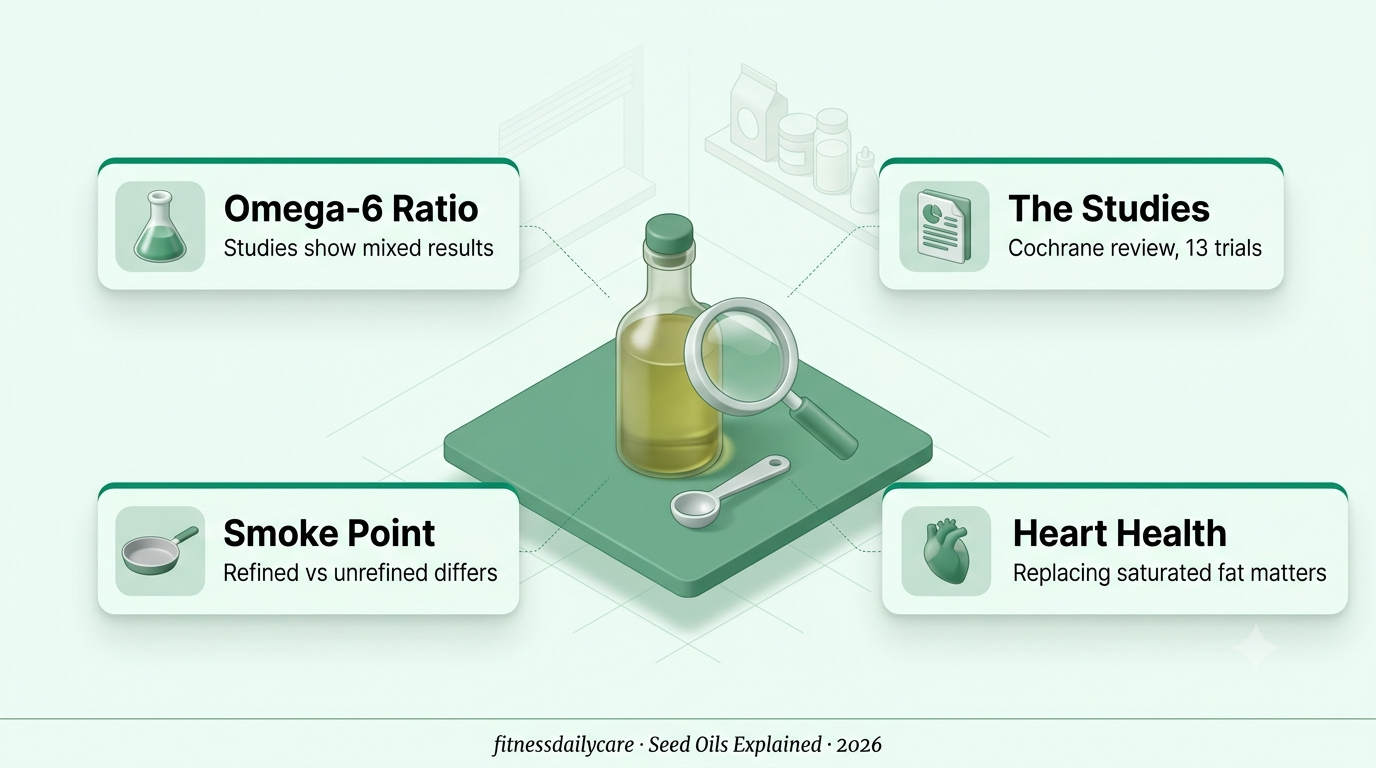
Seed Oils, I Checked What the Research Actually Shows
Johns Hopkins data links high linoleic acid intake to a 35% lower type 2 diabetes risk. Here’s what the actual peer-reviewed studies say, not the internet panic that’s been circulating on social media.
I kept seeing the same claim everywhere online: seed oils are “toxic” and quietly wrecking everyone’s health. It showed up in podcast clips, comment sections, group chats, and even from a few nutrition accounts I generally trust and follow closely on a regular basis. So instead of taking a wellness influencer’s word for it, I went and pulled the actual clinical research behind the claim myself, and what I found didn’t match the panic at all.
The scientific literature on seed oils tells a much less dramatic story than the internet does. A 2026 review published in Critical Reviews in Food Science and Nutrition examined the totality of clinical and observational evidence and concluded that claims linking seed oils to inflammation, oxidative stress, or cardiovascular disease risk simply aren’t supported by the data. Researchers at Johns Hopkins Bloomberg School of Public Health found something closer to the opposite: people with the highest linoleic acid levels, the main fatty acid in most seed oils, had a meaningfully lower rate of type 2 diabetes than people with the lowest levels, not a higher one.
That doesn’t mean every oil on a supermarket shelf is created equal, or that how you cook with an oil stops mattering the moment it’s in the pan. Processing method, smoke point, and how many times you reuse a bottle of frying oil all genuinely matter. It just means the “seed oils are poison” narrative and the actual peer-reviewed research are pointing in very different directions, and it’s worth knowing which one your grocery habits are actually built on.
Here’s what I found once I went through the studies one by one, carefully, in detail: what the research on seed oils actually says, where the legitimate caution genuinely belongs, and what I’d realistically change about how I cook based on all of it.
Why the fear took off
Wellness influencers built an entire narrative around seed oils over the past few years, but Johns Hopkins researchers say the panic is rooted in a misunderstanding of how omega-6 fats actually function in the body, not new contrary evidence.
What the large studies show
Observational and clinical research, including a systematic review of 11 randomized trials, consistently links linoleic acid intake to lower, not higher, cardiovascular and metabolic disease risk across different patient populations.
Refined vs. cold-pressed matters more
How an oil is processed, refined versus cold-pressed, changes its smoke point, shelf life, and nutrient content far more meaningfully than whether the oil originally came from a seed, a fruit, or a nut.
The real problem is context
Seed oils show up constantly in fried and ultra-processed food. The overall food it’s cooked into, not the oil itself, is far more likely driving the health outcomes that people end up blaming on the oil.
What The Seed Oils Research Actually Shows
Before getting into specific studies, it helps to separate two different questions that often get blended together online: is linoleic acid, the main fatty acid in most seed oils, harmful in the amounts people actually eat it, and is the way seed oils get processed or reused in cooking a separate concern worth paying attention to. The research below answers the first question fairly clearly. The second question is really about kitchen habits, not the oil category itself, and it gets its own section further down.
Seed oils and the omega-6 inflammation fear, debunked
Key evidenceThe core argument against seed oils is that their omega-6 content drives chronic inflammation throughout the body. Johns Hopkins nutrition scientist Matti Marklund directly addressed this claim, explaining that seed oils do not cause inflammation the way online critics suggest. His research group found that fatty acids typical of seed oils, particularly linoleic acid, are associated with lower risk of chronic diseases like cardiovascular disease, heart attack, stroke, and diabetes, not higher risk.
A separate review in the Journal of the American College of Nutrition looked specifically at whether omega-6 fatty acids independently raise inflammatory markers in healthy adults, and found only limited evidence that they do. Some laboratory and animal studies have suggested that excessive omega-6 intake could theoretically promote inflammatory pathways, but human trials have produced far more mixed, and generally reassuring, results.
Where the concern has real footing is in the modern omega-6 to omega-3 ratio. Western diets today run somewhere between 15:1 and 20:1, far higher than the roughly 1:1 ratio ancestral diets are estimated to have had. Researchers still debate exactly how much that shift matters on its own, but the fix isn’t cutting omega-6 to zero, since it’s an essential nutrient. It’s adding more omega-3 sources back in, things like fatty fish, walnuts, and flaxseed, rather than eliminating an entire category of fat.
The 11-study review on seed oils and metabolic markers
Key evidenceA 2025 systematic review published in Frontiers in Nutrition pulled data from PubMed, Scopus, Web of Science, and the Cochrane Library, screening specifically for randomized, placebo-controlled, and double-blind clinical trials rather than weaker observational studies. Across 11 qualifying clinical studies, oils derived from canola, flaxseed, and sesame seeds were found to positively influence lipid profiles and glycemic control in patients who already had diabetes or dyslipidemia, two of the exact conditions critics claim seed oils make worse.
Separately, a widely cited 2020 meta-analysis published in Circulation found that replacing saturated fat with polyunsaturated fat, the dominant fat category in most seed oils, was associated with a 17% reduction in cardiovascular events. That’s one of the more consistent findings in nutrition science over the past decade, and it lines up with decades of dietary guidance from major health organizations.
What makes the 2026 Critical Reviews in Food Science and Nutrition paper notable is that it wasn’t a single new study, it was a synthesis of the entire body of existing clinical and observational research on linoleic acid and seed oils. When researchers pool decades of trial data like that and still land on “the totality of evidence supports safety and benefits,” that carries more weight than any single headline-grabbing study in either direction, including the ones that originally fueled the online panic.
Refined vs. cold-pressed seed oils, what actually changes
PracticalRefined oils go through heat extraction, chemical treatment, and a deodorizing and bleaching process that uses activated carbon or Fuller’s earth rather than actual bleach. That processing raises the smoke point and extends shelf life considerably, but it also strips out some natural nutrients, aroma, and flavor compounds along the way. Unrefined, cold-pressed oils keep more of those nutrients and flavor since they’re extracted through pressure rather than heat, but they oxidize faster and can’t handle high heat without breaking down into less stable compounds.
Oxidative stability is where legitimate kitchen caution actually belongs, more so than the seed-versus-fruit origin of the oil itself. Reused frying oil accumulates polar compounds with each heating cycle, and industry testing has found that a soybean oil’s smoke point can drop by 20 to 30 degrees Fahrenheit after just four frying cycles. Oils also degrade faster when stored near heat, light, or left uncapped between uses.
In practice, this plays out differently across specific oils. Refined canola and refined vegetable oil sit in the roughly 400 to 450°F range and work well for weeknight sautéing. Light refined olive oil, despite still technically being an olive product rather than a seed oil, follows the same refined-oil pattern at around 465°F. Extra virgin olive oil, unrefined and full of flavor, sits much lower around 350°F, which is exactly why it belongs on a salad or drizzled over finished vegetables rather than in a screaming-hot pan.
How to actually choose a cooking oil
PracticalInstead of avoiding an entire category of oils based on internet fear, the more evidence-based approach is choosing oils based on what you’re actually cooking that day. For high-heat searing, roasting, or deep frying, refined oils with higher smoke points, like refined canola, avocado, or light olive oil, hold up better without breaking down into potentially harmful compounds. For dressings, dips, or finishing drizzles, unrefined extra virgin olive oil or a cold-pressed oil brings more flavor and retains more of its natural micronutrients, since it never sees high heat in the first place.
A practical two-oil system covers almost every home cooking situation: one refined, high-smoke-point oil for the stovetop and oven, and one high-quality unrefined oil kept specifically for finishing and salads. From there, specialty oils like toasted sesame or walnut oil can be added for flavor rather than as a daily cooking staple.
What this looks like on an actual weeknight: searing chicken thighs or roasting a tray of vegetables calls for the refined bottle, since it can handle 400°F-plus oven and stovetop temperatures without smoking or breaking down. Tossing a quick salad or finishing a bowl of soup calls for the unrefined bottle, where the flavor actually gets to shine instead of burning off. Neither choice requires avoiding an entire aisle of the grocery store.
Why the seed oils panic outran the science
ContextAccording to Marklund and other nutrition researchers, this category of oils has largely been demonized based on a misunderstanding of how they’re made and how the human body actually uses the fats inside them, combined with the fact that they show up constantly in ultra-processed foods. That correlation, showing up in the same foods linked to poor health outcomes, gets mistaken for causation. It’s the ultra-processed food itself, loaded with refined starch and added sugar, that’s more plausibly driving the outcomes people end up blaming on the cooking oil.
There’s also a social media dynamic at play. Claims that a common, cheap pantry staple is secretly dangerous spread faster than claims that reinforce the boring, decades-old consensus. That doesn’t make the fear-based content malicious, but it does mean the loudest voices on a topic aren’t necessarily the most accurate ones, and it’s worth checking what actual researchers publishing in peer-reviewed journals are finding before changing a habit based on a video clip.
The fear got ahead of the science.
The data never actually caught up to the panic.
- Match oil to heat — use refined oils for high-heat searing, roasting, or frying, and save unrefined, cold-pressed oils for dressings and low-heat finishing where their flavor and nutrients actually survive
- Don’t reuse fry oil more than two to three times; quality and smoke point both drop noticeably with each additional heating cycle
- Store in dark bottles, away from the stove and out of direct light, to slow down oxidation and keep oil from turning rancid early
- Watch the food, not just the oil — ultra-processed snacks and fried fast food are the bigger nutritional issue, not necessarily the specific oil used inside them
- Keep some variety on hand — one high-smoke-point refined oil for the stovetop plus one high-quality unrefined oil for finishing covers almost every home cooking situation
- Add omega-3 sources too — fatty fish, walnuts, and ground flaxseed help balance out a diet that leans heavily on omega-6-rich seed oils over time
None of that requires buying anything expensive or specialty-labeled. A basic bottle of refined canola oil and a basic bottle of extra virgin olive oil, both available at any grocery store for just a few dollars, cover the two use cases that matter most: high-heat cooking and low-heat finishing. The research doesn’t support paying a premium for oils marketed specifically as “seed oil alternatives” unless you simply prefer the taste, texture, or price point of a different option for reasons that have nothing to do with health outcomes.
⚠️ Where Caution Still Makes Sense
1. Rancid oil is a real problem. Any oil, seed-derived or not, that smells “off,” tastes bitter, or has visibly darkened should be tossed regardless of what the general research on fresh oil says. Oxidized oil is a separate issue from the underlying fat type.
2. Deep-fried, ultra-processed foods aren’t health foods. The oil isn’t the main nutritional issue in most fast food, but the overall calorie density, sodium, and refined carbohydrate content of what it’s cooking still matters a great deal for long-term health.
3. Individual fat sensitivity varies. If you have a diagnosed lipid disorder, a specific allergy, or another condition affecting fat metabolism, talk to your doctor or a registered dietitian about your specific intake rather than applying general population research directly to your own case.
4. Total fat intake still counts. None of this research is a green light to pour oil liberally on everything. Fat is calorie-dense regardless of source, so portion awareness still matters even when the type of fat is well supported by the evidence.
It’s not the seed in the oil.
It’s the plate the oil showed up on.
Seed Oils, What The Research Says
None of this means blindly trusting every bottle labeled “vegetable oil” without thinking about how you’re using it. It means the specific claim that seed oils are secretly toxic doesn’t hold up against the actual clinical literature, while the more boring, practical advice, watch your smoke point, don’t reuse frying oil too many times, and focus more on cutting back ultra-processed food than on any single ingredient, turns out to be the part backed by the strongest evidence.
💬 Seed Oils, Frequently Asked Questions
Nutrition science rarely settles debates with a single dramatic study, and this topic is no exception. What changed here isn’t one new headline finding, it’s that pulling together over a decade of trials, cohort data, and systematic reviews points in a direction that’s quieter and less alarming than what circulates in short-form video clips. That’s a less exciting story to tell, but it’s the one the evidence actually supports, and it’s worth knowing before deciding to overhaul your kitchen based on a single claim you saw scrolling.