
Bad Digestion Isn’t Random,
5 Habits That Wreck Your Gut Daily
GERD affects 20% of US adults. Fast eating raises gastritis risk 1.7x. The five habits driving most everyday indigestion — and how to fix them this week.
Most people treat bad digestion as random. Bloating shows up after some meals and not others, heartburn comes and goes, gas is worse on some days for no obvious reason. So people cycle through probiotics, elimination diets, TikTok gut tonics, and the occasional antacid, and mostly feel like their gut is a black box. It’s not a black box. It’s a system that responds fairly predictably to five specific habits — habits that most US adults have layered into their normal day without noticing.
The prevalence data is straightforward. Gastroesophageal reflux disease (GERD) affects approximately 20% of US adults, making it the most common upper gastrointestinal condition in the country. Functional dyspepsia — persistent indigestion without an identifiable organic cause — affects another 8.4% globally. A three-year Korean study of 10,893 adults found that the fastest eaters had a 1.7-fold higher risk of gastritis compared to the slowest, and separate five-year data linked fast eating to an 11.6% higher risk of developing metabolic syndrome. When you back into the mechanism, none of this is mysterious. Fast eating swallows air, skips saliva-based digestion, and overloads the stomach. Chronic stress shuts down parasympathetic control of digestion. Screens at the table override fullness signals. Late-night lying down after meals pushes acid up. Ultra-processed food starves the microbiome. Each habit hits a different part of the same system.
This piece walks through the five specific habits behind most bad digestion in otherwise healthy adults, with the actual mechanism for each, the fix that has evidence behind it, and the red-flag pattern that means an actual physician visit is needed. Sources include Cleveland Clinic and Mayo Clinic clinical guidance, a 2023 Journal of Physiology review on stress and gut motility, Northwestern Medicine gastroenterology, and the 2024 global meta-analysis on functional dyspepsia. This is not another gut health supplement pitch. Nothing on this page requires a purchase.
Digestion starts before food hits your stomach
Saliva contains amylase that begins breaking down starches. Skip chewing, skip half the first digestive step. Larger particles reach the stomach and everything downstream works harder.
Stress and digestion cannot coexist
Your parasympathetic system runs digestion. Sympathetic activation (stress, phone stress, anxiety) shuts it down — reduced gastric emptying, less enzyme secretion, altered motility. This is not opinion, it is well-mapped physiology.
Gravity is part of your GERD prevention
Lying down within 2 hours of a meal removes gravity’s help keeping stomach contents down. About 20% of US adults already have some GERD; late-night meals push borderline cases into clinical territory.
The microbiome eats what you eat
Fiber-poor, ultra-processed diets starve the beneficial gut bacteria and let opportunistic species dominate. This shows up as bloating, gas, irregular bowels — long before it shows up as a diagnosis.
Your gut isn’t a mystery.
It responds to five specific habits.
You’re probably running four of them today.
The 5 Daily Habits Behind Most Bad Digestion
Finishing Meals in Under 15 Minutes
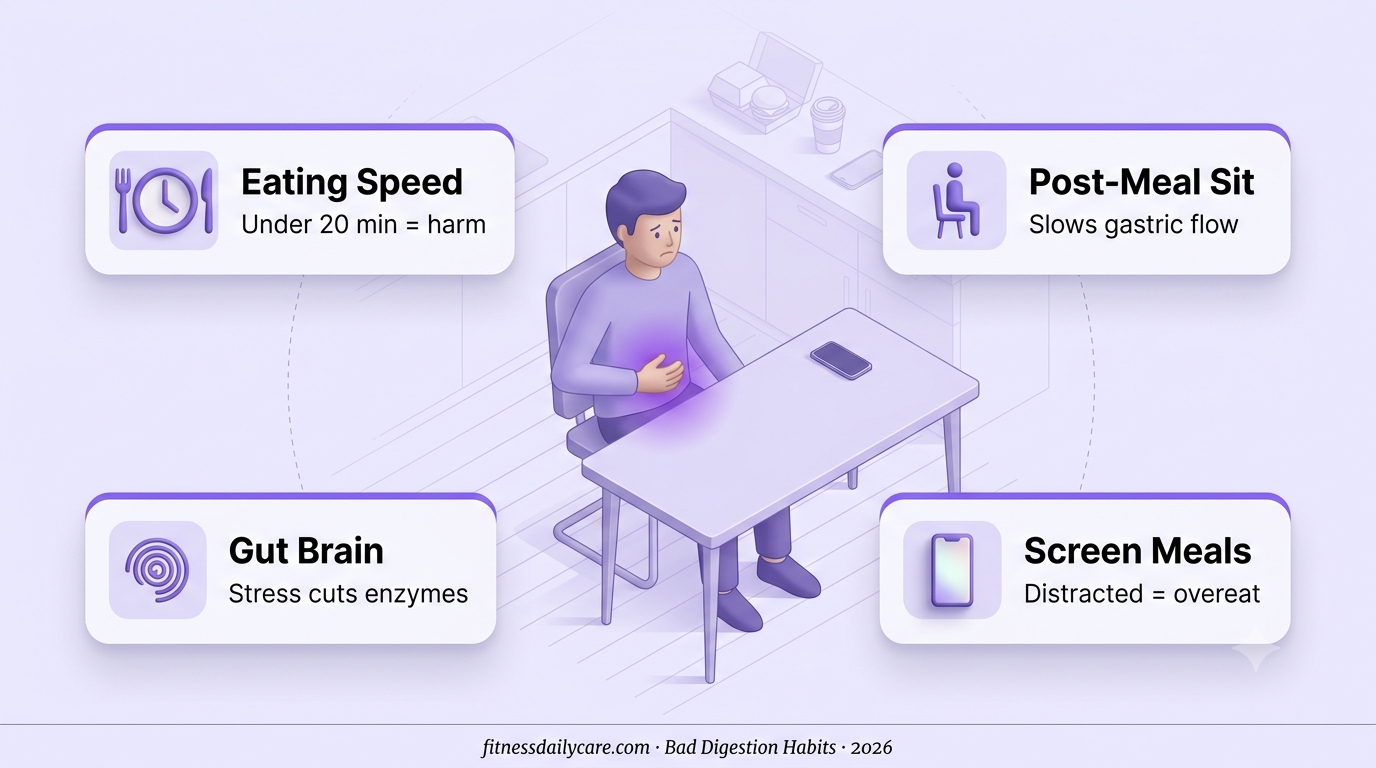
#1 HabitThe single most common driver of bad digestion in US adults is eating too fast. Northwestern Medicine gastroenterology explains the biology cleanly: it takes roughly 20 minutes for leptin and peptide YY to signal fullness to the brain. Anyone finishing a meal in under 15 minutes is systematically eating past the satiety point every time. That is the calorie problem, but the digestion problem is separate and simultaneous. Fast eating means less chewing, which means less saliva-based amylase breakdown of starches, which means the stomach receives larger particles and has to compensate with more acid and more mechanical churn.
The data on this is not soft. A three-year study of 10,893 South Korean adults found that people who ate a full meal in under 5 minutes had a 1.7-fold higher risk of gastritis compared to those who took 15 minutes or more. A five-year cohort linked fast eating to an 11.6% higher risk of developing metabolic syndrome. Fast eating also causes aerophagia — swallowing air — which is the direct mechanical cause of most post-meal bloating and belching. If you routinely feel uncomfortably full and gassy 20 minutes after eating and the meal itself only took 8 minutes, this is your primary variable.
The fitness-culture angle here is significant. Meal-prep culture, protein-forward eating, and desk lunches have all quietly optimized for speed rather than digestion. A 400-calorie chicken-rice-broccoli meal-prep bowl eaten in 6 minutes at a desk hits the same digestion problem as a fast-food meal eaten at the same speed. The macros don’t matter here — the eating pace does. This is a genuine blind spot for a lot of otherwise health-conscious adults who track every gram of protein but never notice that they’re bypassing the 20-minute satiety window every meal.
Eating While Stressed or Anxious
#2 HabitYour digestive system runs on the parasympathetic branch of the autonomic nervous system — the “rest and digest” mode. When you’re stressed, anxious, in a rushed work state, or scrolling through bad news at the table, your sympathetic (“fight or flight”) branch is activated instead. A 2023 Journal of Physiology review documented that sympathetic activation directly inhibits intestinal motility through reduced acetylcholine release, decreases digestive enzyme secretion, and slows gastric emptying. Your body cannot digest properly and prepare for a threat simultaneously — the two systems are designed to be mutually exclusive.
This is why the same meal produces very different digestive results depending on your state. A relaxed lunch on a Saturday causes no bloating; the identical sandwich at your desk on Tuesday during a deadline produces reflux and gas. It’s not the food that changed. It’s the autonomic state you ate it in. Chronic stress compounds the effect over time — it disrupts the gut microbiome, increases intestinal permeability, and produces baseline visceral hypersensitivity that makes normal digestive sensations (gas passing through, food moving) feel painful.
Lying Down Within 2 Hours of Eating
#3 HabitApproximately 20% of US adults have some degree of GERD, and this specific habit is what pushes borderline cases into clinical territory. The mechanism is gravity. When you’re upright, gravity helps keep stomach contents below the lower esophageal sphincter. When you lie down within 2 hours of eating — dinner at 9 p.m., bed at 10 p.m. — that gravitational help disappears. Stomach acid, along with partially digested food, can travel back into the esophagus. Cleveland Clinic gastroenterology guidance is direct on this: the 3-hour buffer between last meal and lying down is the single highest-return GERD prevention behavior.
The overnight version compounds the damage. Because you’re not swallowing while asleep, saliva doesn’t neutralize any refluxed acid, and it sits on the esophagus for hours. This is why people who eat late feel fine going to sleep but wake up with a sore throat, chronic cough, or the sensation of a lump in their throat — all classic silent GERD symptoms. The habit also often stacks with alcohol, which relaxes the lower esophageal sphincter and makes reflux more likely regardless of timing.
Eating in Front of Screens
#4 HabitScreen-based distraction during meals is deceptively harmful because it feels innocuous. You’re eating and you’re doing something else — what’s the problem? The problem is that distracted eating overrides the interoceptive signals — the internal body signals — that tell you when you’re full, when the food tastes different than expected, when your stomach is complaining. Studies of distracted eating consistently show that people consume 10 to 25% more food when eating in front of a phone, TV, or laptop, and they underestimate how much they ate when asked afterward. That extra volume becomes overeating, and overeating is a primary bloating driver.
Beyond volume, screen distraction also delays chewing awareness. People chew less thoroughly when they’re mentally engaged elsewhere. So the fast-eating problem from Habit 1 and the distraction problem here compound each other — the same person often runs both simultaneously. Then add stress from the content on the screen (work Slack, news, social media), and Habit 2 kicks in as well. A single “quick lunch at the desk while catching up” often stacks three of the five habits into one meal.
Ultra-Processed Food Dominance
#5 HabitUltra-processed foods make up roughly 57% of daily calories for the average US adult, per NHANES data. These foods are engineered for shelf life and palatability, not for microbiome health. They tend to be low in fiber, high in emulsifiers and additives, and low in the diverse plant matter that the beneficial gut bacteria feed on. Over time, this shifts the composition of the gut microbiome — beneficial fiber-fermenting species decline, opportunistic species take over. The clinical picture is chronic bloating, gas, irregular bowel movements, and increased visceral sensitivity that gets misdiagnosed as IBS more often than it should be.
The specific missing input is fiber. Most US adults consume 12 to 15 grams of fiber per day, well below the 25 to 38 grams recommended by the Academy of Nutrition and Dietetics. Fiber is what the gut microbiome eats. No fiber means the microbiome shrinks and shifts. This is not a supplement problem — probiotic capsules do very little without the fiber to feed the bacteria. It’s a food composition problem, and the fix is boring: more plants, more variety, more fiber, less packaged.
The compounding factor most people miss: emulsifiers and preservatives in ultra-processed foods appear to directly disrupt the mucus layer that lines the gut and protects the epithelial cells underneath. Animal studies with common food emulsifiers (polysorbate 80, carboxymethylcellulose) show reduced mucus thickness, increased inflammation, and altered microbiome composition. So the ultra-processed problem is not just what’s missing (fiber) but also what’s present (additives designed for shelf life). This is why the same person can eat 30 grams of fiber a day and still bloat if half of that fiber comes from ultra-processed “fiber-enriched” products with a long ingredient list.
⚠️ When Bad Digestion Is a Medical Red Flag
1. Unintentional weight loss with digestive symptoms. If your indigestion is accompanied by 10+ pounds of unexplained weight loss, that combination is a red flag that warrants prompt evaluation. Malabsorption, celiac disease, inflammatory bowel disease, and (rarely) malignancy can all present this way.
2. Blood in stool or black tarry stool. Visible blood, dark tarry stool (melena), or vomiting anything that looks like coffee grounds are same-day medical calls. These indicate GI bleeding and need endoscopic evaluation, not more probiotics.
3. Persistent difficulty swallowing. If food feels like it’s getting stuck, or swallowing is painful, or you’re regurgitating food, these are alarm symptoms in GERD care. Rule out esophageal strictures or eosinophilic esophagitis with a gastroenterologist.
4. Symptoms lasting over 6 weeks despite habit changes. Give the 5-habit fix a solid 4 to 6 weeks. If bloating, indigestion, or reflux persists at the same intensity after that, see a physician. Chronic H. pylori infection, functional dyspepsia, or true IBS may need targeted treatment.
A Realistic 2-Week Digestion Reset
Below is the 2-week protocol most gastroenterologists would recommend as a first-line intervention for otherwise healthy adults with chronic bloating, occasional reflux, or unexplained indigestion. It works by systematically addressing all five habits at once rather than one at a time. Two weeks is the minimum window because the gut microbiome takes 10 to 14 days to noticeably shift in response to diet changes, and habit re-training around eating speed and stress takes about the same. Most people notice meaningful improvement in bloating and reflux frequency within the first week, and near-normalization by the end of week two if the habits stick. If you get to day 15 and nothing has changed, that’s the signal to see a physician — the 5-habit fix has worked for so many adults that its failure is itself diagnostic.
- Slow every meal to 20-30 minutes. Fork down between bites, chew 30 times per bite. Set a timer if needed. This alone often eliminates 40 to 60% of everyday bloating.
- Two-minute breathing reset before eating. Sit, put phone away, take 5 slow breaths. Shifts your autonomic state into digest mode before the first bite arrives.
- 3-hour buffer between dinner and bed. If dinner is 9 p.m., bed cannot be 10 p.m. Move dinner earlier or bed later. This single change resolves most nocturnal reflux.
- Screens off at the table. Not down, not muted — off. Applies to all three meals for 14 days. Track how full you feel afterward.
- Add fiber gradually. +5 grams per week to reach 25 to 35 grams daily. Berries, oats, legumes, leafy greens. Increase water intake with fiber to prevent constipation from the transition.
- 30 different plant foods per week. Any amount, any form — this is the informal microbiome-diversity target. Herbs and spices count. It’s easier than it sounds; a single stir-fry can hit 8 to 10.
- Track bloating on a 1-5 scale morning and evening. Simple daily note. The pattern usually clarifies within 5 days which habit was your biggest lever.
- Day 15: reassess. If bloating and reflux are significantly better, keep going. If not, see a physician for evaluation — mild indigestion should respond to this protocol.
Fix the five habits.
Give it 14 days.
Then decide whether you need a specialist.